
Unbiased headlines. Facts, not spin.
Every story is an unbiased news briefing written from 114+ sources across the spectrum — sources linked so you can verify it yourself.
 economy
Major Story (8/10)
August 19, 2026 at 10:18 AM
economy
Major Story (8/10)
August 19, 2026 at 10:18 AM
Global Food Prices Hit Three-Year High as War and Heatwaves Both Squeeze Wheat Supply
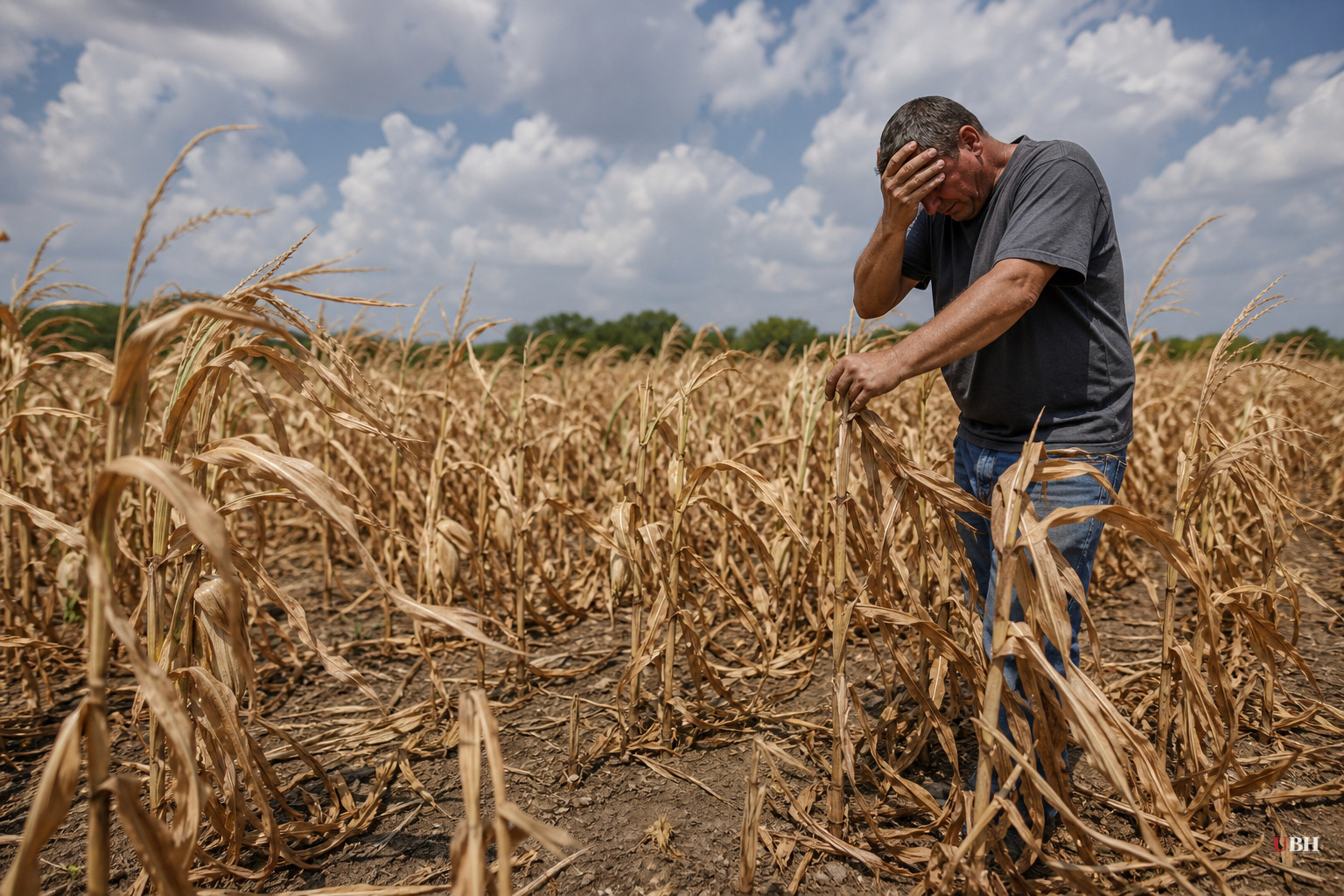
Wheat farmers, cereal shippers and central bankers are all staring at the same problem from different angles: global food prices just hit a three-and-a-half-year high, and two unrelated disasters are hitting at the same time.
The UN Food and Agriculture Organization's price index rose to 131.1 points in July, up from 130.3 in June, according to the Guardian. That's the highest reading since January 2023. Cereal prices rose 3.4% month-on-month, with wheat alone jumping 5.8%, the FAO reported. Sugar rose 5.6% and vegetable oil rose 2%.
Oxford Economics is now projecting global food prices will rise 11.8% in 2026 and another 4.8% in 2027, according to Euronews, with grains, fruit, vegetables and dairy taking the biggest hits.
Two Separate Shocks, Same Result
The first driver is war. Russia's escalating war in Ukraine has disrupted Black Sea and Sea of Azov grain exports, with attacks on ports, terminals and ships threatening roughly 86 million tonnes of annual export capacity, according to Oxford Economics data cited by Euronews. That's nearly 17% of global cereal exports. Russia and Ukraine together account for almost 30% of global wheat exports and more than 10% of corn, Oxford Economics Senior Economist Tomas Dvorak told Euronews.
The Iran war added a second layer. Disruption to the Strait of Hormuz, through which about a third of the world's fertilizer production travels according to the Guardian, sent diesel prices up 36% year-on-year in July and is expected to push fertilizer prices up 22% this year, Dvorak said.
The second driver is heat, and a growing body of analysis suggests it may end up mattering more than the wars. Forbes contributor Ingmar Rentzhog reported that June 2026 was the hottest June ever recorded in western Europe, according to the Copernicus Climate Change Service, with France logging its hottest nationally averaged day on record and Germany, Denmark and the Czech Republic setting all-time highs. The heat wiped out roughly 9 million tonnes of EU and UK grain forecasts, according to Oxford Economics data cited by Forbes.
One farmer's account illustrates the scale of the damage. Benoît Merlo, who farms in France's Auvergne-Rhône-Alpes region, spent a decade preparing for a hotter climate with cover crops, rotations and heat-resistant seed varieties. He still expects to lose half of some crops and up to 70% of his soya, he said in a statement released by the Energy and Climate Intelligence Unit. "With temperatures exceeding 38°C for weeks on end, everything is breaking down," Merlo said.
Coceral, the Brussels-based cereals trade group, cut its combined EU-UK grain harvest forecast from 295.5 million tonnes to 286.6 million tonnes in an extraordinary July update, Euronews reported. That's down from 310 million tonnes harvested in 2025. Germany's grain harvest specifically is expected to fall 7% this year to 41.9 million tonnes, the German Farmers' Association warned, according to AFP.
Why This Splits From Country to Country
The on-the-ground picture is not uniform. In the UK, food inflation actually eased in July, dropping from 1.7% to 1.3% as beef and breaded chicken prices fell, according to the Office for National Statistics data reported by The Grocer. Harvir Dhillon, lead economist at the British Retail Consortium, credited "strong competition among grocers" for keeping a lid on prices despite the supply shocks. Dr. Liliana Danila, chief economist at the Food & Drink Federation, said manufacturers have adapted supply contracts since the Ukraine war began, which is buying UK consumers time. She warned that "supply chain disruption isn't going away" and manufacturers will struggle to keep absorbing costs from the summer's heat.
Britain's overall inflation, meanwhile, rose to 2.9% in July from 2.6% the prior month, driven mainly by energy bills after the price cap lifted, not food.
In the U.S., the picture reported by Breitbart looks different: producer-level consumer food prices rose 2% in July and were up 15.8% year-over-year, the highest annual rate since 1974, according to Bureau of Labor Statistics data. The Consumer Price Index showed grocery prices up 13.1% year-over-year, the most since 1979. Notably, meat prices bucked the trend and fell in the U.S. data, mirroring the FAO's global finding that meat prices dropped 2.8% in July.
Iran's Domestic Squeeze
The war's toll is showing up hardest inside Iran itself. An investigation published by the Iranian newspaper Jahan-e Sanat described supermarket workers encountering customers concealing or eating food without paying, Fox News reported. Miad Maleki, an associate fellow at the Foundation for Defense of Democracies, told Fox News Digital the anecdotes align with hard data showing currency collapse and severe food inflation. These accounts are anecdotal and don't establish nationwide prevalence.
Iranian President Masoud Pezeshkian acknowledged "difficulties and problems" in an Aug. 5 televised address reported by Press TV, while insisting Iran remained strong and accusing outside pressure of trying to "provoke the people into protesting." Maleki pointed to Iran's November 2019 fuel-price protests as a precedent, but cautioned that economic desperation doesn't guarantee political change, given the willingness of Iran's Revolutionary Guard and Basij forces to suppress unrest.
The open question is which force wins out longer-term. Oxford Economics expects the war-driven shock to fade faster than the climate-driven one, projecting heat and drought will weigh more heavily on 2027 prices than the conflicts do, according to Forbes. If that forecast holds, next year's grocery bill fight won't be about a war ending. It'll be about whether farmers like Merlo can find crops that survive a summer that keeps getting hotter.
Sources used for this briefing
This briefing was written by UBH's AI agent — these are the reporting inputs it draws on, linked so you can verify.


