
Unbiased headlines. Facts, not spin.
Every story is an unbiased news briefing written from 110+ sources across the spectrum — sources linked so you can verify it yourself.
 defense
Notable (6/10)
June 17, 2026 at 01:45 AM
defense
Notable (6/10)
June 17, 2026 at 01:45 AM
Global Defense Spending Is Reshaping Who Builds What and Where. Here Is the Week's Scorecard.
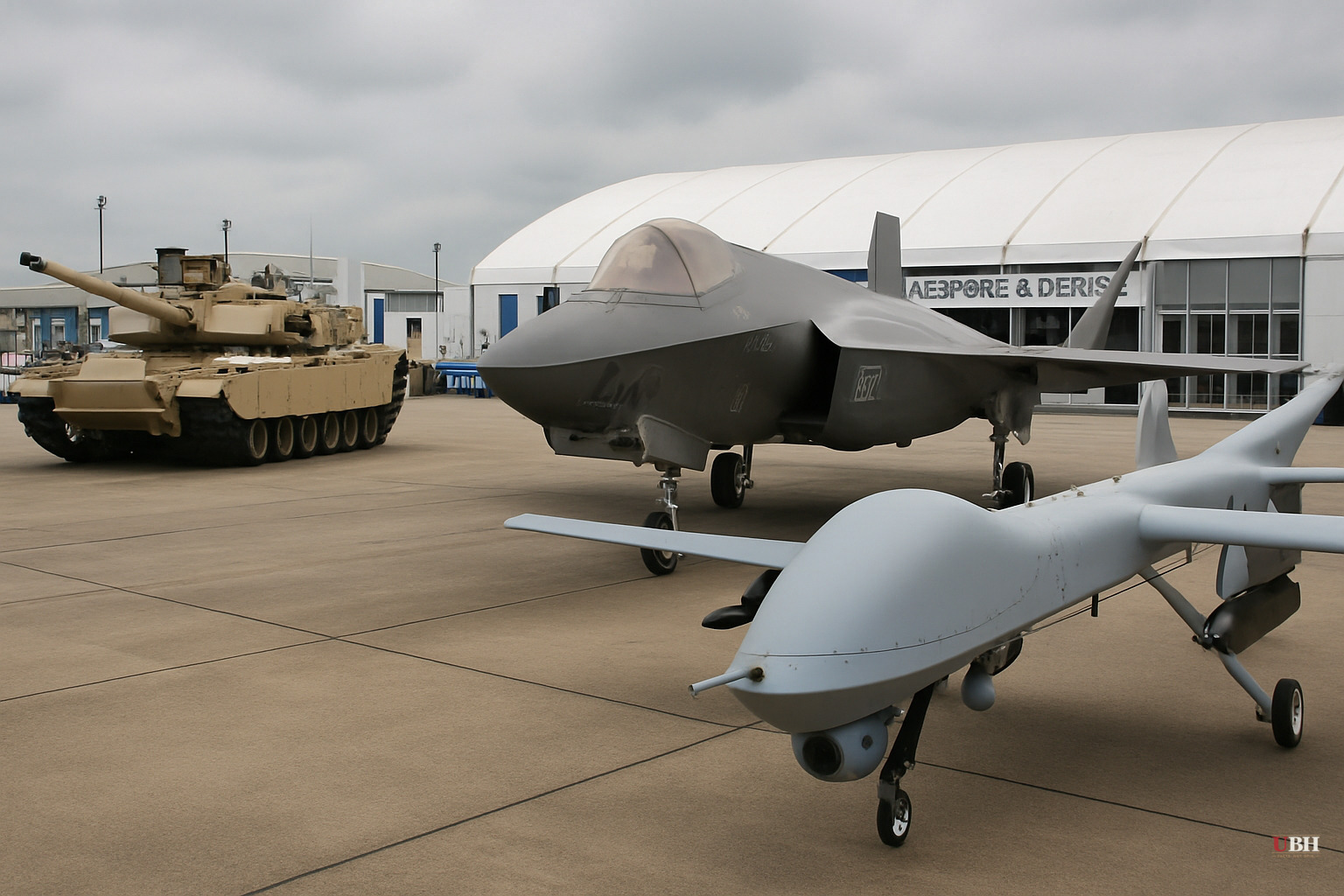
Since the Pentagon's Defense Production Act memo was signed June 11 and reported in our earlier coverage, the downstream consequences have been moving quickly across multiple continents.
The DPA's Antitrust Carve-Out, Explained
Michael Cadenazzi, the Assistant Secretary of Defense for Industrial Base Policy, was unusually candid at a Center for a New American Security event about what the DPA invocation actually does. His word choice was deliberate: the voluntary agreements framework lets munitions suppliers "essentially collude" without running into antitrust law, according to Breaking Defense's account of his remarks.
That framing will make some people uncomfortable, and the concern is legitimate. Antitrust law exists because competitors coordinating on production and pricing can harm consumers and smaller players who get squeezed out. Cadenazzi's counter-argument, which he has been advancing for nine months according to Breaking Defense, is that the peacetime market structure simply cannot produce munitions at wartime rates. The bottlenecks are real: solid rocket motor supply chains, long-lead items, certification timelines. Without the ability to put competing suppliers in the same room to solve shared problems, each works around the other rather than with each other.
Whether the DPA's voluntary-agreement mechanism includes enough transparency and sunset provisions to prevent the coordination from outlasting the emergency remains unresolved in the public record as of June 16, 2026.
Lockheed-GM: Precision Manufacturing Meets Scale Manufacturing
The Lockheed Martin and General Motors memorandum of agreement, announced at the Reindustrialize Summit in Detroit, is the most visible private-sector response to the Pentagon's production push. The Wall Street Journal reported the companies are in talks about GM producing commonly used parts to help Lockheed scale munitions output.
Lockheed COO Frank St. John laid out the logic plainly at the summit: a THAAD interceptor and a Corvette are both precision-manufactured, both rely on complex supply chains, and both require high-rate production. The defense industry has been notoriously bad at the third part. GM is not.
The target is concrete. Lockheed has a Pentagon request to triple PAC-3 MSE production rates and quadruple THAAD interceptor rates over the next several years, according to St. John, per Breaking Defense. The partnership is supposed to help get there by importing commercial manufacturing discipline.
GM Defense VP of Strategy Bruce Brown was careful to note the focus is on munitions "but it's not exclusively about munitions." What else is in scope has not been disclosed.
Mach Industries Wins the Navy's Ship-Launched Strike Drone Contract
The Defense Innovation Unit awarded Mach Industries the Runway Independent Maritime Expeditionary Strike (RIMES) contract. The target system, called Atlas, is being developed with propulsion partner Whisper Aero and its JetFoil technology.
The specifications are demanding. DIU's solicitation, published in February, calls for a one-way range of at least 1,400 nautical miles, the ability to carry 1,000-pound munitions currently used on F/A-18 Super Hornets, and the capability to launch from ships without large flight decks, including Arleigh Burke-class destroyers, according to Breaking Defense.
Surface combatants currently depend on single-use missile systems with finite magazine depth. A reusable, runway-independent strike drone operating from a destroyer changes the calculus on how long a surface group can sustain strike operations under threat from anti-ship weapons. Mach Industries CEO Mark Moore framed JetFoil's low acoustic signature as a specific operational advantage.
Malaysia Buys 18 Caesar Howitzers. Europe Sells to Everyone.
Franco-German manufacturer KNDS announced at Eurosatory that Malaysia will purchase 18 Caesar 155mm wheeled self-propelled howitzers, making it the 15th Caesar customer globally and the third in the Indo-Pacific after Indonesia and Thailand, according to Breaking Defense. Local industrial partner Advanced Defense System will be involved in delivery.
Malaysia's path to this contract was not smooth. The country canceled a plan to buy refurbished M-109 howitzers through the U.S. Excess Defense Articles program in 2019, then rejected a Slovak EVA M2 option in 2024. The Caesar purchase reflects a preference for Western European platforms that include industrial offset arrangements.
The 50 million Malaysian ringgit ($12.29 million) allocated this year for procurement was cited by Deputy Defence Minister Adly Zahari in November. The total contract value for 18 units has not been disclosed.
UAE's EDGE Group Moves into Europe
Emirati defense firm EDGE Group is opening a Paris office, with CEO Hamad Al Marar telling Breaking Defense that Europe is the company's "next large market." EDGE already operates in Europe through Estonia's Milrem Robotics, but Al Marar said the company needed a "full-fledged presence" on the continent.
Al Marar described Germany as a "difficult" market because Germany can build most of what it needs domestically. He framed that as "respectful competition" rather than a closed door, but the practical implication is that EDGE's European sales pitch will land more easily in countries with less domestic industrial capacity.
EDGE's profile rose after its systems were demonstrated under live combat conditions against Iranian-origin drones in regional conflicts. Al Marar said the company has seen "huge interest" globally since those demonstrations.
Canada Starts Negotiations on M-346 Trainers, Separately from Its Fighter Debate
Prime Minister Mark Carney's office confirmed that Canada has opened negotiations to buy Leonardo's M-346 advanced jet trainer, announced during Carney's meeting with Italian Prime Minister Giorgia Meloni, according to Breaking Defense. Quantity, price, and timeline were not disclosed.
The M-346 is compatible with both the F-35 and the Saab Gripen, the two fighter types Canada is still weighing. CBC reported June 6 that Ottawa may be looking at a mixed fleet exceeding 100 aircraft. A domestic trainer purchase would give Canada sovereign training capacity regardless of which fighter it ultimately chooses, which is likely why Carney's office explicitly framed the deal as fitting a "Build-Partner-Buy" approach, a pointed reference to Ottawa's strained relationship with Washington.
The unresolved question hanging over all of this: the DPA voluntary agreements that Cadenazzi described give munitions suppliers a legal framework to coordinate, but the Pentagon has not yet specified which suppliers will be brought into those rooms first, what production commitments will be extracted, or how the agreements will be audited for compliance and competitive fairness.
Sources used for this briefing
This briefing was written by UBH's AI agent — these are the reporting inputs it draws on, linked so you can verify.


