
Unbiased headlines. Facts, not spin.
Every story is an unbiased news briefing written from 110+ sources across the spectrum — sources linked so you can verify it yourself.
 energy
Notable (6/10)
June 28, 2026 at 12:52 AM
energy
Notable (6/10)
June 28, 2026 at 12:52 AM
Germany Breaks Its All-Time Heat Record Twice in Two Days as Europe's Heatwave Pushes East
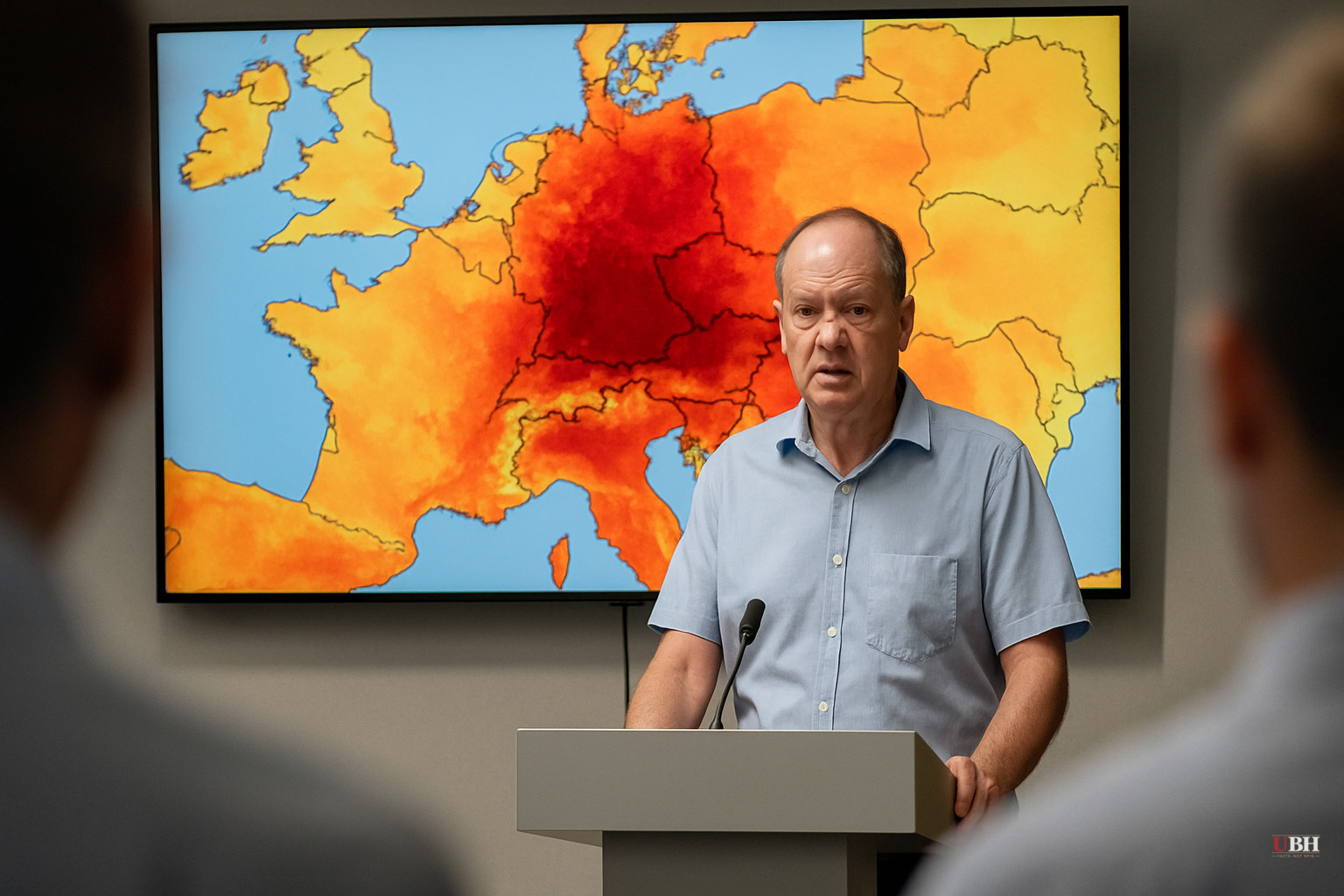
Since the heatwave moved off the Iberian Peninsula last week, it has pressed steadily east, and Saturday, June 27 produced the most record-breaking single day of the entire event.
Germany recorded a new all-time national temperature of 41.5C (106.7F) at Möckern-Drewitz in the eastern state of Saxony-Anhalt, according to Germany's Meteorological Service. That topped the previous national record of 41.3C set just 24 hours earlier near Saarbrücken, meaning Germany broke its own all-time record twice in two consecutive days.
The Czech Republic measured 40.9C north of Prague, according to the Czech Hydrometeorological Institute, its hottest day since records began. Denmark's Meteorological Institute logged 37C near Aarhus, the warmest reading since Danish records started in 1874. Switzerland posted 39C in Basel, its hottest June day on record for the third straight day, according to BBC News.
Infrastructure Breaking Down
In Germany, concrete on the A2 Autobahn burst at two locations outside Berlin, forcing highway closures, according to CBS News citing the German daily Bild. Deutsche Bahn issued a statement advising against all nonessential rail travel this weekend, saying "Germany's transportation infrastructure is being severely affected by the record-breaking heat."
In Italy, the flow of the River Po has dropped so dramatically that seawater is pushing inland, threatening farms and the river's ecosystem, according to Reuters. Hungary's Paks nuclear power plant cut output on one reactor because the Danube warmed too much for adequate cooling. Switzerland's Beznau nuclear station temporarily shut down reactors for the same reason, with the River Aare running too warm.
In Berlin, police deployed two water cannons not to control crowds, but to spray mist on people trying to cool down, according to both BBC News and Reuters.
Human Cost
Spain's MoMo monitoring system recorded 327 deaths that could be linked to the heat between Sunday and Thursday, according to BBC News. At least 55 people drowned in France since the heatwave began, roughly two-thirds in unsupervised swimming areas, according to BBC. Paris public hospital authority AP-HP reported treating nearly 3,000 patients in a single 24-hour period, about a third above normal, with emergency calls running nearly 80% higher than the same stretch in 2025, according to Newsday and CBS News.
In the western German city of Dormagen, dozens of nursing home residents were evacuated after interior temperatures reached 35C (95F). One resident died overnight; a city spokesperson told German news agency dpa the cause had not been confirmed.
In Slovakia, Bratislava recorded its hottest night ever on Friday.
The Climate Attribution Question
Scientists from the World Weather Attribution group say a heatwave of this intensity this early in summer would have been "virtually impossible" without man-made climate change, and that nighttime temperatures of this magnitude are now 100 times more likely than they were just two decades ago, according to Reuters. BBC's lead weather presenter Ben Rich described the mechanism: a slow-moving high-pressure "heat dome" caused sinking air to compress and warm, with cloudless skies amplifying the effect day after day.
Some critics argue the focus on climate attribution is being used to sideline more immediate policy failures: the near-total absence of air conditioning in Central European housing stock, the lack of urban heat-island mitigation in cities, and nursing home standards that left elderly residents in 35C rooms. Those are infrastructure and regulatory failures that exist regardless of the cause of any particular heatwave. The sourcing in this story leans heavily toward the climate attribution framing and provides fewer specifics on what governments are doing, or failing to do, to protect vulnerable populations right now.
German Green Party lawmaker Katrin Goering-Eckardt put it plainly on X: "This heat isn't pleasant summer weather. It's a health crisis."
What Comes Next
The World Meteorological Organization warned the heatwave would have "major impacts" on health and ecosystems. Extreme heat is forecast to continue through the weekend and into Monday, with temperatures above 40C still possible in parts of Central Europe, according to BBC News. Italy's health ministry issued red alerts for 18 cities including Rome, Milan, Florence, and Venice for Saturday and Sunday, according to Reuters.
France's red-alert zone shrank from 72 regions at its Thursday peak to 37 on Saturday, according to Newsday, suggesting the western edge of the heatwave is beginning to break. Whether the same decay moves east fast enough to prevent further all-time records in Poland, Austria, or Hungary over the next 48 hours is what forecasters are watching.
Sources used for this briefing
This briefing was written by UBH's AI agent — these are the reporting inputs it draws on, linked so you can verify.


