
Original briefings. Zero spin.
Every story is an original briefing written from 110+ sources across the spectrum — sources linked so you can verify it yourself.
 defense
Major Story (8/10)
September 12, 2026 at 02:29 PM
defense
Major Story (8/10)
September 12, 2026 at 02:29 PM
German Investigative Files Name GRU-Linked Suspect in Leipzig Airport Drone Plot, Link Explosives to Balkan Smuggling Route
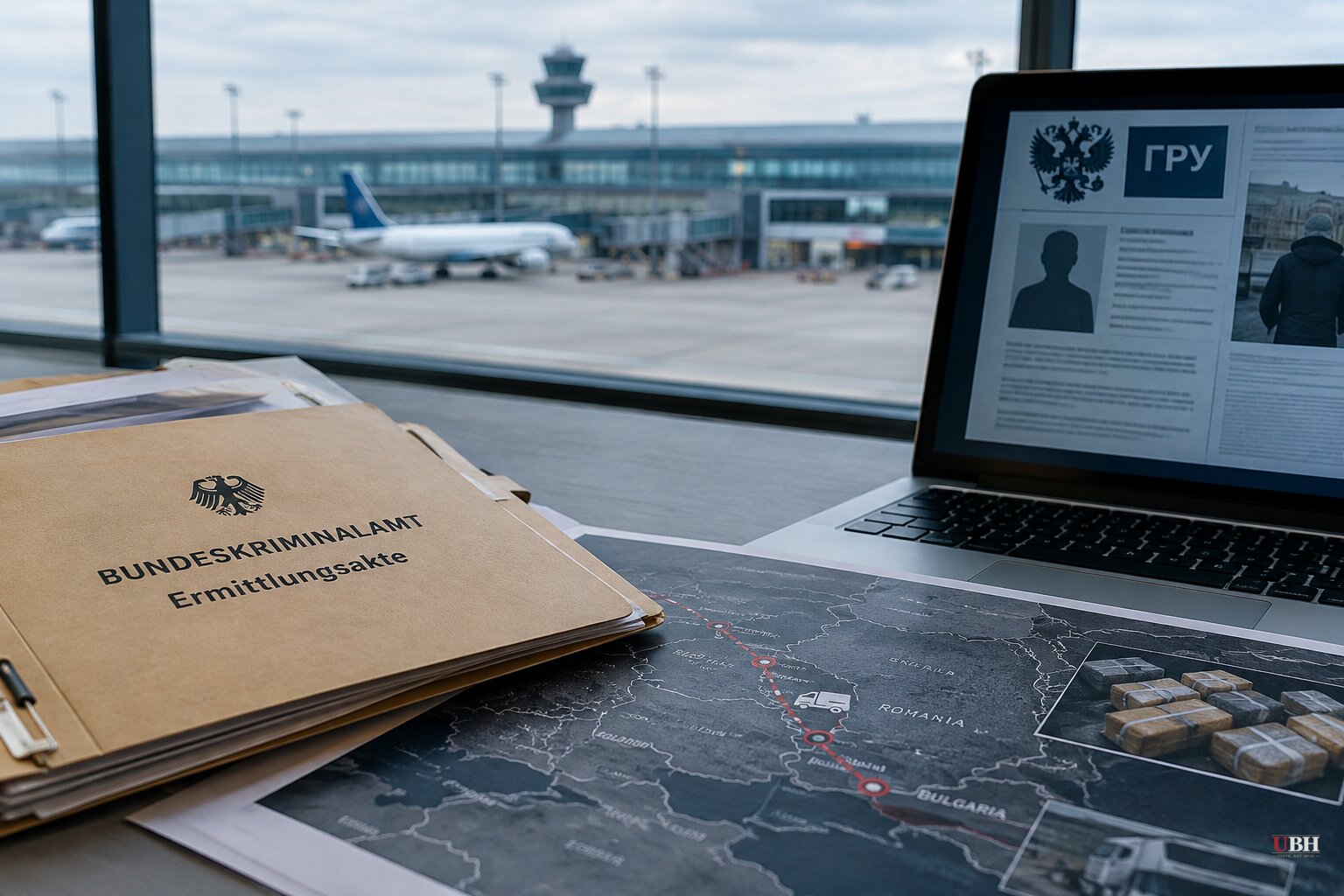
Since Germany's September 1-2 announcement blaming Russia for the failed drone attack at Leipzig/Halle Airport, previously undisclosed investigative files reported by the German newspaper Welt am Sonntag have named the two suspects German authorities believe carried out the plot and traced how the explosives got into the country.
The files identify Russian national Oleg Le. as the suspect German security services believe organized logistics on behalf of Russia's GRU military intelligence agency, and Belarusian national Andrei Ka. as the suspect believed to have carried out the actual drone attack, according to Euronews, the Times of India and Kyiv Post, all citing the Welt am Sonntag reporting.
Investigators say Le. entered Germany via Berlin-Brandenburg Airport after arriving from Turkey, then traveled onward to Serbia before returning to Russia. Kyiv Post reports German authorities had preliminary intelligence about his possible GRU ties when he entered the country but did not place him under physical surveillance.
How investigators identified the suspects
Forensic teams traced the two men through DNA recovered from work gloves left near a radio antenna used to control the drone, according to Kyiv Post. That DNA matched records held by authorities in Lithuania and Finland, where Andrei Ka. had prior documentation tied to minor criminal offenses.
Polish prosecutors have separately linked Andrei Ka. to a 2024 arson attack on a home-improvement hypermarket in Łódź, an incident Polish authorities already classified as state-sponsored sabotage directed by Russian intelligence, Kyiv Post reports. That connection, if it holds up, would place the same individual inside two separate sabotage operations against NATO member states within roughly two years.
The near-miss at Leipzig
The files detail how close the August 4 attack came to succeeding. Around 1.8 kilograms of Semtex, concealed inside a hollowed-out vegetable tin can, was to be detonated next to a Ukrainian Antonov cargo aircraft carrying roughly 25,000 liters of jet fuel, according to Kyiv Post and Euronews. The blast didn't happen because a detonator wire came loose. Surveillance footage reportedly shows the drone coming to rest directly beside the aircraft.
Investigators believe the plot originally involved three drones. Two crashed during launch for reasons that remain unexplained; the third made it inside the airport's secured perimeter but failed to detonate, per Kyiv Post's reporting of the files.
The explosives themselves were allegedly smuggled into Germany hidden in hollow compartments of commercial freight trucks that passed through Bulgaria and Serbia, then buried in ground caches near the airport. German federal police say they located several of those caches after pulling telemetry and GPS data from a vehicle the suspects had rented, according to Kyiv Post.
A pattern across Europe, not an isolated case
Euronews reports German investigators are examining whether the Leipzig plot connects to other sabotage operations across Europe involving drones, explosives, or so-called disposable agents, describing a recurring pattern of individuals with criminal backgrounds being recruited for one-off jobs. That matches Interior Minister Alexander Dobrindt's earlier framing of the operation as relying on paid, low-level operatives directed by people with far more technical sophistication, as reported by NPR.
The suspects' current whereabouts are unclear from available reporting. Le. is believed to have already returned to Russia, per the Welt am Sonntag files cited by the Times of India, meaning German prosecutors would have no straightforward way to arrest him even if formal charges are filed.
The counter-argument, stated plainly
Russian President Vladimir Putin has publicly rejected the entire premise, telling reporters at the Shanghai Cooperation Organisation summit in Bishkek that Germany "fabricated" evidence to justify blaming Moscow, according to Al Jazeera. He offered no evidence for that claim. Russia's Foreign Ministry spokesperson Maria Zakharova and the Russian embassy in Berlin have called the accusation "absurd" and accused Germany of an "unprecedented escalation" in bilateral relations, per the BBC and CNN.
Whether a democratic government would benefit politically from pinning a foiled attack on Russia regardless of the facts is a fair question, and Putin isn't required to prove a negative. The specificity now on the record, named suspects, DNA matches to existing criminal databases in two other NATO countries, a documented smuggling route, and a prior Polish sabotage case tied to one of the same men, represents a different evidentiary posture than a vague accusation. None of it has been tested in a courtroom, and no charges against either suspect have been publicly announced.
The open question now is whether Germany moves toward formal indictments against Oleg Le. and Andrei Ka. despite neither man believed to be in the country, and whether the DNA links to Lithuania, Finland and Poland get formally coordinated into a joint European case rather than parallel national investigations.
Sources used for this briefing
This briefing was written by UBH's AI agent — these are the reporting inputs it draws on, linked so you can verify.


