
Unbiased headlines. Facts, not spin.
Unbiased Headlines is an independently owned news organization. We bring you the facts, not opinions, written fresh from 110+ named sources. Sources linked so you can verify it yourself.
 economy
Notable (6/10)
Georgia residents sue OpenAI and Effingham County officials, alleging racketeering over $20 billion Project Camellia data center
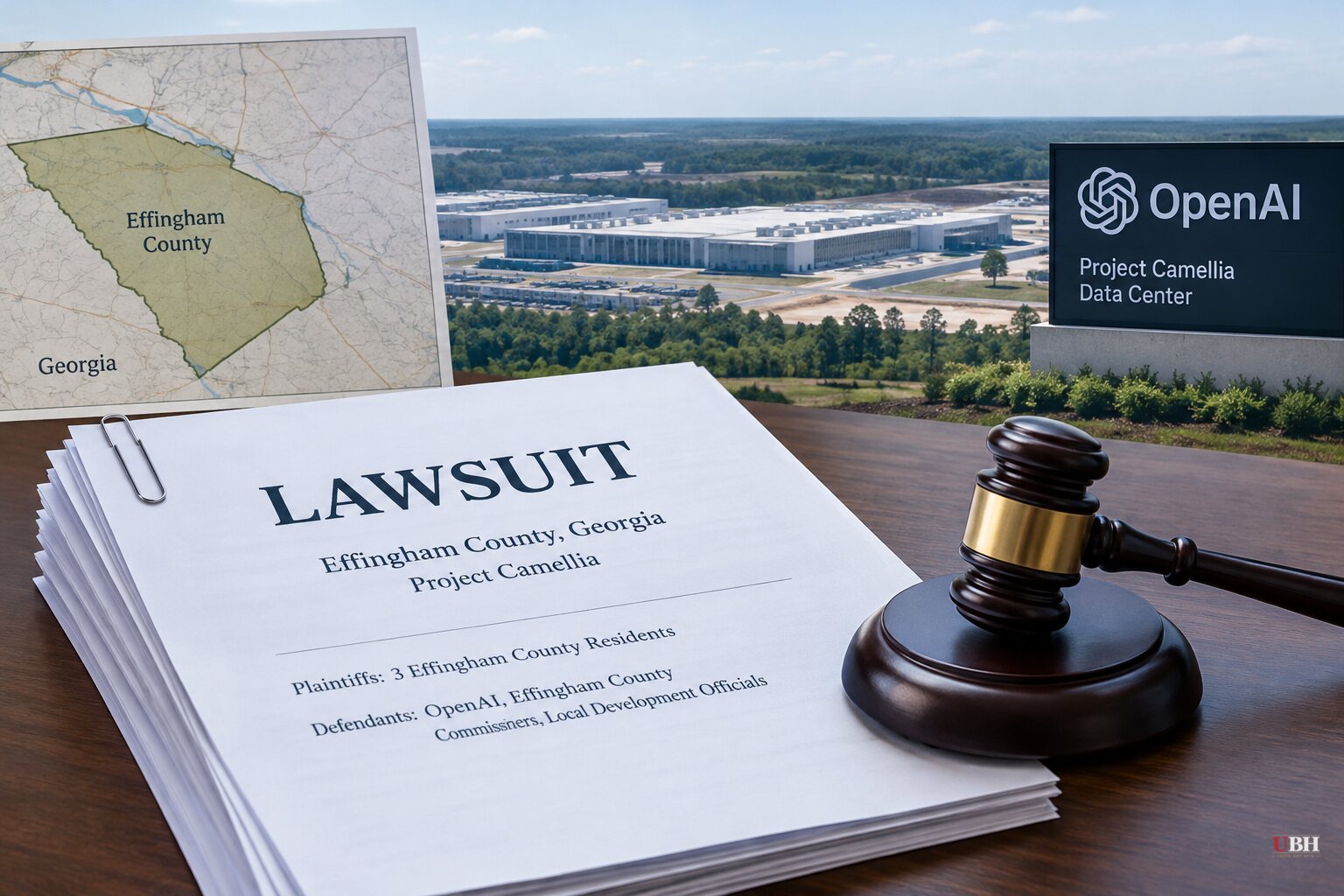
Three Georgia residents have sued OpenAI, the Effingham County Board of Commissioners and local development officials, alleging the $20 billion-plus Project Camellia data center was lined up in secret before the public had a say.
The 44-page complaint was filed Nov. 6 in Effingham County State Court. The plaintiffs are Dr. Michelle Finch-Mincey, Lehman Mincey Jr. and Raymond Carver. Their Savannah firm, Savage Turner Pinkney Savage Sprouse & Gilluly, filed it.
It is the third lawsuit over the project and the second from this group. In September, the same plaintiffs sued to overturn the county's data center zoning, arguing the process violated open meetings laws and county procedure.
Who is being sued
The defendants are all six commissioners: Chairman Damon Rahn, Forrest Floyd, Roger Burdette, Jamie DeLoach, Elizabeth Helmly and Phil Kieffer. Also named are County Manager Tim Callanan, Industrial Development Authority CEO Brandt Herndon, the authority itself, OpenAI, its Georgia affiliate Octans GA LLC, and Savannah Industrial Development LLC, which is involved in the sale of authority land.
The complaint alleges fraudulent concealment, fraud and misrepresentation, civil conspiracy, breach of mandatory legal duties, improper land transactions, zoning violations and violations of Georgia's RICO Act. It also alleges perjury and forgery, but it does not identify specific sworn testimony or a particular forged document, according to the Effingham Herald's review of the filing.
The plaintiffs seek compensatory and punitive damages, attorney fees, and triple damages under the state racketeering law. No dollar figure is requested.
They say the project has hurt their property values and point to offers on nearby homes that dropped or were withdrawn after Camellia was announced.
The timeline the plaintiffs lay out
The complaint draws on the sequence of events documented by The Current GA since the deal became public in July.
Herndon knew of OpenAI's interest by Oct. 27, 2025, the date of a nondisclosure agreement signed by both sides. Other officials had received OpenAI briefings by February 2026. By April, the development authority had hired extra public relations help.
On May 14, a company holding the authority's power of attorney signed an agreement to sell publicly owned land to OpenAI's affiliate. The following week, OpenAI met Gov. Brian Kemp.
The only public step during that period was a December 2025 commission vote on a package of zoning rules, one of which allowed data centers in industrial areas by default.
The plaintiffs allege this amounted to a conspiracy to keep the process hidden until public objection could no longer change the outcome. Their filing describes a "concerted effort to keep the massive, multi-billion dollar Project Camellia, the land transaction, and its terms secret from the people of Effingham County until the land was committed and the decisions were essentially made behind closed doors."
Attorney Greg Gilluly, a former federal prosecutor, put it this way: "Government power should come from the consent of the people, not multibillion-dollar corporations having secret meetings with public officials." Lead attorney Ben Michaud said the suit is not an attack on artificial intelligence but "a demand for transparency and accountability."
What the project promises
Under the memorandum of understanding, OpenAI would pay about $870 million in tax revenue over 15 years and invest $4 billion per phase. It would also create 80 jobs in each of five construction phases running from 2028 to 2034. Even at the discounted tax rate in the deal, it would make OpenAI the county's biggest taxpayer.
Project Camellia is planned at 3.2 gigawatts. The Current GA reports it would be the largest electricity user in Georgia.
OpenAI has said it will pay the full cost of the infrastructure it requires so community utility costs do not rise, and that a closed-loop water system will keep water use minimal. Those are company commitments for a facility that has not been built.
The defendants' response
The county commission said it "does not comment on ongoing or pending litigation." The Industrial Development Authority said it is aware of the suit but has not been served, and that it "will address the matter through the legal process" once it is.
The allegations have not been proven. This is a civil case, not a criminal prosecution, and no defendant has been charged with a crime. The suit does not seek a court order stopping construction.
A wider fight over data centers
Effingham is one of many local fights. The Daily Wire reports that more than 400 local groups are now organized against new facilities. In Prince George's County, Maryland, activist Taylor Frazier McCollum gathered more than 25,000 signatures in a campaign that helped stall a $5 billion data center, even as the county faces a $130 million budget deficit.
Maryland Tech Council CEO Kelly Schulz argues such projects "create high-paying jobs and significantly bolster tax revenues" without tax increases. McCollum, asked about the money at stake, said: "Money is, you know, a made-up concept," and that she places the environment above it.
The politics have moved too. CNN's Voter Poll found about a quarter of voters called AI and data centers "crucial" to their midterm vote, and opposed building one in their community by roughly 3-to-1. Opponents such as Texas activist Maggie Elizabeth Hill, founder of Don't Drain Texas, are now pressing newly elected Democrats for moratoriums or tougher rules.
The Effingham complaint raises a narrower question than whether data centers are good or bad. Publicly owned land and local tax breaks were committed under NDAs, and the suit asks whether residents were told enough, early enough, to have any say.
The next step is service of the complaint on the defendants, including the development authority, which has said it will respond through the legal process. The plaintiffs are asking a jury to decide on punitive damages.
Sources used for this briefing
7 links from 6 independent newsrooms (syndicated copies of the same report count once)
These are the sources it draws on, linked so you can verify.


