
Original briefings. Zero spin.
Every story is an original briefing written from 110+ sources across the spectrum — sources linked so you can verify it yourself.
 economy
Major Story (8/10)
Event date: September 6, 2026
economy
Major Story (8/10)
Event date: September 6, 2026
Gas Hits Record $4.14 Labor Day High as Trump Predicts $2 Gallon If US Beats Iran
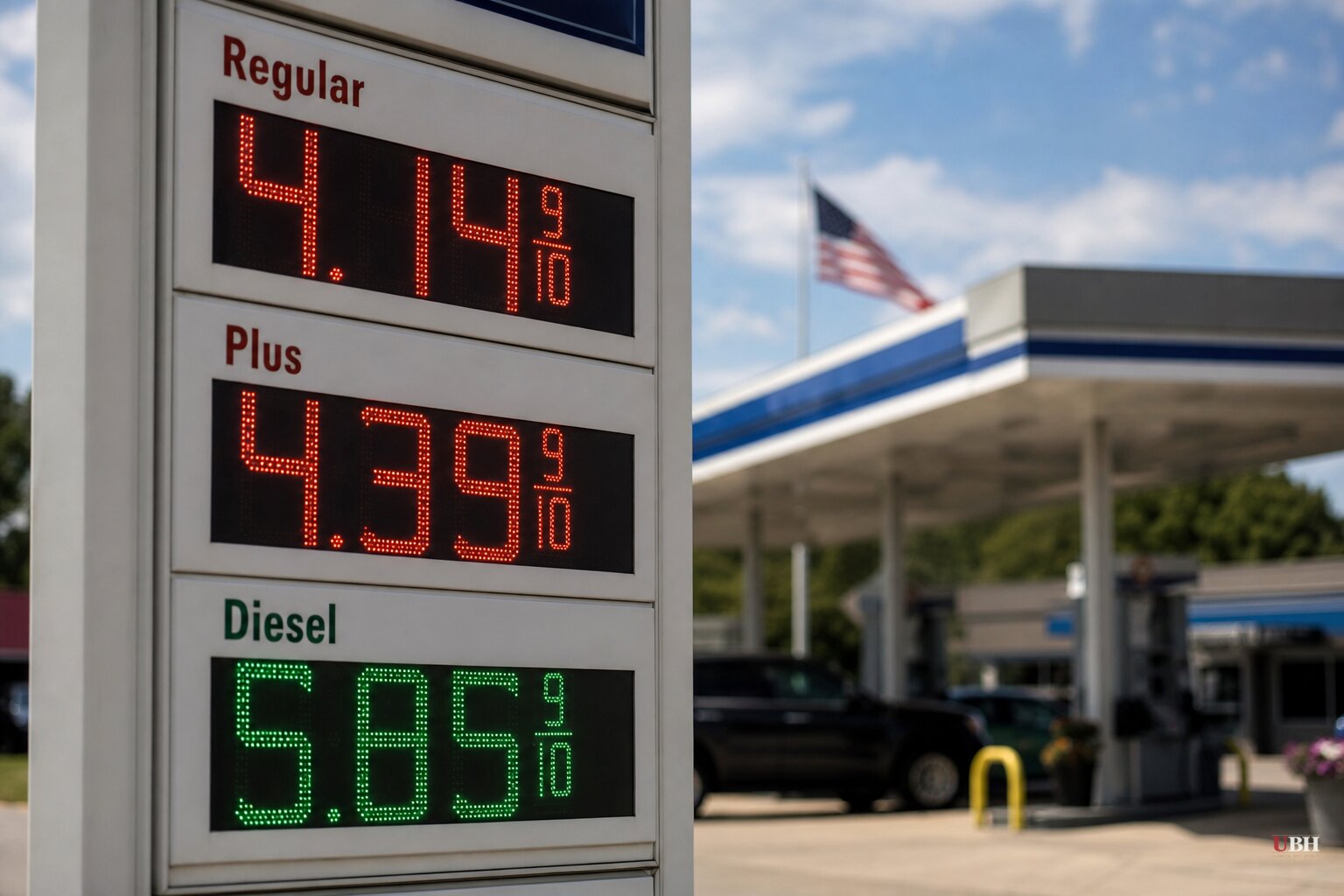
Gas prices hit their highest Labor Day level in U.S. history this weekend, averaging $4.14 a gallon nationwide, according to AAA. That's nearly a dollar more than a year ago and well above the previous Labor Day record of $3.82 set in 2012.
Diesel is worse. It hit a record national average of $5.85 a gallon on Friday, September 4, according to AAA data cited by both the Associated Press and Breitbart. Crude oil is trading near $90.85 a barrel.
The cause, according to AAA's own analysis, is straightforward: "Continued volatility in the Strait of Hormuz has pushed crude oil prices in the $90 per barrel range." The U.S. and Israel struck Iran in February, and the war has not settled since.
The Hormuz Math
CNN's analysis of UK Maritime Trade Operations data found that Strait of Hormuz vessel traffic in mid-August was running at just 20% of the pre-war average, even though it had risen 27% week-over-week. Most ships transiting the strait are now flagged from Panama and Liberia, with zero from the United States.
Energy Secretary Chris Wright says the U.S. Navy has helped move more than 15 million barrels of oil and products out of the strait plus another 5 million via pipelines, and Daily Wire reported the administration touting a new wartime high of 18 million barrels moving through Hormuz on one day this week. Wright told ABC's "This Week" on Sunday that prices are indeed higher than last Labor Day, but said the administration is "doing everything we can to push them down."
The administration is citing rising throughput numbers as a sign of progress, while consumers are staring at record prices at the pump. Both things can be true at once. Supply lines can be improving off a very low base while still not being enough to bring prices down yet.
Other factors are compounding the squeeze. Tom Seng, a professor of energy finance at Texas Christian University, said U.S. refineries are running at 98% capacity, many in extreme Texas heat, leaving little cushion if a hurricane or mechanical failure knocks capacity offline. Matthew Metzgar, a clinical economics professor at UNC Charlotte, pointed to Ukrainian drone strikes on Russian refineries and declining Chinese refinery output as additional pressure that has nothing to do with Iran at all.
Trump's $2 Promise
President Trump has repeatedly said gas prices will collapse once the U.S. wins the war. In comments carried by Crypto Briefing, Trump said prices could reach $2 a gallon contingent on an American victory. In a separate statement, Trump laid out a staged prediction: "Three Dollars per gallon, and eventually below two dollars per gallon," adding that "Iran will never have nuclear weapons."
Trump has also argued the Strait of Hormuz is becoming less strategically important. "A lot of alternatives are being made to the Hormuz Strait. The Hormuz Strait is not what it used to be," he told reporters at the White House, pointing to new pipelines and an overland trucking route through Syria. He also touted a deal to secure majority control of what he says is more than 65 billion barrels of Venezuelan oil reserves, writing on social media that the deal "MORE THAN DOUBLES American Oil Reserves" and "will substantially lower Gas Prices for all Americans, long into the future."
A reasonable skeptic would point out that none of this has shown up in the price data yet. Gas was around $3.00 a gallon before the war started in February and has climbed steadily since, hitting $4.00 a month ago and $4.14 now. The administration's case rests on alternative pipelines, the Syria route, and the Venezuela deal eventually adding enough supply to bring prices down. Those are future-tense claims, not current results.
Is It a War?
How officials describe the conflict itself has become its own dispute. Vice President JD Vance said Thursday he "wouldn't call it a war," citing the absence of "active shooting" at the time. Trump backed him up Friday, calling it a "military conflict" rather than a war.
Sen. Bernie Sanders pushed back hard on X, asking Vance to "explain that to the families of the 19 U.S. service members who lost their lives or the thousands of people who have been killed across the region." Fox News reported the exchange without resolving it. Both descriptions reflect real facts about the campaign's intensity and its human cost, and the dispute is fundamentally about framing, not about the underlying casualty figures, which neither side disputed.
What Happens at the Grocery Store
The AP's analysis, cited by Fox News, found that record diesel prices are already pushing up costs for freight companies, farmers and delivery networks, with some businesses passing the expense to consumers through shipping surcharges. Produce, meat and other perishables that depend on diesel-powered transport and farm equipment are expected to see the earliest price increases.
AAA notes gas prices typically fall once refineries switch to cheaper winter blends after Labor Day, but Seng says that seasonal relief may not materialize this year given refinery capacity constraints and the unresolved war. Whether Trump's $2-a-gallon prediction lands anywhere close to reality depends on developments in the Strait of Hormuz, the pace of the Syria pipeline route, and whether the Venezuela oil deal actually increases global supply. None of these has a confirmed timeline yet.
Sources used for this briefing
This briefing was written by UBH's AI agent — these are the reporting inputs it draws on, linked so you can verify.


