
Unbiased headlines. Facts, not spin.
Unbiased Headlines is an independently owned news organization. We bring you the facts, not opinions, written fresh from 110+ named sources. Sources linked so you can verify it yourself.
 health
Low Interest (4/10)
Event date: October 13, 2026 ·
Gallup: 54% of Americans Drink, Tying Record Low, as Catholic Drinking Falls From 79% to 55%
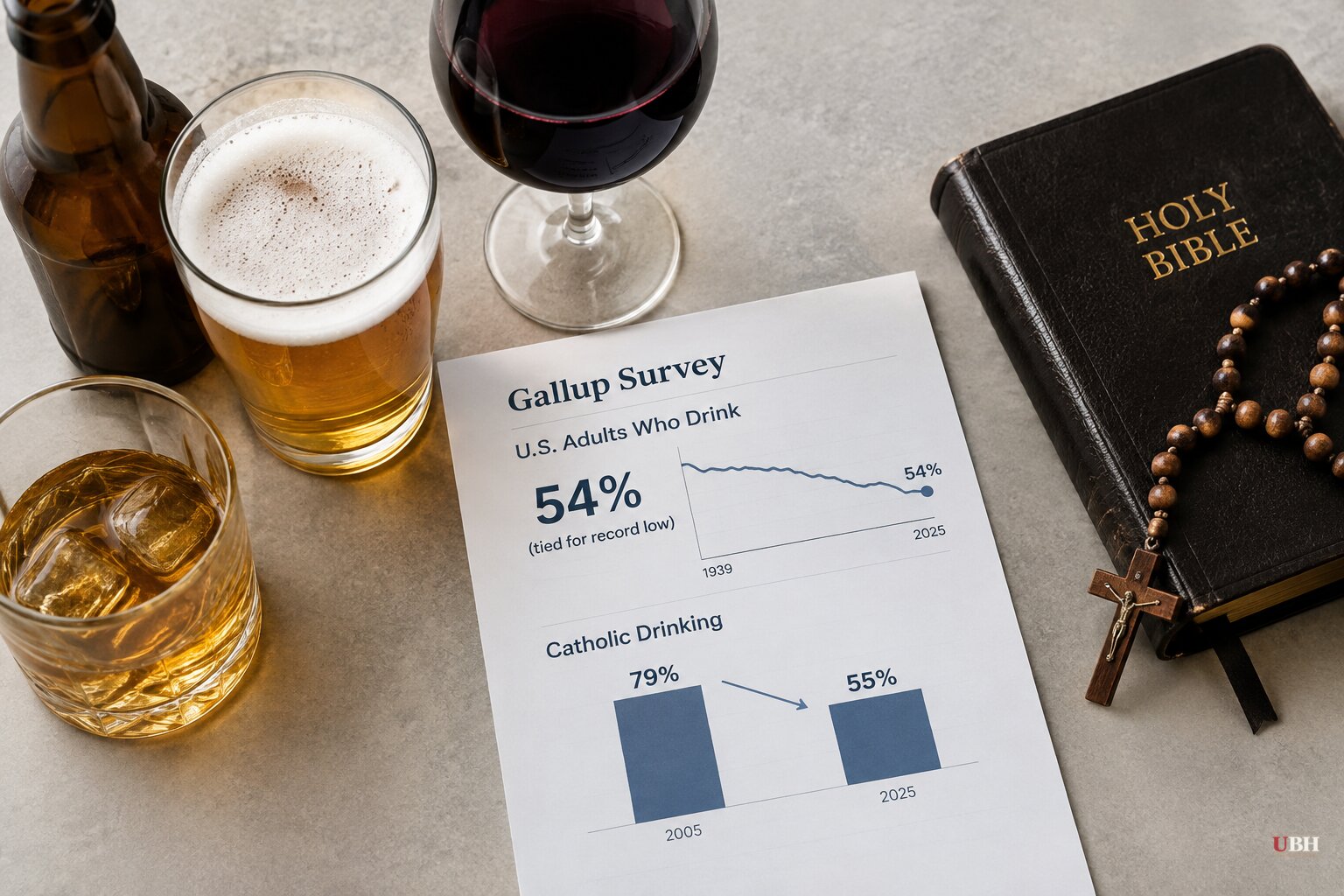
The share of Americans who drink has stopped falling, but only after hitting the lowest level Gallup has ever recorded.
Gallup's July 1–19 survey of 1,200 adults found 54% say they drink alcohol. That matches 2025 and ties the lowest reading since Gallup first asked the question in 1939. The margin of error is ±4 percentage points.
The trend line is steep. Gallup recorded 62% in 2023 and 58% in 2024 before the two straight readings of 54%.
Fewer drinkers, but heavier drinking among those who remain
Gallup counts how many adults say they drink. It does not measure total alcohol consumed.
Among those who do drink, the average rose to 3.2 drinks in the prior week, up from 2.8 in 2025. So the population of drinkers is shrinking while the typical drinker reported more.
The religion gap has closed
For decades, Protestants were the least likely to drink. Catholics and Americans with no religious identity drank more.
Gallup's pooled data show Catholic drinking at 55% in 2025–2026, down from 79% in 2002–2004. Protestant drinking has stayed flat at 54%. Gallup analyst Frank Newport writes that Protestants and Catholics are now identical in their alcohol use, with the nonreligious only modestly higher.
The nonreligious group fell to 60% from 72%. Weekly churchgoers barely moved, slipping to 44% from 46%.
Those are comparisons between pooled periods, not year-to-year changes or the same people tracked over time. The categories also overlap, so the numbers cannot be added together.
Why Newport says religion is not the main driver
The country has become less religious, and less religious Americans have historically drunk more. Newport notes that if secularization were driving behavior, drinking should have gone up. It went down.
His explanation is arithmetic. Adults who attend services less than weekly make up a large and growing majority of the country, and their drinking is at its lowest in Gallup's timeline. Weekly attenders have shrunk from 30% of adults 15 years ago to about 20% today, so their modest dip matters little to the national number.
The nonreligious have nearly doubled in size over the past 15 years, to 25% of adults, according to Newport. That makes their decline count for more.
Health attitudes shifted
Gallup found 51% of adults now say one or two drinks a day is bad for health. That is close to the 2025 peak of 53% and roughly double the 27% who said so in 2001. Only 6% call moderate drinking good for health, down from 22% a quarter-century ago.
Among Catholics, 52% call moderate drinking bad for health. The figure is 56% for the nonreligious and 48% for Protestants.
Awareness has grown too. Gallup found 86% of adults have heard at least something about research on alcohol's long-term health effects, up from 79% in 2024.
The federal government has added to that backdrop. The U.S. Surgeon General's 2025 advisory identified a causal link between alcohol and at least seven cancers. It estimated roughly 100,000 cancer cases and 20,000 cancer deaths a year in the United States.
The 2025–2030 Dietary Guidelines, released in January 2026, tell Americans to "consume less alcohol for better overall health." They dropped specific daily drink limits. The American Association for the Study of Liver Diseases criticized that change as insufficiently clear.
A researcher urges caution on the Catholic number
Not everyone is ready to build a story around Catholics specifically. Dr. Joshua Gowin, an associate professor in the Department of Radiology at the University of Colorado Anschutz Medical Campus who studies alcohol's effects on the brain, told Fox News Digital that the overall decline is real.
"There's definitely a general pattern of alcohol use decreasing across groups," Gowin said. On the subgroups, he said it was not "clear or necessarily compelling" that one group showed a broad trend the others did not.
"It seemed like really only one data point showed that effect," Gowin said. That made him "a little skeptical that this is a broader phenomenon versus a single survey sample."
The subgroup caution has a basis in the survey itself. The ±4-point margin applies to the national sample. Religious subgroups drawn from 1,200 respondents carry wider uncertainty, which is why Gallup pools years of data for the Catholic comparison.
What the numbers leave open
The 79% to 55% Catholic drop and the flat Protestant line come from Gallup's pooled data, and Newport frames religion as one of several possible explanations rather than the cause. Health concern is the factor that has moved most sharply in Gallup's polling, but Gallup's survey records attitudes and self-reported behavior side by side. It does not show which one changed first.
The open question is whether the pause holds. After three years of steep declines, the 2025 and 2026 readings are identical. Whether 54% is a floor or a plateau before another drop is not yet known.
The rise to 3.2 weekly drinks among current drinkers is a second open question. Whether it reflects a real shift toward heavier drinking among those who remain or ordinary variation in a 1,200-person sample is not established.
Sources used for this briefing
3 links from 3 independent newsrooms (syndicated copies of the same report count once)
These are the sources it draws on, linked so you can verify.


