
Unbiased headlines. Facts, not spin.
Unbiased Headlines is an independently owned news organization. We bring you the facts, not opinions, written fresh from 110+ named sources. Sources linked so you can verify it yourself.
 health
Notable (5/10)
Event date: October 20, 2026 ·
NYU pilot: one 10-minute ultrasound session lowered delusion scores in 10 patients with schizophrenia
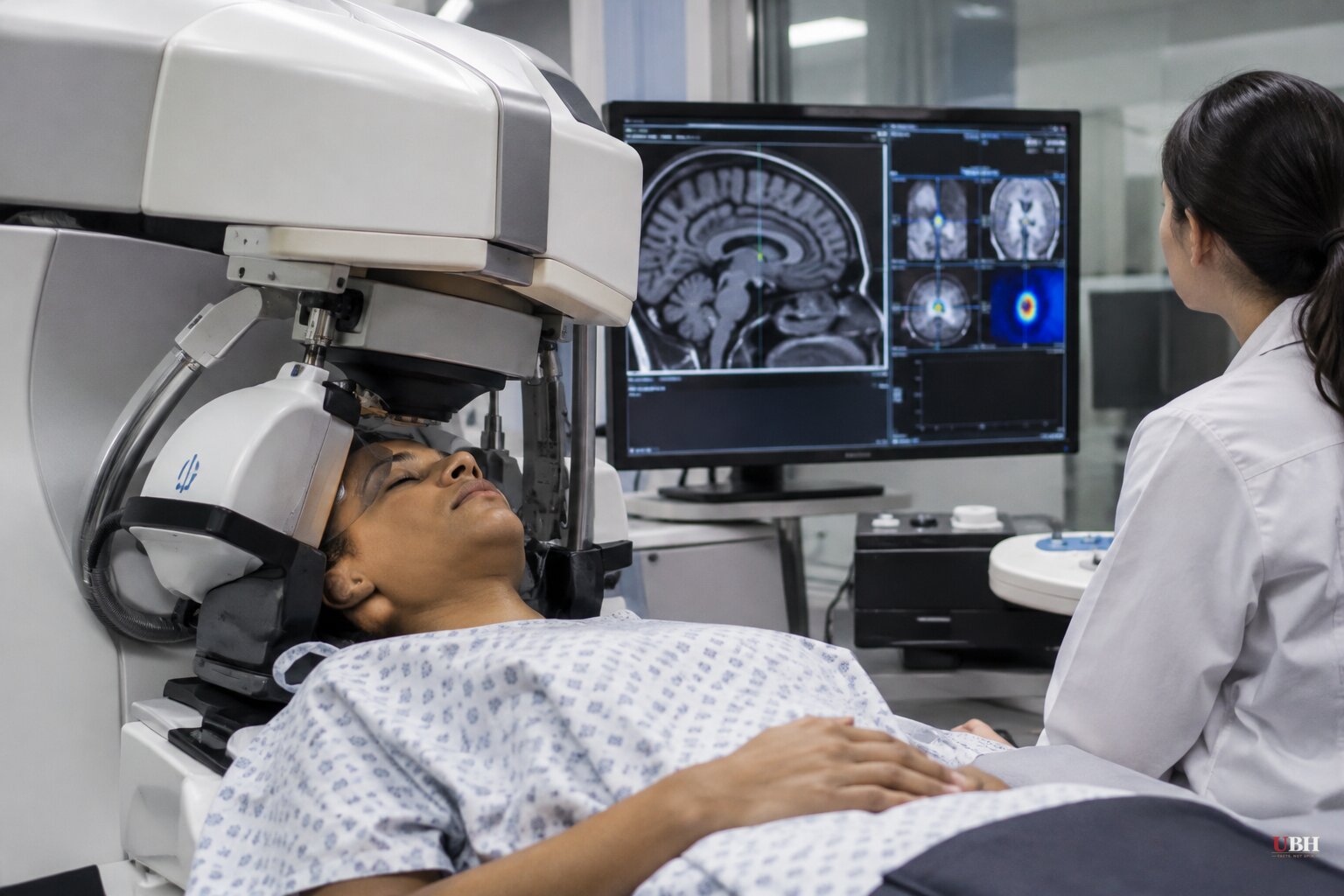
A small NYU Langone Health trial published October 20 in the journal npj Acoustics found that a single 10-minute dose of focused ultrasound reduced delusions in people with schizophrenia and schizoaffective disorder. The group was 10 people.
The researchers describe it as early evidence. That is the right size for it.
What the researchers did
All 10 participants had ongoing symptoms despite taking medication. Each one got two sessions, one week apart: a real ultrasound treatment and a sham version, in random order.
Neither the patients nor the staff rating their symptoms knew which session was which. In the sham session, the device sat on the head and switched on, but a mechanism inside blocked the sound waves from reaching the brain.
MRI scans guided the placement of the device onto the right globus pallidus interna. That is a deep structure in a circuit that helps control movement, thought and emotion. The ultrasound ran for 10 minutes in alternating 30-second on and 30-second off cycles.
The team assessed delusions, hallucinations, thinking, memory and side effects before and after each session.
The numbers
After the real treatment, average delusion scores fell by 1.2 points on a standard clinical scale. After the sham treatment, they rose by an average of 0.4 points.
The gap between the two conditions was still detectable at the end of the seven-day observation period.
Side effects included fatigue, headache and brief increases in psychotic symptoms. The researchers say these were mild, short-lived, and did not differ between the real and sham sessions.
"Our results offer early evidence that a single session of transcranial ultrasound stimulation can safely 'tune' a brain circuit linked to psychosis and lead to a noticeable drop in delusions," said lead author Wei Qi, MD, a clinical assistant professor of psychiatry at NYU Grossman School of Medicine.
Why that brain region
Qi and colleagues previously found that problems in this circuit were associated with delusions and predicted how well patients responded to medication. The new trial tested whether poking that circuit directly would change symptoms.
The team says it is the first to aim transcranial ultrasound at schizophrenia symptoms. The technique has previously been explored for anxiety, depression and obsessive-compulsive disorder, and for thinking and memory in Alzheimer's and Parkinson's disease.
Co-senior author Shy Shoham, PhD, a professor of neuroscience and ophthalmology at NYU Grossman and director of the Tech4Health Institute at NYU Langone, said the method "offers a unique opportunity to precisely target very small regions that affect thinking and behavior." Established tools such as transcranial magnetic stimulation have a harder time reaching structures buried that deep without affecting overlying tissue, according to the NYU summary of the work.
The need
Antipsychotic drugs are the standard first-line treatment. An estimated 30% of patients still have persistent, treatment-resistant symptoms, and the drugs can carry heavy metabolic and neurological burdens, according to the NYU summary. Anything that works without surgery or implants would be worth serious testing.
The limits
The researchers themselves say the results are early. Ten people is a pilot. One session and one week of follow-up cannot say whether benefits last, whether repeat sessions work, or how the treatment performs across a broader patient population.
The study was classified as a randomized controlled trial, but its size and format mark it as a pilot. A 1.2-point average drop is described by the authors as modest. Nothing in the report shows patients functioning better in daily life.
The safety finding is also narrow. Mild side effects across 10 people and two sessions each say little about rarer problems or repeated dosing.
What comes next
The researchers plan to use advanced brain scans to tailor the strength of the sound waves to each person and confirm they reach the intended spot.
Larger studies will have to show whether the treatment is safe and effective over a longer period. No such trial has been announced.
Sources used for this briefing
7 links from 7 independent newsrooms (syndicated copies of the same report count once)
These are the sources it draws on, linked so you can verify.


