
Unbiased headlines. Facts, not spin.
Unbiased Headlines is an independently owned news organization. We bring you the facts, not opinions, written fresh from 110+ named sources. Sources linked so you can verify it yourself.
 health
Notable (6/10)
Event date: October 20, 2026 ·
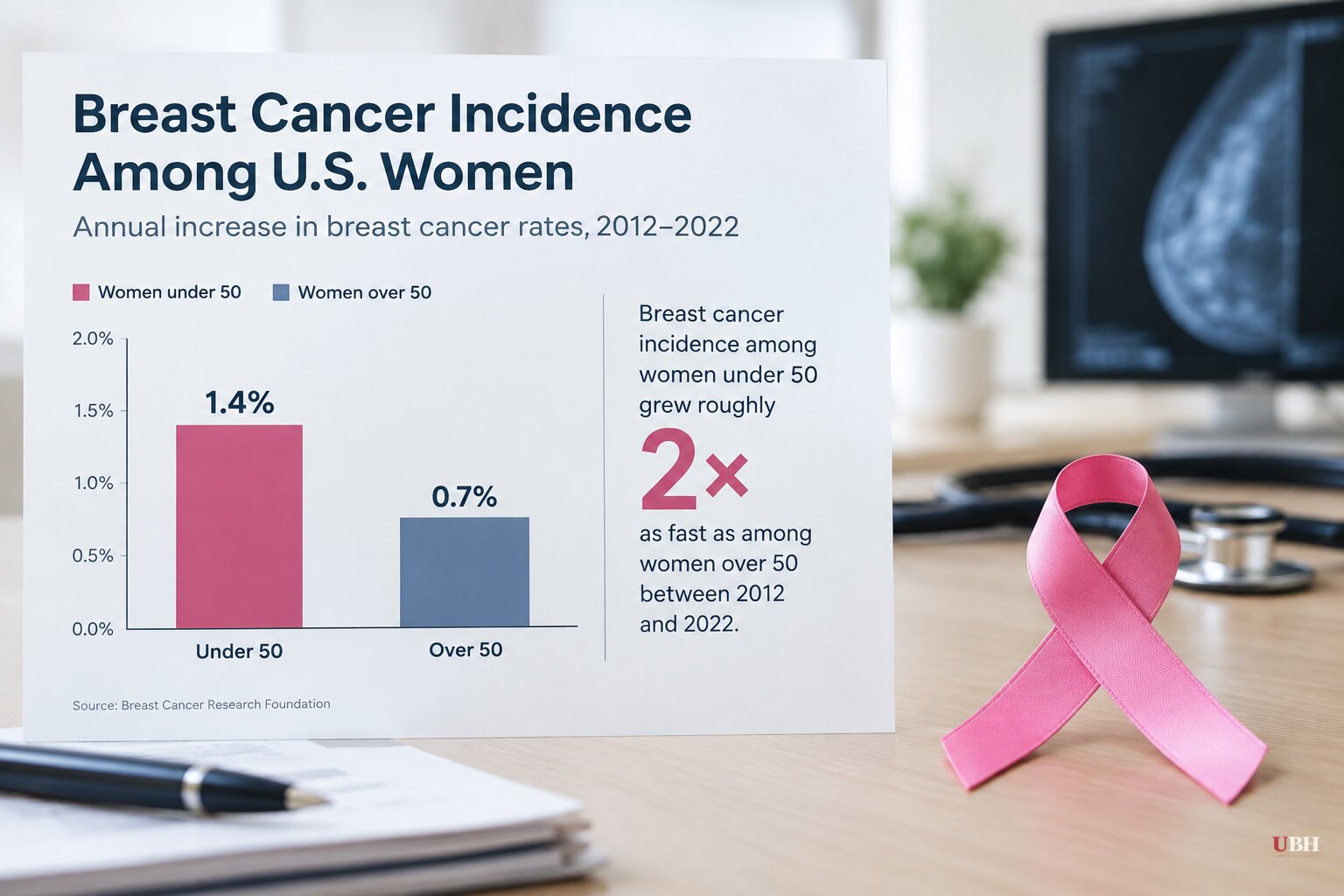
Breast Cancer Rates in Women Under 50 Rose About 1.4% a Year From 2012 to 2022, Double the Pace for Older Women
Breast cancer is still mostly a disease of older women. The median age at diagnosis is 63. But the trend line for younger women is moving the wrong way.
The Breast Cancer Research Foundation (BCRF) reports that incidence among women under 50 rose about 1.4% per year from 2012 to 2022. Among women over 50, the increase was about 0.7% per year. The foundation puts the 2023 rate for younger women at roughly 52 per 100,000. That is low in absolute terms, but the direction is what has researchers worried.
The American Cancer Society has reported that women under 50 now have an 82% higher cancer incidence rate than men the same age, a gap driven mainly by breast cancer, per BCRF. For women under 45, diagnoses rose 11% between 2012 and 2022.
Why younger patients face worse odds
BCRF says breast cancer is the leading cause of cancer death for women ages 20 to 49 in the U.S. The foundation also cites estimates that women under 40 are nearly 40% more likely to die of the disease than women over 40.
Part of the problem is timing. Most women under 40 are not in routine screening. BCRF says nearly 80% of younger women who are diagnosed find the abnormality themselves.
The organizations behind a new research initiative say cancer in younger women is more likely to be caught at a later stage and to behave aggressively.
A lump is not a diagnosis. BCRF notes that many breast lumps in younger women are benign, with cysts and fibroadenomas among the common causes. Its guidance is that any change that persists or cannot be explained should be checked by a provider, not watched and dismissed. Inflammatory breast cancer, the foundation adds, may show up as redness, warmth and swelling rather than a distinct lump.
What researchers think is driving it
Nobody has a settled answer. BCRF describes the causes as complex, multifactorial and not fully understood.
Andrew Huang, MD, a radiation oncologist at Aspirus Cancer Care and senior principal investigator at the Aspirus Oncology Research Institute, points to obesity and changes in reproductive patterns as leading contributors. Fat tissue produces estrogen, he said, and many breast cancers use estrogen to grow. He also said childhood obesity can trigger early puberty, which raises risk.
Women are also having children later, having fewer of them, and breastfeeding for shorter periods. Huang said childbirth and breastfeeding can protect against breast cancer.
Elly Peters, a breast care nurse navigator with CommonSpirit Health, made a similar point about estrogen exposure across the reproductive cycle. She cited CDC data showing obesity prevalence of 40.3% among U.S. adults in August 2021 to 2023.
Other factors under investigation include increased alcohol use, environmental exposures and sleep disruption from shift work. BCRF lists genetics among them as well.
Huang said the rise is not mainly an inherited-mutation story. The prevalence of BRCA1 and BRCA2 mutations has stayed relatively stable. Much of the increase is in estrogen receptor-positive cancers, which respond to hormonal signals.
Family history still matters. Huang and Peters both say women with multiple affected relatives, especially relatives diagnosed young, should talk to a provider about it. Peters said anyone with a relative who had breast or ovarian cancer should be tested earlier than the typical mammogram age. Huang noted that genetic testing is now more available and affordable.
Money and screening
On Sept. 23, The Estée Lauder Companies announced a five-year, $15 million global research program with BCRF focused on cancer in younger women. The organizations say only a tiny fraction of breast cancer research funding in recent years has targeted this age group. The program is meant to link scientists studying why it develops and how to detect, prevent and treat it.
William P. Lauder, chair of the Estée Lauder board and cochair of BCRF, called it a continuation of his mother Evelyn Lauder's work. She founded BCRF in 1993.
On screening, the guidance in these accounts is individualized. Typical mammography starts in the 40s and 50s. Huang said screening can begin as early as 40 depending on risk and family history. Peters said women who know they carry risk factors should get checked earlier.
Both stress the practical point: report changes. A CBS News segment this week profiled a young woman who nearly skipped getting a symptom checked because she assumed she was too young. Peters urged women to advocate for themselves, noting that providers see many patients a day and can make mistakes.
What comes next
The open question is the one researchers keep returning to: which of the suspected factors, alone or in combination, is actually pushing diagnoses up in women under 50. The five-year Estée Lauder and BCRF program is the newest funded effort aimed at that question. No results have been announced.
Sources used for this briefing
6 links from 6 independent newsrooms (syndicated copies of the same report count once)
These are the sources it draws on, linked so you can verify.


