
Unbiased headlines. Facts, not spin.
Unbiased Headlines is an independently owned news organization. We bring you the facts, not opinions, written fresh from 110+ named sources. Sources linked so you can verify it yourself.
 health
Major Story (8/10)
Event date: October 20, 2026 ·
U.S. Measles Cases Reach 4,588, Pennsylvania Outbreak Tops 1,280 With Five Deaths Confirmed
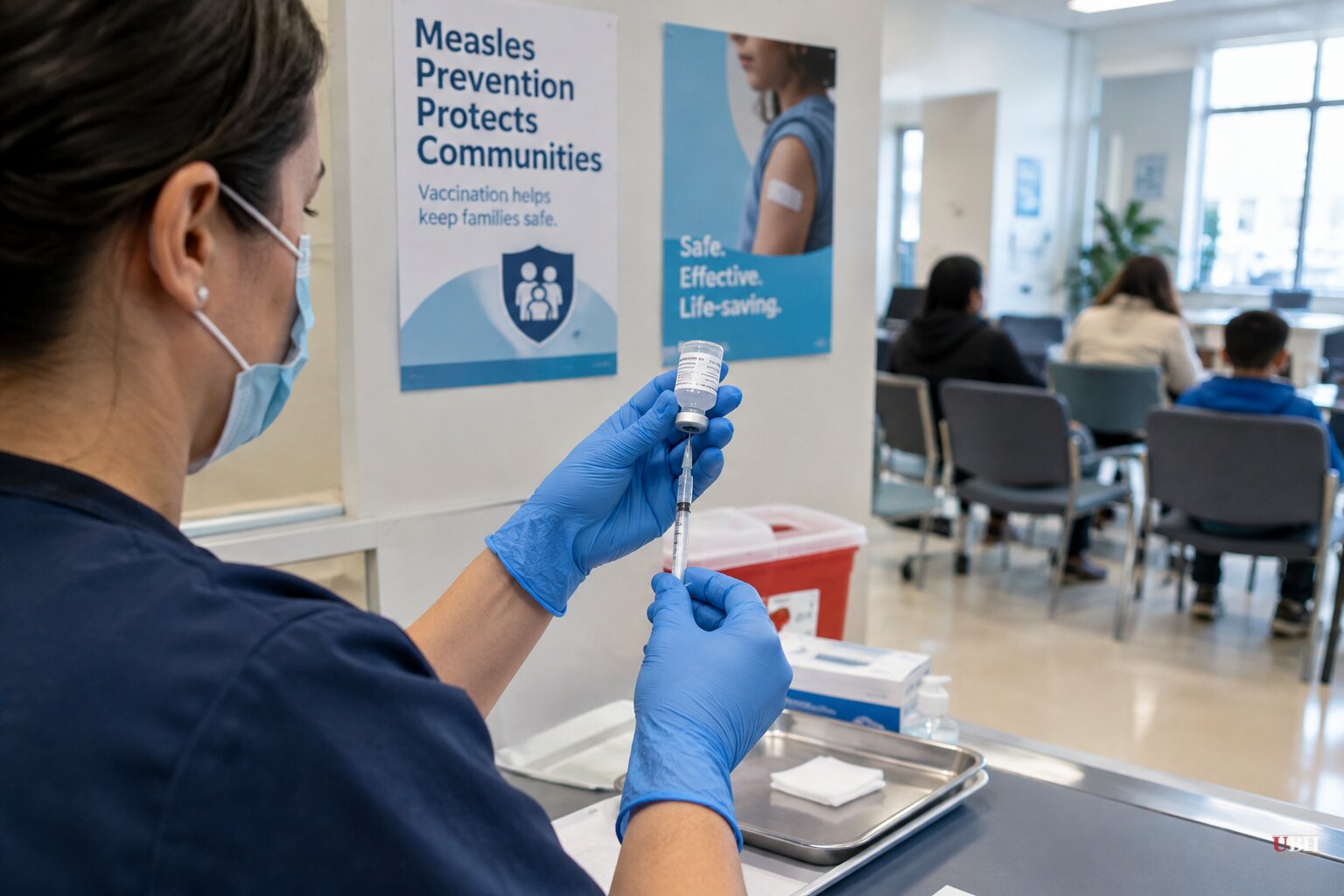
The United States is on pace for its worst measles year in more than three decades. As of Oct. 22, the CDC reported 4,588 cases, up from 2,289 in all of 2025. About 96% of this year's cases are in people who were unvaccinated or whose status is unknown.
The CDC counts three measles deaths nationally. Pennsylvania alone has confirmed five, with a sixth under review. The gap between the federal and state figures has not been explained.
Pennsylvania's outbreak
The state outbreak began in April and has become the largest in the country this year. Pennsylvania's Department of Health counted 1,286 confirmed cases across 42 counties as of its Oct. 19 update, with 26 new cases since Oct. 16. Other tallies put the total near 1,300.
Hospitalizations reached 247. Only four cases involve vaccinated people, fewer than 1%.
The state recorded 16 cases in all of 2025. In January, it had 12. Patsy Stinchfield of the National Foundation for Infectious Diseases' Measles Collaborative says the state now sees more than 100 cases a week.
Lancaster County is the center, with 443 cases at the last county breakdown. Mifflin County had 183 and Chester County 90.
Gov. Josh Shapiro announced the state's first two measles deaths in 35 years on Aug. 25 at Penn Medicine Lancaster General Hospital. Both victims were infants.
A higher death rate than history predicts
Historically, 1 to 3 of every 1,000 unvaccinated people who catch measles die. Five deaths among roughly 1,300 reported cases puts Pennsylvania well above that range, by CNN's calculation at least 1.5 times higher and possibly five times.
Dr. Matthew Ferrari, director of Penn State's Center for Infectious Disease Dynamics, says the virus itself has not changed. "There clearly is a shift — not in the biology but a shift in the epidemiology that we're seeing here in Pennsylvania," he said.
Undercounting is likely. Dr. Remy Pasco of the University of Colorado Boulder says U.S. measles data is outdated and any estimate comes "with a big grain of salt." He points to higher-than-expected hospitalization rates in this outbreak and to the way the Amish and broader Plain community interacts with the health care system.
The CDC sent an Epi-Aid "disease detective" to Pennsylvania, who arrived Oct. 19, according to the state. The officer will model the outbreak's trajectory and evaluate local vaccination efforts.
Babies lose protection early
A retrospective analysis presented at the IDWeek meeting by Dr. Buddy Creech of Vanderbilt University found that infants' maternal measles antibodies fade fast. They begin dropping below their mothers' levels by 2 months. By 6 months, median levels fell below 120 mIU/mL, the study's protection threshold, for all three measles strains tested.
At 6 months, only 8.7% of infants were seropositive for the Edmonston strain, 19.6% for Maryland.USA/18.18 and 17.4% for Missouri.USA/15.18.
"Infants are going to be susceptible to measles virus infection sooner than maybe we previously thought," Creech said.
He did not call for an immediate schedule change. He said the effect of vaccinating at 9 or 10 months "should be evaluated in a well-powered clinical study." At minimum, he said, doctors will have to consider vaccinating in the 12-to-15-month window and possibly accelerating the second dose.
There is a tradeoff. Pennsylvania health officials say infants respond less strongly to the vaccine, and early-dose babies still need two more doses after their first birthday. Maternal antibodies can also blunt the shot's effect, which is why the early dose is not given before 6 months.
What families are doing now
Pennsylvania recommends an early "zero dose" of MMR from 6 months for babies in outbreak areas. The health department says at least 14,954 Pennsylvania children under 1 have received one in 2026.
Laura Esch of eastern Lancaster County told CIDRAP News she has kept her 5-month-old daughter out of indoor public spaces and booked the early dose for the week after the child turns 6 months.
For pregnant women, who cannot receive the vaccine, the state issued a health alert Oct. 19. Non-immune pregnant women exposed to measles can receive immunoglobulin within six days of exposure. Symptoms usually appear 7 to 21 days after exposure, long after that window closes. The same option applies to exposed babies.
Adults unsure of their status have options too. People born before 1957 are presumed immune, according to Dr. Larry Kociolek of Lurie Children's Hospital in Chicago. People vaccinated before 1968 may have received an early, less effective inactivated-virus vaccine and may need another dose. Two doses of MMR are 97% effective.
Federal policy cuts the other way
The American Academy of Pediatrics recommends the first MMR dose at 12 to 15 months and the second at 4 to 6 years. CDC guidance mirrors that, but the agency changed course on the first dose and now recommends separate MMR and varicella shots rather than the combined version.
The Trump administration has also proposed splitting the MMR vaccine into individual shots and spacing them out where possible. MedPage Today reports that Health Secretary Robert F. Kennedy Jr. and other administration officials have continued to raise vaccine safety concerns, which that outlet calls disproven. Pediatric infectious disease physician Dr. Adam Ratner says the measles vaccine "is safe. It's highly effective, and it confers lifelong immunity."
Splitting the shot would mean more injections and a longer stretch with children only partly protected. That gap would open during the worst measles year since 1991. The administration's proposal is not yet in effect.
Open questions
Community immunity needs roughly 95% vaccination, according to a Philadelphia-area physician writing in the Inquirer. In 2025, almost 250 kindergartens in the Philadelphia area fell below that line, and one was under 80%.
The CDC investigator's modeling, due from Pennsylvania's outbreak response, will give the first estimate of how many infections are going uncounted. Creech's call for a trial of 9-to-10-month dosing has no study scheduled.
Sources used for this briefing
6 links from 6 independent newsrooms (syndicated copies of the same report count once)
These are the sources it draws on, linked so you can verify.


