
Unbiased headlines. Facts, not spin.
Unbiased Headlines is an independently owned news organization. We bring you the facts, not opinions, written fresh from 110+ named sources. Sources linked so you can verify it yourself.
 health
Notable (6/10)
Event date: October 21, 2026 ·
U.S. Fertility Rate Falls to Record Low of 53.2 Births Per 1,000 Women in 2025, CDC Says
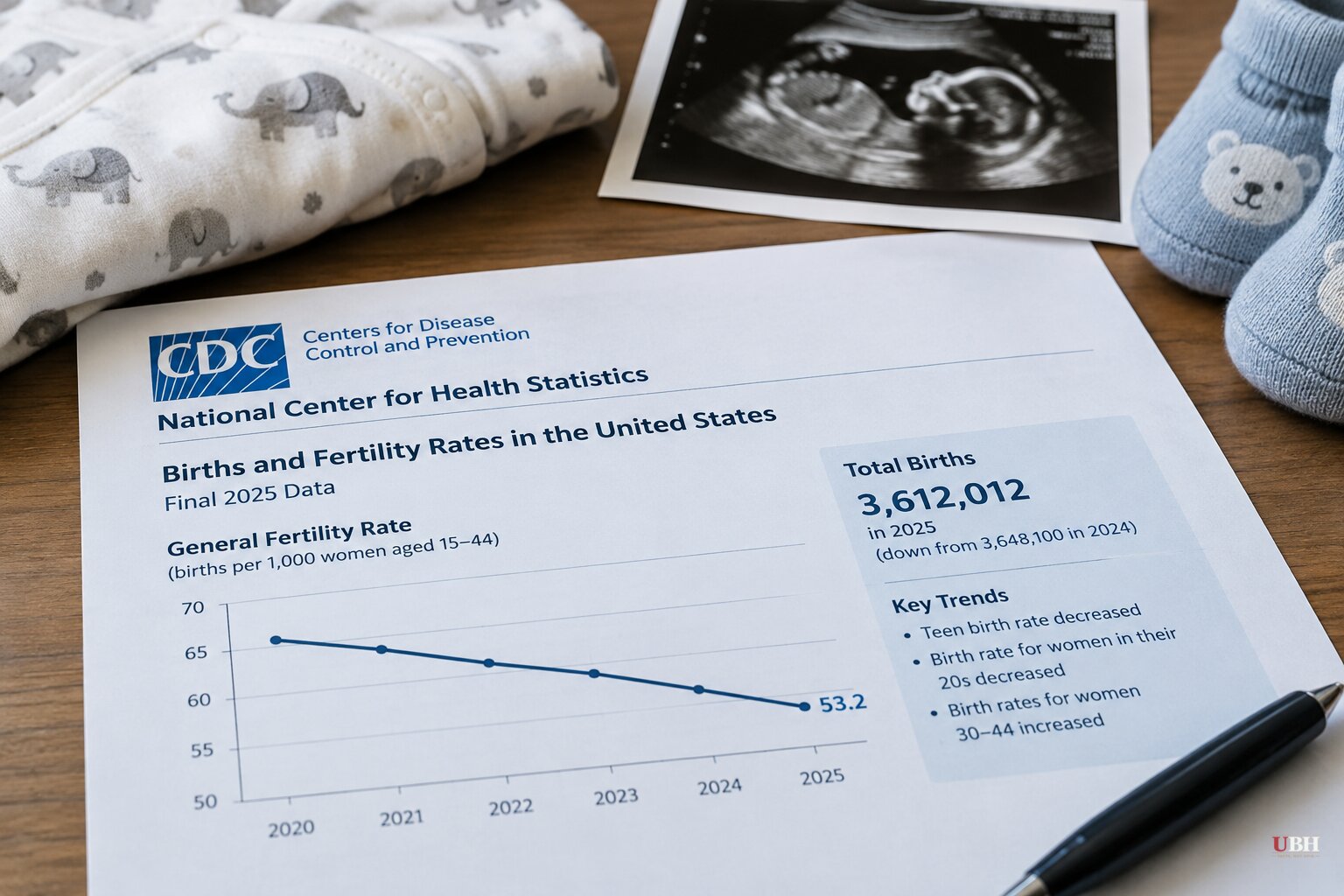
The U.S. general fertility rate hit another record low in 2025. The Centers for Disease Control and Prevention released the final birth data Wednesday, Oct. 21.
The rate was 53.2 births per 1,000 women ages 15 to 44, down 1% from 53.8 in 2024. A century ago, in 1925, it was 106.6, double today's figure.
Total births came in at 3,612,012, compared with 3,628,934 the year before, a decline of less than 1 percent.
Who is having fewer babies, and who is having more
The decline is concentrated among younger women, according to the CDC:
- Ages 10 to 14: from 0.2 to 0.1 births per 1,000.
- Ages 15 to 19: down 7%, from 12.6 to 11.7, a record low.
- Ages 20 to 24: down 6%, from 55.8 to 52.3.
- Ages 25 to 29: down 4%, from 89.5 to 85.7.
Older age groups moved the other way. Rates rose 3% for women 30 to 34, 2% for women 35 to 39 and 1% for women 40 to 44. The rate for women 45 to 49 was unchanged.
The gains among women in their 30s and 40s did not offset the losses among younger women. The average woman today has fewer than two children, well below replacement level.
Teen births and the policy debate
Not everyone reads the numbers as a problem. Sarah Hayford, director of the Institute for Population Research at Ohio State University, pointed to the teen decline. "That's been an explicit goal of US public health policy for three decades, to reduce teen birth rates," she said. "So that's a policy success."
Karen Benjamin Guzzo, director of the Carolina Population Center at the University of North Carolina at Chapel Hill, told NBC News that "people are able to avoid having kids at points in their life when they don't feel it's the right time." Demographers cite better contraception, including wider IUD access, and women waiting for financial, educational or career footing before starting a family.
Pro-natalist advocates and some conservatives see it differently. They warn of long-term economic and national-security risks and call for a new "baby boom," a goal President Donald Trump has voiced, including in a speech to the Conservative Political Action Conference. Elon Musk has said falling fertility could mean the "end of civilization." The New York Times reported last year that the administration was weighing a $5,000 "baby bonus" for new mothers.
Money and the mood
A new national survey adds an economic angle. The SSRS Economic Attitudes Tracker, released Thursday, Oct. 22, found that 63% of Americans consider the current economy a bad time to have a child, up from 59% in August 2025. Only 16% said it is a good time, and 21% were unsure.
The numbers run higher among the young: 71% of Gen Z adults and 70% of millennials said it is a bad time.
Four in five respondents said they are at least moderately worried about rising living costs, including 41% who are very worried. Sixty-four percent rated the national economy as bad or very bad, up 7 points from June and 11 points from October 2025.
The poll surveyed 1,033 adults Oct. 1 to 4, with a margin of error of plus or minus 3.4 points. It asked whether people think now is a good time to have children, not whether they personally plan to.
A Pew Research Center study from July 2024 looked at adults under 50 who said they are unlikely ever to have kids. Among them, 57% said they simply do not want children, 44% wanted to focus on other priorities such as career and personal interests, and 38% cited concern about the state of the world. Thirty-six percent named affordability as a major reason.
What the projections say
The Census Bureau's 2023 national projections show how much is at stake. Under one scenario, deaths begin to exceed births by 2038. The population in that projection reaches about 370 million in 2080 and then slips to 366 million by 2100.
The Bureau says that path could change with future immigration, fertility and life expectancy, and that international migration is expected to become the main source of population growth as the country ages.
Pro-natalists want incentives such as the reported baby bonus, while demographers say much of the recent drop reflects choices and tools women now have.
Sources used for this briefing
6 links from 6 independent newsrooms (syndicated copies of the same report count once)
These are the sources it draws on, linked so you can verify.


