
Unbiased headlines. Facts, not spin.
Unbiased Headlines is an independently owned news organization. We bring you the facts, not opinions, written fresh from 110+ named sources. Sources linked so you can verify it yourself.
 health
Major Story (7/10)
Event date: October 22, 2026 ·
Flu Hospital Admissions Reach 4,811 in Week Ending Oct. 17 as H1N1 Dominates Early Season
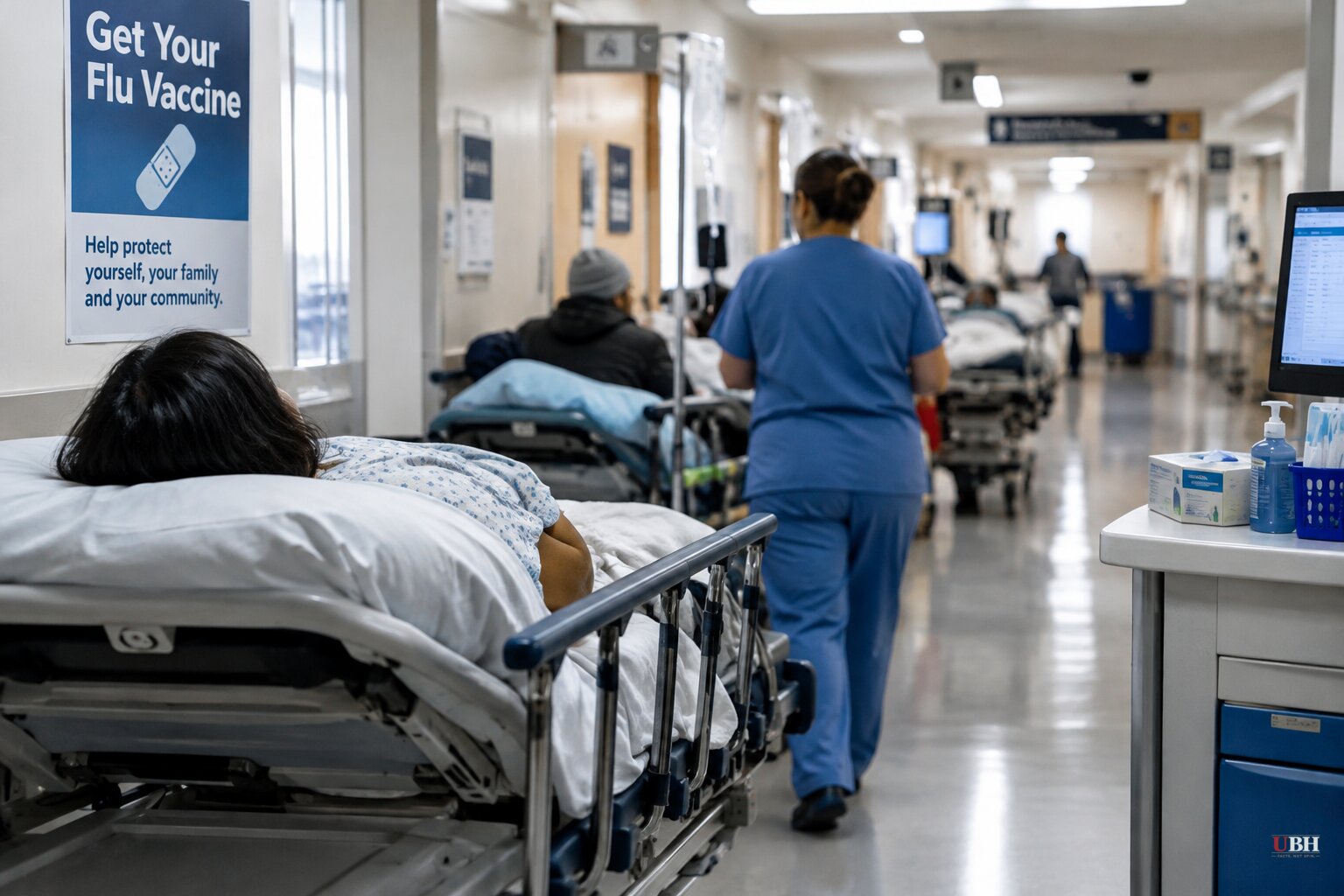
Since flu activity started rising in early September, the numbers have kept climbing. The CDC reported 4,811 laboratory-confirmed flu hospital admissions nationwide for the week ending Oct. 17. Its surveillance network recorded the highest hospitalization rate for this point in the season since 2010-11.
"Early-season influenza activity is currently higher than typically observed at this time of year," the CDC said in its weekly surveillance report.
How early is early
The CDC's Oct. 9 FluView report put national test positivity at 3.6%. A year earlier it was 0.6%. That is a sixfold jump.
The region covering Arizona, California, Hawaii and Nevada hit 9.5% positivity in that report. By last week, at least 10% of flu tests there were coming back positive.
In Washington state, roughly 1 in 10 people tested last week had the flu, according to the state health department. "We're basically seeing January levels of flu in the last week," said Dr. Alex Greninger, head of infectious disease diagnostics at the University of Washington's Department of Laboratory Medicine.
Walgreens said this week that flu activity is tracking about four weeks ahead of recent seasons, based on its testing, prescription and retail sales data. The chain says it is dispensing more antiviral prescriptions and cough and cold medications than at this point last year.
Ryan Maves, an infectious-disease professor at Wake Forest School of Medicine, said test positivity by late September was about eight times higher than at the same point last year.
An unusual map
The flu usually arrives in the South first, often Florida, and spreads north. This year the West Coast went first.
Johns Hopkins epidemiologist Caitlin Rivers said the pattern is now moving east. "All regions of the country are seeing increases at this point," she said.
The national picture is still mixed. About 2.1% of doctor visits last week were for influenza-like illness, which remains below the national baseline. In the CDC's week ending Oct. 17 map, Louisiana and Hawaii showed "moderate" levels of illness. Florida, South Carolina, West Virginia, Oregon and Washington were "low." Every other state was "minimal."
The virus behind it
Nearly everything being identified is H1N1. In the week ending Oct. 17, 239 of 241 influenza A samples the CDC analyzed were H1N1. The CDC says it is not a newly emerged strain but a descendant of the virus behind the 2009 swine flu pandemic. The agency is not detecting H3N2 subclade K, the so-called super flu that surfaced last year.
The H1N1 viruses have picked up a mutation, G155E, on the surface protein. Dr. Peter Chin-Hong, an infectious-disease specialist at UCSF, said it makes it harder for antibodies to recognize the virus. People with immunity from last season or from vaccination may not recognize it as well, he said. Greninger called the mutation the best explanation for the early season, and NPR reported the variant appears especially good at evading immunity among teenagers.
Dr. Thomas Russo of SUNY Buffalo's Jacobs School of Medicine said a flu wave in Japan tied to G155E may help explain why the West was hit first. "Geographically, moving eastward from Japan, the western U.S. is the first stop," he said.
Chin-Hong drew a line on severity. The change looks like an immune-evasion advantage rather than a "super flu," he said, and "there is no evidence so far that people are getting more seriously ill than usual." Health officials say it is too early to tell whether the season will end up worse than recent years.
Get the shot, and when
Experts are pushing the timing up. Dr. Amesh Adalja, a senior scholar at the Johns Hopkins Center for Health Security, said the vaccine's main value is preventing severe disease, including hospitalization. "People should get vaccinated ASAP," he said.
Scott Hensley, a University of Pennsylvania virologist, said this might be a year to get vaccinated early. In a Washington Post opinion newsletter, the author wrote that the ideal time is typically the end of October, but that she moved up her own flu shot appointment.
The vaccination push is coming from outside the federal government. NPR reported that the CDC has not been promoting flu shots as it usually does. The agency is overseen by Health Secretary Robert F. Kennedy Jr., a longtime vaccine skeptic. Newsweek reached out to the CDC by email on Saturday seeking comment.
The vaccine is a personal and family medical decision, and the doctors quoted here are making a case on cost-benefit grounds, not a mandate. The shot targets severe illness, and hospital admissions are the number rising fastest.
It is not yet clear where the season is headed. Rivers said flu activity is still very low in most of the country, and the CDC says it is too early to know how the season will unfold. The next several weeks of surveillance data will show whether the eastward spread is accelerating and whether the 2.1% outpatient figure crosses the national baseline.
Sources used for this briefing
7 links from 6 independent newsrooms (syndicated copies of the same report count once)
These are the sources it draws on, linked so you can verify.


