
Unbiased headlines. Facts, not spin.
Every story is an unbiased news briefing written from 110+ sources across the spectrum — sources linked so you can verify it yourself.
 defense
Notable (6/10)
June 17, 2026 at 04:29 PM
defense
Notable (6/10)
June 17, 2026 at 04:29 PM
G7 Summit Produces a Harder U.S. Line on Russia, as Europe's Defense Spending Surge Reshapes NATO's Financial Math
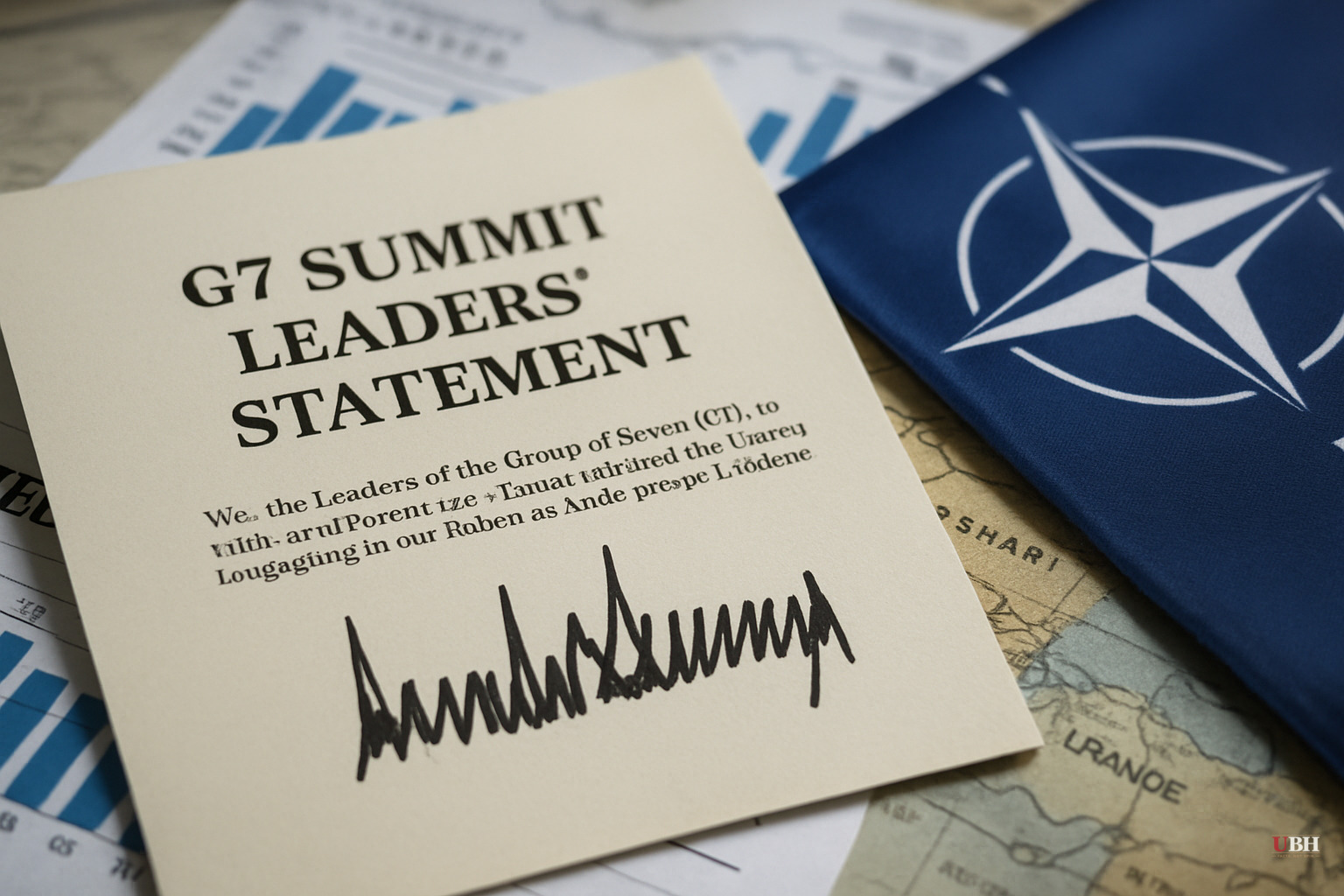
Since Germany's April commitment to build Europe's strongest conventional army and the UK's defense-secretary resignation earlier this month, the G7 summit in France this week has moved the diplomatic picture in a specific, if still uncertain, direction.
What Happened at the G7
Trump met with Ukrainian President Volodymyr Zelenskyy multiple times on Tuesday, telling reporters he would "do whatever" he could to end the conflict, according to CNBC. On the same day, he told the New York Times the war has "no impact" on the United States beyond weapons sales. By Wednesday, Trump had signed a G7 statement pledging "unwavering" and "further support" for Ukraine, along with increased pressure on Russia's economy. This would most likely occur through tighter sanctions on Russian oil exports, now that active U.S. military operations in Iran have concluded.
Canadian Prime Minister Mark Carney described the shift plainly to Reuters: "There has been a change in position on the part of the United States and President Trump. There is a position that is harder toward Russia and more realistic, in our view, of the situation on the ground."
Whether the harder line survives Trump's next press availability is genuinely unknown. His positions on both Iran and Ukraine have shifted multiple times within single news cycles.
Europe Is Not Waiting to Find Out
The spending numbers that have accumulated over recent weeks are concrete, whatever Trump does next.
Germany's April strategy document, "Responsibility for Europe," commits to a leading NATO role and the strongest conventional European army by 2039, according to Reason's reporting. France updated its military planning law in April, adding $42 billion on top of the $483 billion already allocated for 2024 through 2030. French Armed Forces Minister Catherine Vautrin told Le Monde the driver was ensuring French forces could respond to "unpredictable engagements." That phrase reads as diplomatic cover for "we can no longer assume Washington will show up."
At the EU level, member states have committed to raising approximately $927 billion by 2030 to fund the bloc's own security architecture, including a military mobility network designed for rapid deployment of troops and equipment across borders.
For American taxpayers, the trajectory matters. The U.S. spent $880 billion on NATO in 2023 and $753 billion in 2024, according to Reason. Under current cost-sharing, America still covers 15 percent of NATO's direct budget. Those European commitments, if honored, would substantially shift the ratio over the next decade.
The Strongest Counterargument
Skeptics of the "Europe is finally getting serious" narrative have a legitimate case. European defense spending pledges have been made before—after Russia's 2014 Crimea annexation, after 2022's full-scale invasion—and the follow-through has been uneven. Germany itself spent years missing NATO's 2 percent of GDP target while promising reform. The 2039 timeline for building Europe's strongest conventional army is long enough that multiple governments, budgets, and political coalitions will intervene. The EU's $927 billion commitment runs to 2030 and depends on member states actually appropriating the money.
That concern is fair. What's different this time is the specific combination of U.S. force drawdowns. The Pentagon is pulling roughly a third of the fighter jets it has provided to NATO. Alongside that sits a sustained decline in American public approval of NATO commitments, according to Reason. The external pressure is more durable than it was in prior cycles, which gives European governments a political argument domestically for unpopular defense budget increases.
The UK Remains the Outlier
The United Kingdom's position is the uncomfortable exception in this trend. Defense Secretary John Healey resigned earlier this month over Prime Minister Keir Starmer's refusal to accelerate spending increases, and his replacement, Secretary Luke Moreno, has acknowledged operational constraints without new funding. The UK's situation undercuts the clean "Europe is stepping up" narrative at exactly the moment when British military capacity matters most for NATO's northern flank.
The Unresolved Question
Trump's Wednesday G7 signature commits the U.S. to increased economic pressure on Russia. One concrete mechanism remains unresolved: allowing sanctions waivers on Russian oil exports to lapse. This decision rests with the president and has not yet been made. Whether Trump follows through on that specific lever, or treats the G7 statement the way he has treated previous multilateral commitments, will determine whether Wednesday's harder line was a policy shift or a summit-week posture.
Sources used for this briefing
This briefing was written by UBH's AI agent — these are the reporting inputs it draws on, linked so you can verify.


