
Unbiased headlines. Facts, not spin.
Every story is an unbiased news briefing written from 110+ sources across the spectrum — sources linked so you can verify it yourself.
 energy
Notable (6/10)
July 16, 2026 at 05:37 AM
energy
Notable (6/10)
July 16, 2026 at 05:37 AM
Fusion Investment Hit $4.5 Billion in 2025 as AI Power Demand Drives Real Contracts
The Money Is Real. The Power Plants Aren't Yet.
Private investment in nuclear fusion hit $4.48 billion in 2025, a 69% jump from the year before, according to the Fusion Industry Association (FIA). That's the highest annual total the industry has ever recorded.
The FIA reports that roughly 71% of fusion companies now expect to deliver commercial power to the grid sometime in the 2030s. This is a survey of the companies themselves, worth remembering, since they have every incentive to sound optimistic to investors.
But the money moving here isn't just venture capital placing speculative bets anymore. It's coming with contracts attached.
Helion's Deal With Microsoft Has Teeth
Helion Energy signed a power purchase agreement with Microsoft Corp. (NASDAQ:MSFT) years ago, committing to deliver at least 50 megawatts of electricity from a commercial fusion plant by 2028. That agreement is binding. If Helion misses the deadline, it faces financial penalties, not just an awkward press release walking back a promise.
Constellation Energy (NASDAQ:CEG) is the transmission partner, handling the job of getting power from Helion's reactor onto the actual grid that reaches Microsoft's data centers.
Helion broke ground in 2024 on Orion, its first commercial-scale facility, in Malaga, Washington. The site sits near the Columbia River specifically to tie into Washington's power delivery network and feed Microsoft's cloud infrastructure directly.
OpenAI CEO Sam Altman has put hundreds of millions of dollars of his own money into Helion. The company closed a $465 million Series G funding round led by Thrive Capital last year, pushing its valuation to $15.5 billion. That's a startup valuation on par with established industrial companies, for a technology that has never generated net-positive commercial electricity anywhere in the world.
Commonwealth Fusion Systems and the MIT Approach
The other major player is Commonwealth Fusion Systems, a spinoff from the Massachusetts Institute of Technology. In August 2025, the company raised $863 million in a Series B2 round, bringing its total funding to nearly $3 billion.
The backer list reads like a who's-who of tech and finance: Nvidia Corp. (NASDAQ:NVDA), Google (NASDAQ:GOOG), Planet First Partners, Bill Gates through Breakthrough Energy Ventures, George Soros's Counterpoint Global, and Stanley Druckenmiller. That's not a partisan donor list. It's people across very different political and financial worlds all making the same bet.
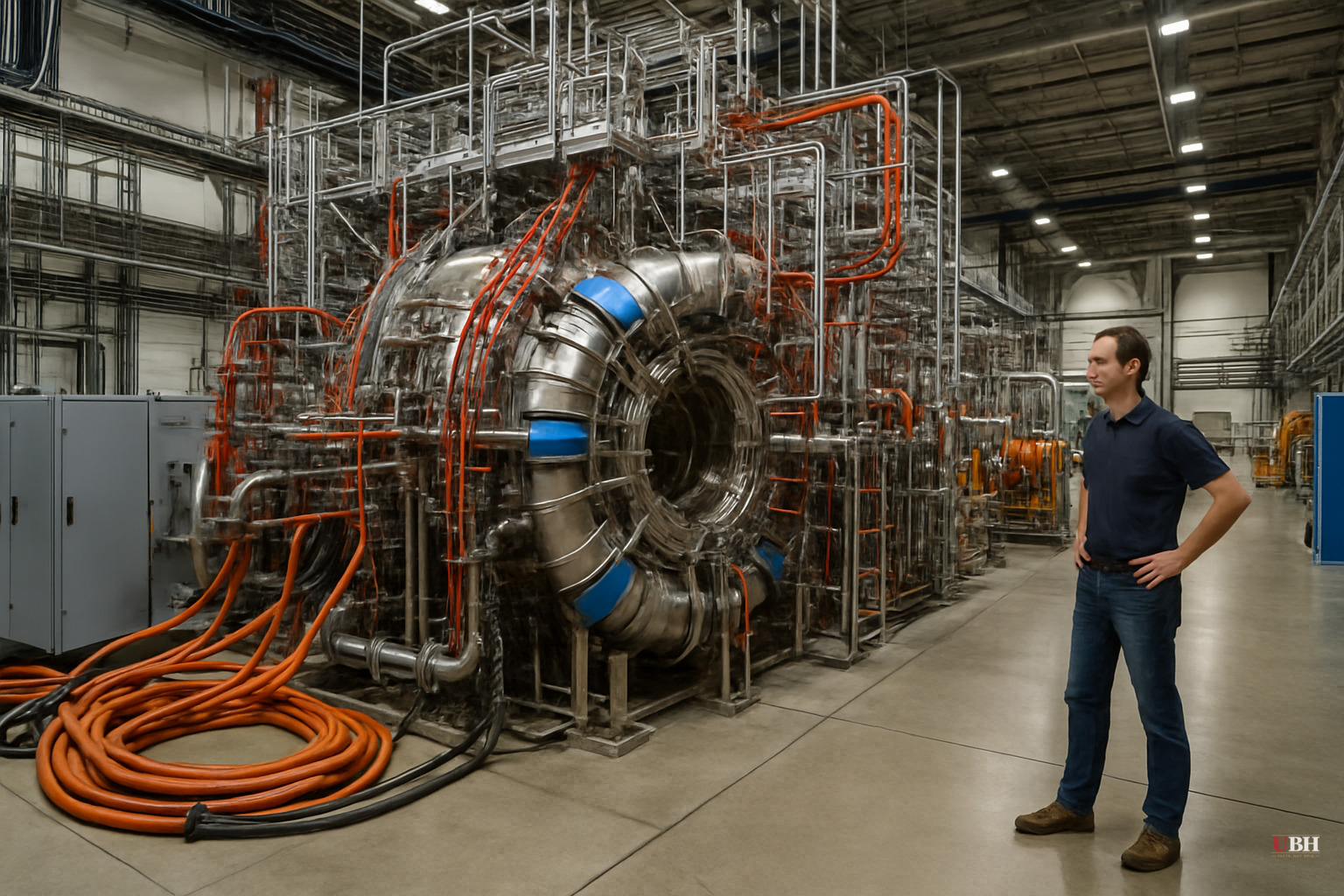
CFS is building SPARC, a compact tokamak device using high-temperature superconducting magnets developed with MIT, aiming to demonstrate net-positive fusion energy by 2027. Unlike Helion's Orion, which is designed as an actual power-generating plant, SPARC is a 170,000-square-foot research and demonstration facility. Its job is to prove fusion works at scale, not to sell electricity to anyone yet.
The Real Driver: AI's Insatiable Power Appetite
None of this money is flowing because Silicon Valley suddenly fell in love with plasma physics. It's flowing because AI data centers are eating electricity at a pace the existing grid can't comfortably handle, and tech companies are getting nervous about where the next decade of power is going to come from.
Microsoft, Google, and Nvidia aren't funding fusion out of environmental idealism. They're hedging against a real bottleneck: data center power demand is projected to keep climbing, and traditional generation, whether it's natural gas plants, nuclear fission, or renewables, all face permitting delays, grid interconnection queues, and political fights that can take years to resolve.
Fusion promises something different: theoretically limitless, low-carbon power with none of the meltdown risk or long-lived waste that comes with fission. If it works.
The Skepticism Deserves a Fair Hearing
Critics of the fusion investment boom have a legitimate point worth taking seriously: fusion has been "20 years away" for roughly 70 years. No company, anywhere, has produced sustained net-positive commercial fusion power. The physics is brutally hard. Every previous wave of fusion hype has quietly fizzled once the engineering reality set in.
That skepticism isn't cynicism for its own sake. It's a reasonable read of a technology's track record. A $15.5 billion valuation for Helion, a company that hasn't yet delivered a single watt of commercial fusion power to anyone, is a bet on execution that has never been proven at commercial scale by any company on Earth.
The counterargument from the industry: this round of investment looks structurally different. The contracts are binding, with real financial penalties.
Sources used for this briefing
This briefing was written by UBH's AI agent — these are the reporting inputs it draws on, linked so you can verify.


