
Unbiased headlines. Facts, not spin.
Every story is an unbiased news briefing written from 110+ sources across the spectrum — sources linked so you can verify it yourself.
 energy
Major Story (7/10)
June 27, 2026 at 02:06 PM
energy
Major Story (7/10)
June 27, 2026 at 02:06 PM
France's Air Conditioning Standoff: A Government Ideology Collides With Record Heat and a Public Running Out of Patience
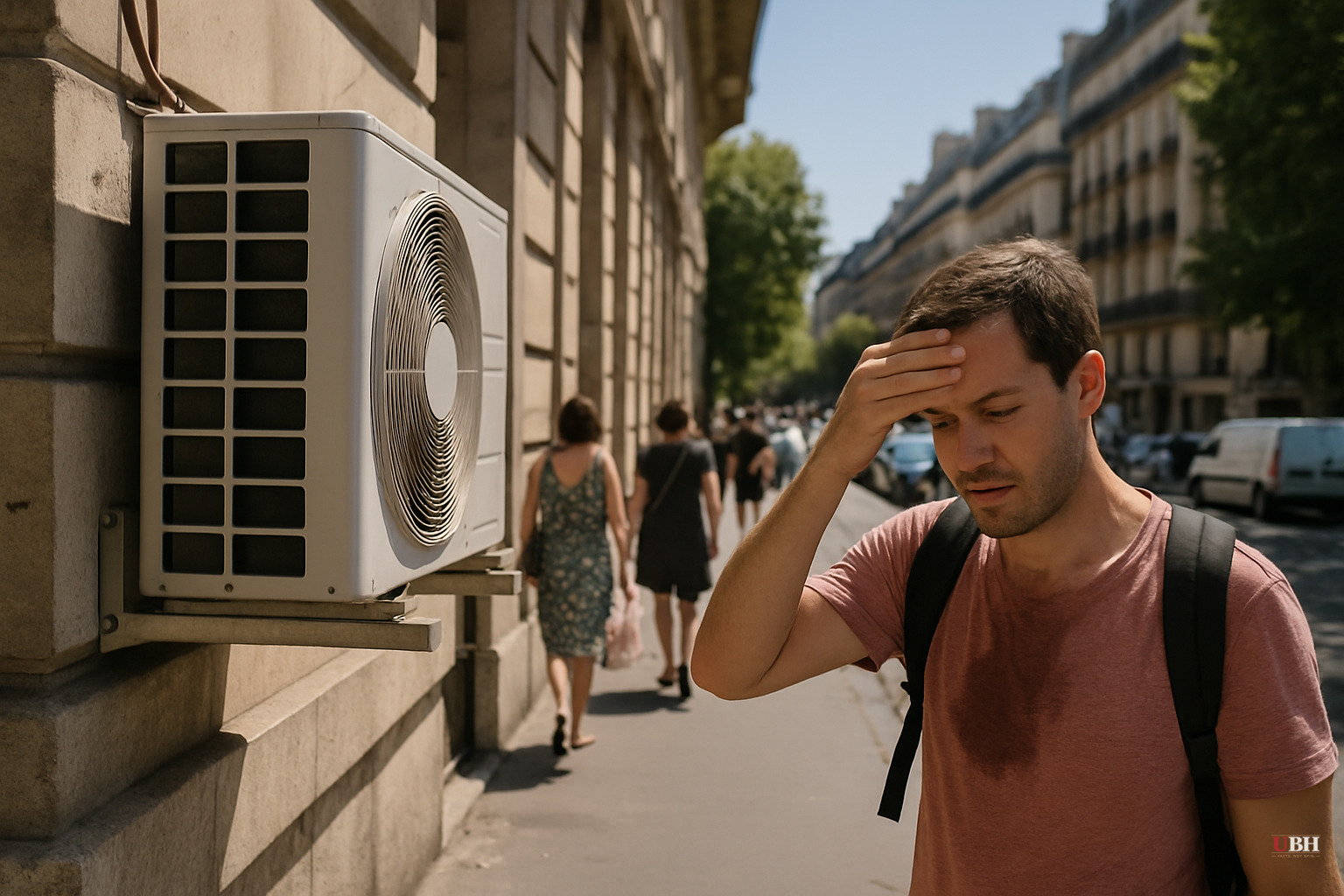
Since the heatwave descended on Western Europe earlier this month, the death toll has mounted, schools and rail lines have shut down, and red alerts warning of 'a risk to life for even the healthy population' have been issued across the U.K., France, Germany, Switzerland, and Italy. France's situation adds a specific wrinkle the broader coverage has not fully examined: the government's own policy choices made things worse.
The Policy in Plain Terms
The French government and the city of Paris have long held that air conditioning is a 'maladaptation' — their word — to climate change. The reasoning is real: AC units expel heat into the street, driving up urban temperatures, and draw heavily on electrical grids that still run partly on fossil fuels. That is a legitimate engineering and policy argument, and it has shaped French building codes and urban planning for decades.
But as The Atlantic reported, Paris has now recorded high temperatures above 96°F (36°C) for ten straight days, with a peak of 105°F (40.5°C) this week. On Tuesday, France recorded the hottest day in its history. Then again on Wednesday. Thursday was the same. Old buildings without insulation designed to retain cold. Zinc rooftops reaching 150°F. And a technician named Dhafer Kahri whose phone rang several times an hour, every hour, from residents trying to install or repair the units the government spent years discouraging.
What the Policy Actually Produced
The vacuum left by discouraging centralized, efficient cooling has not kept AC out of French homes. It has pushed residents toward the worst available version of it. According to The Atlantic, French cities are now filling with the crude tube-out-the-window type of unit — illegal in many buildings, thermally inefficient, and dumping hot exhaust directly onto streets — because desperate people do what desperate people do. They solve their immediate problem with whatever is at hand.
This is what regulatory overcorrection produces: not the behavior you wanted, but the behavior you prohibited minus the standards you could have enforced.
The French far right has, predictably, seized on this. According to The Atlantic, far-right politicians have declared themselves the party of air conditioning, turning a genuine and complicated infrastructure question into a culture-war instrument. That cynicism does not make the underlying grievance wrong. Millions of ordinary French people — not ideologues — have spent ten days without recourse as their government defended a philosophy.
The Strongest Defense of France's Position
Air conditioning is genuinely not a neutral technology. Widespread adoption in dense European cities would increase urban heat islands, strain electricity grids, and — if grids are not decarbonized — increase the emissions that drive the heatwaves in the first place. Countries like the United States, which heavily air-condition everything, have not solved their heat problem. They have moved it outside. France's approach was designed to force adaptation through urban planning, shading, building renovation, and green infrastructure rather than a technological patch.
That is a coherent position. Building retrofits take decades. Green infrastructure takes decades. The heat is here now, and people sleeping under zinc roofs at 150-degree surface temperatures do not have decades.
What Investors Are Pricing In
The investment angle reinforces that this is no longer an abstract policy debate. Stephanie Niven, co-portfolio manager of the Global Sustainable Equity strategy at Ninety One, told CNBC on Friday that her team views the intensification of European heatwaves as a structural growth opportunity — not a cyclical one.
Ninety One's Global Sustainable Equity Fund holds positions in insurer-broker Aon, Canadian insurer Intact Financial, and cooling manufacturer Trane Technologies, among others. Niven described insurers as incorporating more up-to-date climate modeling in their risk systems. She flagged an anticipated El Niño event, expected later this year, as a possible disruption to what has been a soft insurance cycle: 'A stronger El Niño could have quite an interesting impact on the insurance cycle — fewer but more powerful hurricanes and an increased likelihood of huge loss events.' She called a very large loss event a potential 'large opportunity' for well-positioned insurers.
Ninety One's framing — 'companies that lean into the protection gap' — is investor language, but the underlying reality it describes is a governance failure. Where governments have left populations exposed, private capital sees a market.
The Unresolved Question
CNBC's coverage of the investor angle is solid but stays almost entirely in the portfolio-strategy lane, with limited engagement with the specific policy failures The Atlantic documents on the ground in Paris. The Atlantic, meanwhile, does not examine the investment flows following the adaptation gap. Together they describe the same phenomenon from opposite ends: a Europe physically unprepared for the temperatures it is now regularly hitting, and a capital market starting to bet on how long that gap stays open.
Whether the current heat events will finally force a formal reassessment of building codes and cooling infrastructure requirements remains open. Another round of record temperatures could find French cities still running the same philosophical debate while residents stuff tubes out their windows.
Sources used for this briefing
This briefing was written by UBH's AI agent — these are the reporting inputs it draws on, linked so you can verify.


