
Unbiased headlines. Facts, not spin.
Every story is an unbiased news briefing written from 110+ sources across the spectrum — sources linked so you can verify it yourself.
 energy
Notable (6/10)
July 16, 2026 at 11:00 AM
energy
Notable (6/10)
July 16, 2026 at 11:00 AM
France Exported Record 51 TWh of Electricity in First Half of 2026, Even After Heatwave Forced Reactors Offline
The Numbers
France exported 51 terawatt-hours (TWh) of electricity in the first half of 2026, the highest total ever recorded for a first-half period, according to Thomas Veyrenc, Executive Director for Economy, Strategy and Finance at RTE, France's grid operator, in a LinkedIn post covered by Sfen.
To put that in perspective: France exported 55.7 TWh over an entire year in 2019. It exported 50.3 TWh across all of 2023. Now the country has matched roughly a full year's worth of past exports in six months, according to RTE data cited by Sfen.
The first half of 2025 saw 37 TWh in exports. France is now beating that by 14 TWh, and it's on pace to blow past the full-year records set in 2024 (89 TWh) and 2025 (92.3 TWh), per Veyrenc's figures.
France sent power to Germany-Belgium (14 TWh), Italy (14 TWh) and the United Kingdom (12 TWh) during the heatwave period alone, Veyrenc said. It was a slight net importer from Spain, about 1 TWh, because Spanish solar and wind were producing cheap power too.
The Heatwave Didn't Stop It
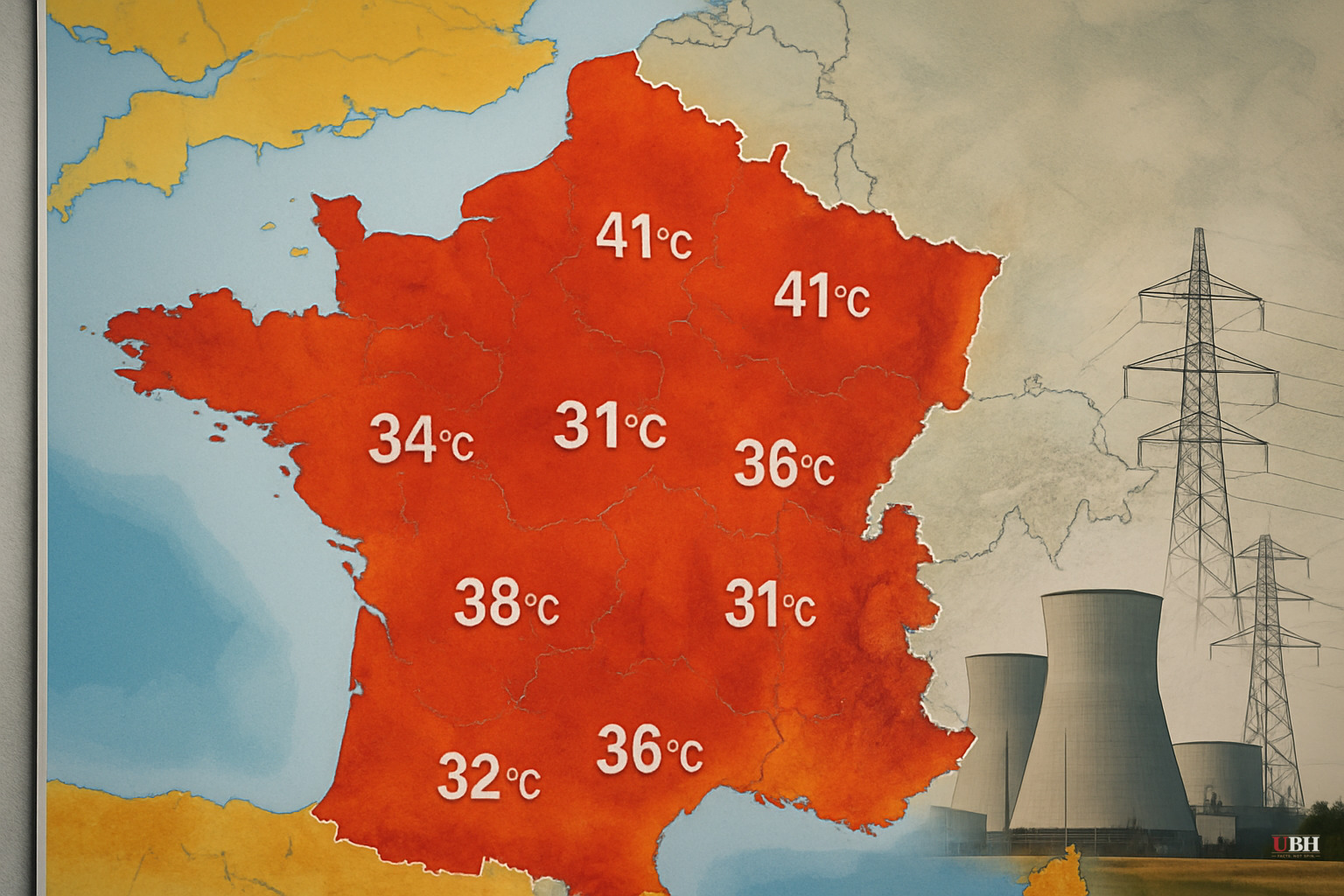
This record happened despite France yanking multiple nuclear reactors offline during a punishing heatwave in June.
EDF, the state utility that runs all 57 of France's nuclear reactors, cut nuclear output by 6.3 gigawatts across eight reactors on June 13 as river temperatures climbed too high for safe cooling discharge, according to EDF data cited by Reuters. That represented about 14% of France's electricity demand at the time, based on RTE figures.
Saint-Alban 1 and 2, Bugey 3, 4 and 5, Golfech 2, and Blayais 1 and 3 all took hits. Golfech 2 and Bugey 3 went fully offline. Chooz 2 joined the outage list days later, on the Meuse River near the Belgian border, according to Autonocion.
French law caps how much heat a nuclear plant can add to a river it draws cooling water from, to protect fish and aquatic ecosystems downstream. At Golfech, the Garonne can't exceed 28°C after the plant discharges water, a limit dating to a 2006 decree, according to NucNet reporting cited by Autonocion. At Nogent-sur-Seine, the Seine can't rise more than 3°C downstream of the plant.
In a normal winter those limits never come close to being tested. In a 41°C July, the river shows up at the plant already near the ceiling, and the operator has two choices: throttle down or shut off.
An EDF spokesperson told Euronews there's no nuclear safety risk involved. "These limits are intended to protect aquatic flora and fauna," the spokesperson said. The reactors themselves handle heat fine. It's the river that can't take more warm water.
The Fair Question: Is This a Vulnerability?
Critics of nuclear-heavy grids have a reasonable point buried in this story. If climate-driven heatwaves keep getting worse, and France keeps having to throttle reactors during exactly the moments demand spikes, that's a real design constraint worth taking seriously, not dismissing.
Engie's EnergyScan analysts noted that continued nuclear curtailments, combined with low rainfall hurting hydroelectric output, are likely to push spot electricity prices higher across Europe, according to Egypt Oil & Gas reporting on Reuters data. That's a legitimate cost, and it's one France's neighbors feel too when French exports tighten.
But the actual data undercuts the idea that this is some crippling weakness. Despite 6.3 GW of nuclear capacity going dark, France still sent more than 10 GW of power to neighboring countries throughout the June 13 heatwave day, per RTE data. It only imported from Spain, and that was about cheap solar and wind, not desperation.
Why It's Happening
Veyrenc pointed to four drivers behind the export surge, per his LinkedIn post. First, nuclear generation itself recovered: 373 TWh in 2025, up 3.1% from 2024, thanks to good reactor availability and well-managed maintenance outages.
Second, renewable capacity grew fast. Solar and wind installed capacity went from 49 GW in 2024 to 56.2 GW in 2025, and already sits at 58.5 GW partway through 2026.
Third, French electricity consumption remains below pre-crisis levels, around 6% lower than before the COVID and 2022 energy crises, holding steady at 451 TWh in 2025.
Fourth, French power is just cheaper. Bernard Fontana noted wholesale prices for French customers locking in 1-to-5-year contracts have fallen 30% since November 2023, back to pre-crisis levels. As of late May 2025, French companies could contract 2026 delivery at prices €26/MWh below Germany and €40/MWh below Spain.
What's Next
RTE is set to publish its full first-half 2026 electricity report later in July, which should confirm the final export tally and break down the mix in more detail. Meteo-France had forecast the June heatwave to keep intensifying eastward through midweek, and EDF flagged that as many as seven more reactors could face river-temperature curbs if conditions persisted. Whether France keeps setting export records while managing more frequent heat-driven shutdowns will be the real test of whether this nuclear-heavy model holds up as summers get hotter.
Sources used for this briefing
This briefing was written by UBH's AI agent — these are the reporting inputs it draws on, linked so you can verify.


