
Unbiased headlines. Facts, not spin.
Every story is an unbiased news briefing written from 110+ sources across the spectrum — sources linked so you can verify it yourself.
 energy
Major Story (7/10)
July 28, 2026 at 12:20 AM
energy
Major Story (7/10)
July 28, 2026 at 12:20 AM
France Confirms Its First Fire-Generated Thunderstorm Over the Gironde Blaze
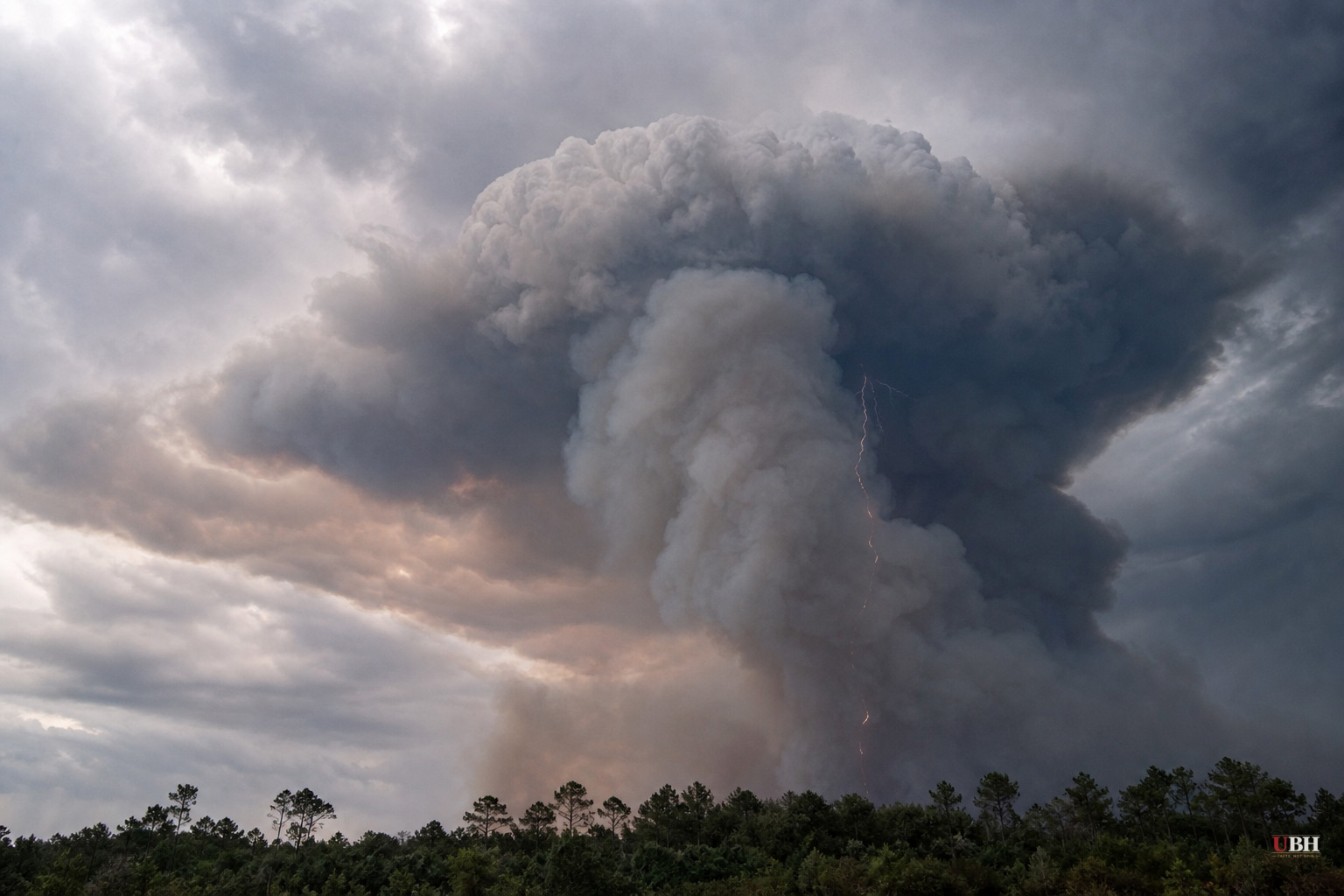
Since the Gironde fire broke out near Saumos on July 22 and grew into the evacuation crisis covered in prior reporting, French officials have confirmed a new detail: the fire got hot enough to make its own weather.
At around 6:20 p.m. on Friday, two days after the blaze ignited, the departmental fire and rescue service in Gironde recorded a pyrocumulonimbus cloud, or pyroCb, over the fire, according to the Associated Press. France's national firefighters federation says it's the first time the phenomenon has ever been documented in the country.
PyroCbs are rare enough globally that they're mostly studied in North America and Australia, where they show up only over the most extreme fires. Seeing one over French countryside tells scientists something about how far outside historical norms this fire season has pushed.
What Actually Happened in the Sky
A pyroCb isn't just smoke rising into a normal cloud. According to Theodore M. Giannaros, a fire meteorologist at the National Observatory of Athens, it takes very hot, dry air near the ground combined with cooler, moister air aloft, the same setup that produces dry thunderstorms without a fire involved.
Superheated air loaded with smoke and moisture shoots upward from the flames. As it climbs and cools, water vapor condenses around ash particles into droplets. Above the freezing line, those droplets turn to ice crystals, and the collisions between them separate electrical charges, exactly like a normal thunderstorm, Giannaros told the AP.
The result over Gironde was a black, electrified thundercloud sitting directly on top of the fire, generating its own lightning. That lightning struck the ground and ignited new fires beyond the original burn area, French officials said. The cloud weakened overnight as humidity rose, then reformed multiple times.
Giannaros called it "a feedback loop, not a one-way effect." Once the cloud forms, he said, "it becomes its own weather system, sitting on top of the fire and making it harder to predict." That includes violent downdrafts that punch back down to the surface and can send flames racing in new directions or split them into multiple fronts.
Why This Matters for Firefighters on the Ground
A French firefighter association spokesperson described the broader fire situation to AFP as an "operational impossibility," a "natural force beyond our control." The pyroCb is the clearest evidence for that description. Once a fire is generating its own storm system, it stops behaving like something crews can predict using normal wind and weather forecasts.
These systems can also spin up fire whirls, violent rotating columns of flame and heat. True fire tornadoes are rarer still, but not unprecedented. One struck Redding, California, during the 2018 Carr Fire with winds equivalent to an EF-3 tornado, killing a firefighter, according to the AP.
The Gironde fire itself has burned more than 420 square kilometers, or roughly 162 square miles, and damaged or destroyed more than 240 homes, per the AP. That's on top of the roughly 220,000 evacuations already reported in the region.
The Scale Problem Behind the Cloud
The pyroCb didn't appear in isolation. According to the European Forest Fire Information System, as reported by Wired, last week was France's single most destructive week for wildfires in the past 20 years, more than double the previous record over that period. More than 220,000 acres have burned nationwide so far this year, six times the country's annual average and 61,000 acres above the previous full-year record.
A 2024 study cited by Wired found that the global incidence of extreme wildfires more than doubled between 2003 and 2023, with six of the seven most extreme years occurring since 2016. That data doesn't prove any single fire event is caused by a warming climate, but it does establish a documented long-term trend of more frequent extreme fire behavior worldwide, a trend scientists studying fire weather patterns broadly attribute to warming and drying conditions.
The Guardian's coverage frames the story mainly through the lens of Spanish Prime Minister Pedro Sánchez linking the fires to the climate crisis, a political framing that reflects a statement from a government official managing a disaster rather than an independent scientific finding. The meteorological mechanics described by Giannaros and confirmed by French fire officials stand on their own regardless of that political framing.
Officials have not said whether the pyroCb phenomenon will recur as France's fire season continues, or whether the country's firefighting doctrine needs updating to account for fires capable of generating their own lightning and wind systems. That's now a live question for France's national firefighters federation, which had no prior domestic case to draw on before this week.
Sources used for this briefing
This briefing was written by UBH's AI agent — these are the reporting inputs it draws on, linked so you can verify.


