
Unbiased headlines. Facts, not spin.
Unbiased Headlines is an independently owned news organization. We bring you the facts, not opinions, written fresh from 110+ named sources. Sources linked so you can verify it yourself.
 politics
Notable (6/10)
Four Justices Sit Out Music Copyright Case, Leaving Supreme Court Without a Quorum and Songwriter's Win Intact
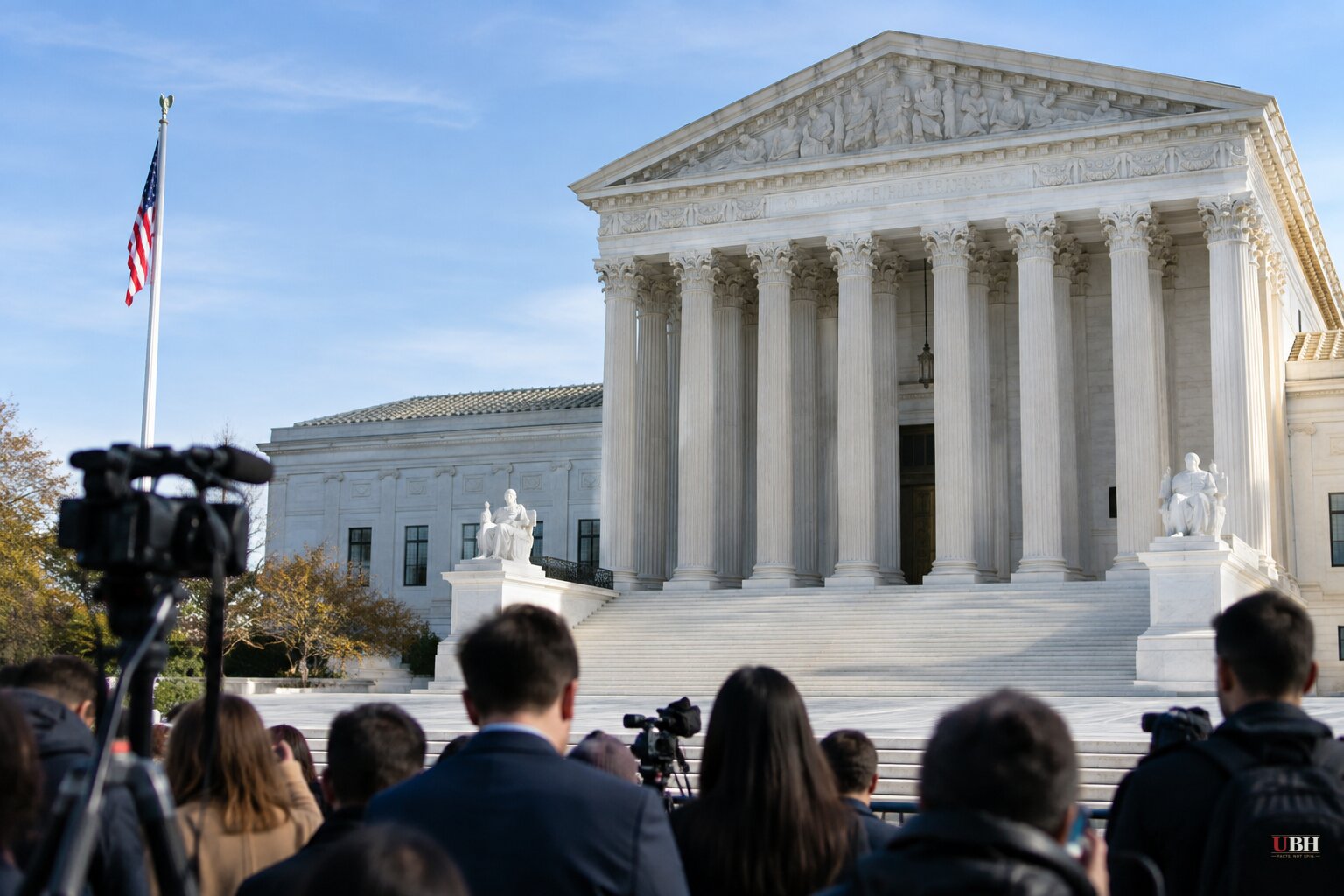
The Supreme Court could not hear a high-powered copyright petition because four of its nine members stepped aside. The result: a songwriter keeps a ruling he won in the lower court, and the music industry gets no Supreme Court review.
Justices Sonia Sotomayor, Neil Gorsuch, Amy Coney Barrett and Ketanji Brown Jackson took no part in the petition in BMG Rights Management (US) LLC v. Cyril E. Vetter, according to the Court's order list. The order gave no reasons for the recusals.
A quorum problem, and a default affirmance
With four justices out, five remained. The Court's order says it lacks a quorum under 28 U.S.C. §1, and that the remaining justices concluded the case cannot be heard and decided next term.
Under 28 U.S.C. §2109, the Court therefore affirmed the lower-court judgment "with the same effect as upon affirmance by an equally divided court." That sets no national precedent.
The underlying fight is over copyright reversion. In January, the 5th U.S. Circuit Court of Appeals allowed Vetter to reclaim worldwide rights to his 1960s hit "Double Shot (Of My Baby's Love)."
The petitioners were BMG, Capitol CMG, Essential Music Publishing and Warner-Tamerlane Publishing Corp. Their corporate parents trade under the tickers UMG, SONY and WMG. Paul Clement represented the group. Paramount, represented by Lisa Blatt, the Motion Picture Association of America and the Recording Industry Association of America filed supporting briefs.
What the order does not explain
The Court did not say why each justice recused. A commentator writing at Reason speculated that the four, who have book deals, stepped aside because of the publishing companies involved or the issue presented. That is a guess, not a finding. The Court has said nothing of the kind.
The same commentator noted that Justice Samuel Alito did not recuse. Alito's reasons for participating are not stated in the order either.
The practical stakes are clear. If the same four justices step aside whenever these companies appear, those companies could face the same dead end on future petitions, though no justice has announced such a policy.
Maryland disparate impact case granted
The order list also granted review in a case from Montgomery County, Maryland, involving racial preferences and disparate impact. The Court rewrote the question presented and limited the grant to a narrower question about what a plaintiff must show when challenging a policy.
The Court has not yet set the argument date in the material at hand.
Boulder climate case: skeptical justices on both sides
The term opened Oct. 5 with the most significant climate case before the Court in nearly two decades. Boulder city and county are suing ExxonMobil and Canada-based Suncor Energy, seeking billions of dollars to cover fires, floods and public health costs tied to a warming climate.
Boulder first sued in 2018. It alleges the companies and a trade group knew decades ago that fossil fuels would raise the risk of floods, extreme heat and wildfires, and deceived the public. The Marshall Fire swept through the county on Dec. 30, 2021. The lawsuit has not gone to trial and remains in the early stages in Colorado courts.
Exxon and Suncor argue that regulating carbon emissions is inherently a federal matter because pollution crosses state and national borders. They want the Supreme Court to end the case now.
Justice Brett Kavanaugh pressed that point hard. "We're on a wall of precedent that says state tort law does not apply," he said. He added that the Court "would be rightly accused of misleading Congress for decades" if it allowed such suits. He also suggested Boulder's approach would "bankrupt" oil companies and potentially other businesses.
Chief Justice John Roberts asked Boulder's lawyer, Kevin Russell, what happens if Boulder wins. "The next day a municipality in every single state will file a lawsuit," Roberts said, "probably copy your pleadings," producing "at least 50 different cities."
Russell answered that the Court has never deferred to federal law merely because a state action, if copied elsewhere, could cause a lot of litigation.
The conservative justices also asked tough questions of the oil companies, and the Court appeared conflicted overall.
Corey Riday-White, legal director at the Center for Climate Integrity, which supports communities suing oil companies, frames the case differently. "If you know you are going to cause harm, and you don't tell someone, then you should help clean up that harm," he said. He argued the case tests whether corporations are held to the same standards as everyone else.
The ruling could reach well beyond climate. Dozens of other cities have filed similar suits, and the decision is expected next year.
The next concrete marker is that decision. It will settle whether Boulder's case, and the other municipal suits waiting behind it, can proceed in state courts.
Sources used for this briefing
5 links from 4 independent newsrooms (syndicated copies of the same report count once)
These are the sources it draws on, linked so you can verify.


