
Unbiased headlines. Facts, not spin.
Unbiased Headlines is an independently owned news organization. We bring you the facts, not opinions, written fresh from 110+ named sources. Sources linked so you can verify it yourself.
 politics
Major Story (7/10)
Event date: October 16, 2026 ·
DHS Reports 98,708 Southwest Border Apprehensions for FY2026 as Immigrant Visa Issuance Roughly Halves
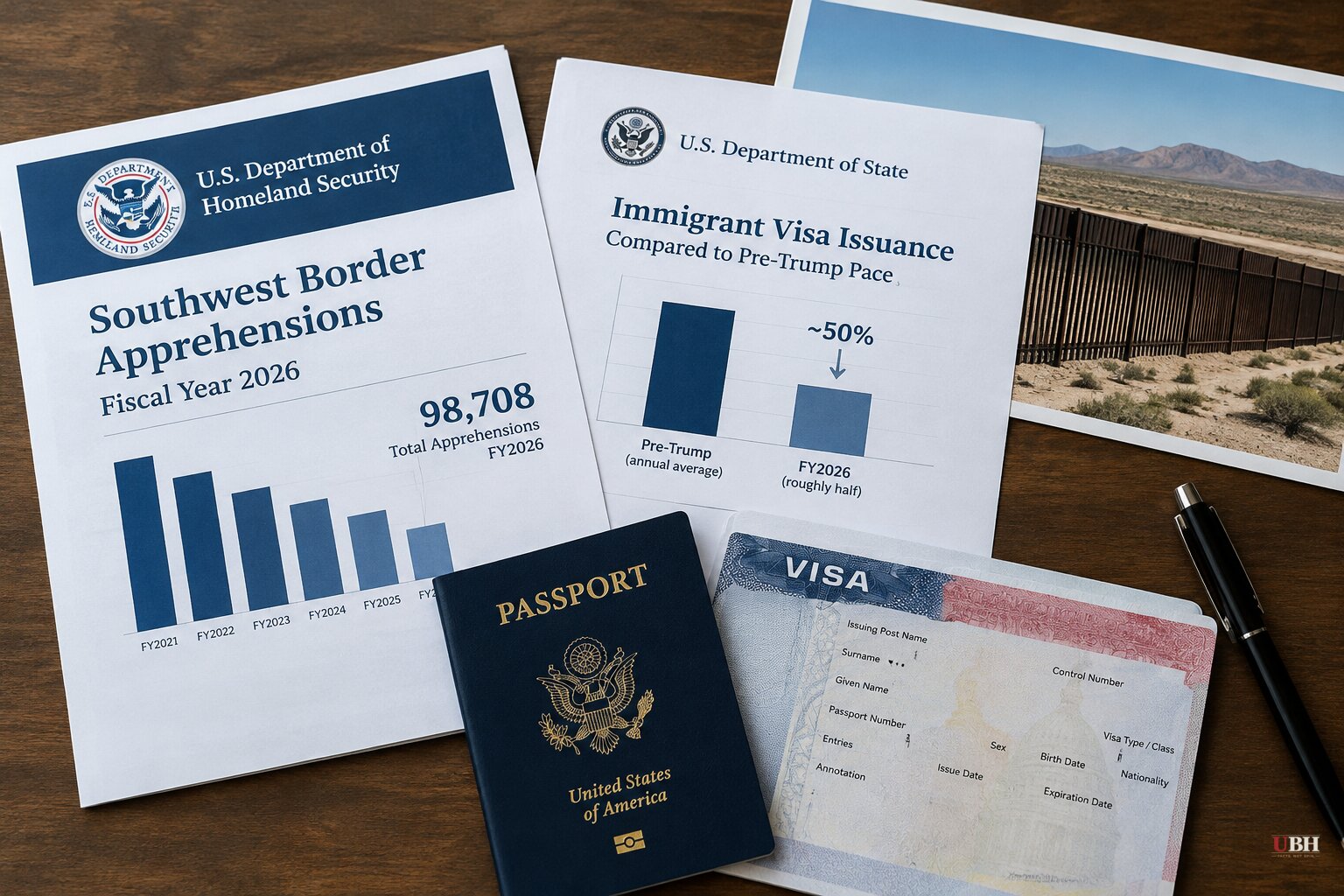
The border numbers are in, and by the government's own count they are the lowest on record.
DHS and Customs and Border Protection said in preliminary fiscal 2026 data that Border Patrol logged 98,708 southwest border apprehensions. DHS puts the drop at 95% from the more than 1.8 million a year it cites for the Biden years. Total nationwide encounters came to 379,243, against 2.7 million a year under Biden, the agency said.
DHS also says September was the 17th straight month with zero Border Patrol releases, and calls fiscal 2026 the first full fiscal year with none. These are the agency's preliminary figures about its own performance. Border-related deaths identified by the Border Patrol fell nearly 80%, DHS said.
"The results could not be clearer: strong enforcement works," Secretary Mullin said.
Legal immigration is shrinking too
The front door has narrowed as well. According to a New York Times analysis as relayed by Breitbart, the State Department issued just 26,000 immigrant visas in February, compared with an average of 52,000 a month in the years before Trump took office.
The report says the cut came through regulations, not legislation, without help from Congress. It said those regulations made it all but impossible to immigrate from 91 countries and reduced visa availability in another 61. Immigration from Muslim-majority countries fell by more than 90%, according to the report.
The administration has not released migration data beyond the spring of 2026, so the full-year legal picture is unknown.
For scale, the Biden administration granted a record 1.35 million green cards in 2024. The normal award under the 1990 immigration law is roughly one million a year.
Vice President JD Vance has been outspoken about the need to cut both illegal and legal migration. He told CBS on Sunday: "My goal here is to make it so that we can have a country with some baseline of social cohesion and sense of community." He added that when too many people come to the United States, "even if they're very good people," it "changes the country in very profound ways."
That is a policy choice made in plain view. Voters can weigh it, and Congress could have written it into law. It was done by regulation instead.
Courts and the interior fight
Enforcement inside the country is proving harder than enforcement at the line. U.S. District Judge Ramón Reyes Jr. in Brooklyn tossed the administration's lawsuit against New York City's sanctuary policies, which let local officials refuse to transfer noncitizens into federal custody without an arrest warrant.
Reyes, a Biden appointee, found the federal government lacks standing. "Even if the United States has standing — and it does not — its preemption claims fail," he wrote. He said the relevant federal statutes "do not regulate private actors" and that nothing in federal law obligates states to take part in immigration enforcement.
The administration's July 2025 lawsuit argued the city's laws violate the Supremacy Clause and make it harder for federal immigration officers to do their jobs by obstructing the sharing of information such as release dates, court appearance dates and custodial status. Reyes called the preemption arguments "nothing more than a backdoor around the Tenth Amendment."
Murad Awawdeh, president and CEO of the New York Immigration Coalition, praised the ruling and said the lawsuit was "a last ditch attempt to make an end run around the 10th Amendment." Neither the White House nor DHS immediately responded to a request for comment.
Friction inside the administration
CNN reported that when word of an internal ICE leadership call over the weekend leaked, some administration officials came to believe the agency planned to limit arrests to people with criminal histories. Three sources briefed on the call told CNN the verbally communicated guidance appeared to direct agents toward a different approach to "collateral arrests," meaning people in the vicinity of an operation or with a person on law enforcement's radar, and fueled confusion among agents.
Trump then told a well-known Fox News correspondent by phone that ICE would continue to arrest anyone in the country illegally, regardless of criminal history. A source familiar with the incident and a source close to the White House told CNN he also directed anger toward Mullin. DHS denies any such directive was issued.
The sources told CNN Mullin privately supports the shift away from collateral arrests. One said he is "definitely out of step with President Trump and the base on immigration." Those are anonymous claims. Mullin has said publicly that anyone in the country illegally may be eligible for removal.
CNN also reported that Trump overturned a summer pause on most ICE vehicle stops, which followed fatal shootings in Texas and Maine. Mullin took over DHS six months ago when Trump fired his predecessor, Kristi Noem.
Refugees: a targeted program, thin demand
The refugee system has been narrowed to a small, specific slice. Last year the president restricted refugee admissions to 7,500, the lowest in U.S. history, then raised the cap to 17,500 in May, with the added slots going primarily to Afrikaners. The overall cap was 125,000 under Biden.
An August State Department proposal seen by the Guardian outlines a roughly $335,000 research and advertising effort in South Africa, including focus groups, a survey of 1,000 Afrikaners and a six-month digital campaign. The proposal says applications "trended lower than expected" since Afrikaners were allowed to apply directly online in November 2025, and that "there's currently little research about why."
Administration officials have said Afrikaners face racial discrimination and "white genocide." The South African government has rejected the genocide claims. A State Department spokesperson said the department continues to process and admit as refugees Afrikaners in South Africa. The reporting does not say whether the proposal was approved.
It's taxpayer money. If the program is meant to be a priority, someone should explain why the demand isn't there and whether a $335,000 research and ad campaign is the answer.
What comes next
Immigration remains a key political issue for the White House ahead of the midterm elections. The open questions are concrete: whether ICE issues clearer guidance on collateral arrests, and whether the administration publishes legal-immigration figures past spring.
Sources used for this briefing
5 links from 5 independent newsrooms (syndicated copies of the same report count once)
These are the sources it draws on, linked so you can verify.


