
Unbiased headlines. Facts, not spin.
Every story is an unbiased news briefing written from 110+ sources across the spectrum — sources linked so you can verify it yourself.
 energy
Notable (6/10)
August 13, 2026 at 12:56 AM
energy
Notable (6/10)
August 13, 2026 at 12:56 AM
Form Energy Raises $750 Million as Tesla Files $10.1 Billion Solar Plant Plan in Texas
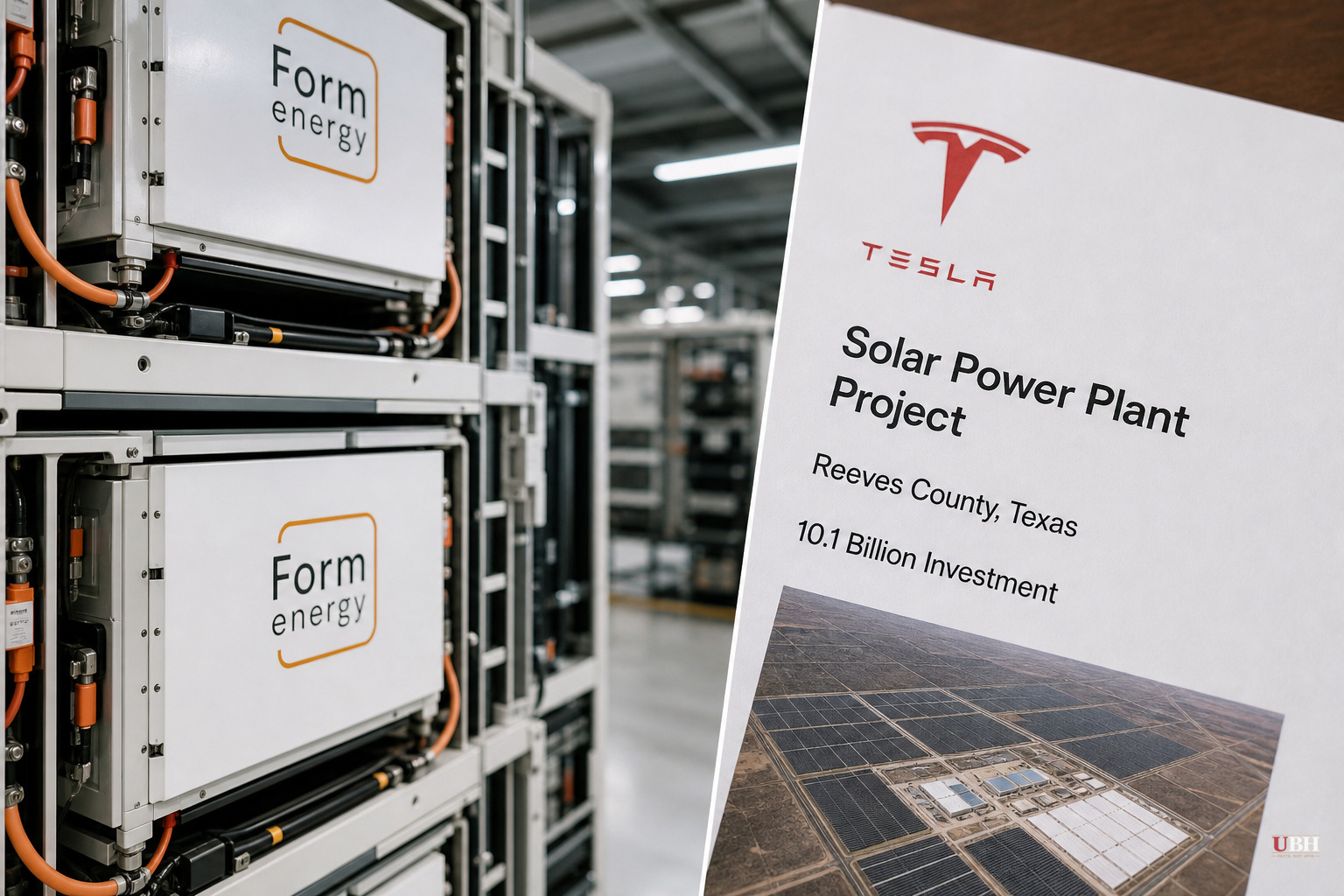
Form Energy announced Wednesday it raised $750 million in a Series G round led by T. Rowe Price, pushing the battery startup's total equity raised past $2 billion, according to a company statement posted on formenergy.com. The money goes toward scaling up manufacturing in Weirton, West Virginia, where the company builds iron-air batteries that can discharge power for up to 100 hours straight.
Most grid batteries on the market today run on lithium and can only push power for a handful of hours. Form's batteries use plain iron instead of lithium, cobalt, or nickel, cycling it between iron and rust as it charges and discharges, according to TechCrunch. Cheaper materials, longer runtime.
The Series G brought in new money from Sequoia Capital, Janus Henderson, Franklin Templeton, and PEAK6 Investments, plus continued backing from Breakthrough Energy Ventures, GE Vernova, Coatue, and Dustin Moskovitz and Cari Tuna, among others, per the company's own release. Morgan Stanley ran the placement.
Form also added two executives: Navneet Govil, formerly CFO at SoftBank Investment Advisers, takes over as CFO, and Wes Sloan, who ran Panasonic's battery operations in Nevada, becomes COO. Bringing in someone who actually built out Panasonic's Nevada plant suggests Form is bracing for the hard part: manufacturing at volume, not just landing contracts.
Google is powering part of a new Minnesota data center with a 30-gigawatt-hour Form battery system that cost roughly $1 billion, TechCrunch reported. Crusoe signed on for 12 gigawatt-hours in March. Xcel Energy and FuturEnergy Ireland are customers too. The company's total backlog jumped from about 20 gigawatt-hours to 80 gigawatt-hours this year, according to the Wall Street Journal, cited by TechCrunch.
Data centers are driving the sudden appetite. AI is pushing the first sustained rise in U.S. electricity demand in decades, and data center power consumption is projected to quadruple by 2035, eating up roughly 20% of all U.S. electricity generated, per TechCrunch's reporting. The U.S. installed 9.7 gigawatt-hours of storage in the first quarter of this year alone, up 32% from 2025.
Form says 80% of its materials are sourced domestically, with the rest coming from Europe and Asia, specifically not China. Both the Biden and Trump administrations pushed to cut U.S. battery supply chains loose from Chinese dominance, and Form's iron-based chemistry offers a structural advantage there since it doesn't rely on the lithium and cobalt China largely controls processing for.
Tesla's bigger bet in Texas
Tesla has filed paperwork with the Texas Comptroller proposing a $10.1 billion solar manufacturing campus in Fort Bend County, southwest of Houston, according to PV Tech and PV Magazine, both of which reviewed the application. Code-named Project Crystal Sun, the filing covers a 3,050-acre site near Richmond and was prepared by consulting firm Kroll, signed July 22 and made public in early August.
If built, it would be Tesla's largest single manufacturing investment on paper: $1.5 billion in real property and $8.6 billion in equipment, according to the filings. Tesla says the plant would create 9,712 permanent jobs and 1,147 construction jobs, and it's asking for a 10-year property tax limitation under the Texas Jobs, Energy, Technology and Innovation Act.
This isn't just a module assembly plant. The equipment list includes ingot pulling, wafer slicing, chemical coating, metallization, and cell testing, meaning Tesla wants to control the entire silicon-to-module chain domestically, per PV Tech. Joe Hennessy, a market research analyst at PV Tech Research, said the investment is "as big as we've ever seen for one site," and estimated the facility could exceed 10 gigawatts of capacity based on comparisons to Qcells' $2.5 billion, 3.3-gigawatt plant in Cartersville, Georgia.
An economic impact analysis attached to the filing projects the buildout could add $107 billion to Texas GDP and $6.4 billion in state and local tax revenue over 38 years, according to PV Magazine. Tesla also disclosed it's weighing a competing out-of-state site, meaning the tax break Fort Bend County offers could decide where the plant actually gets built. Construction is targeted for 2026 through 2028, with commercial production slated to start in the first quarter of 2029, if the project moves forward as filed.
Hennessy told PV Tech the push toward vertical integration is a direct response to trade enforcement: antidumping and countervailing duty cases against imports from India, Indonesia, and Laos, plus new Section 232 tariff rules starting in December and investigations into alleged Chinese component circumvention through Ethiopian and South Korean solar cell producers. Manufacturers that don't want to get caught in that mess are building the whole chain here instead of importing pieces of it.
Tesla's filing is an application, not a groundbreaking, and the company itself flagged an alternative site is still on the table. Fort Bend County and the Lamar Consolidated Independent School District haven't yet ruled on the tax abatement request. Whether Texas outbids whatever other state Tesla is eyeing will determine if Project Crystal Sun becomes steel and glass or stays a filing on the Comptroller's website.
Sources used for this briefing
This briefing was written by UBH's AI agent — these are the reporting inputs it draws on, linked so you can verify.


