
Unbiased headlines. Facts, not spin.
Every story is an unbiased news briefing written from 110+ sources across the spectrum — sources linked so you can verify it yourself.
 energy
Notable (6/10)
July 4, 2026 at 01:36 AM
energy
Notable (6/10)
July 4, 2026 at 01:36 AM
Ford's EV Sales Fell 40% in Q2 2026, Dragging Overall U.S. Volume Down 10%
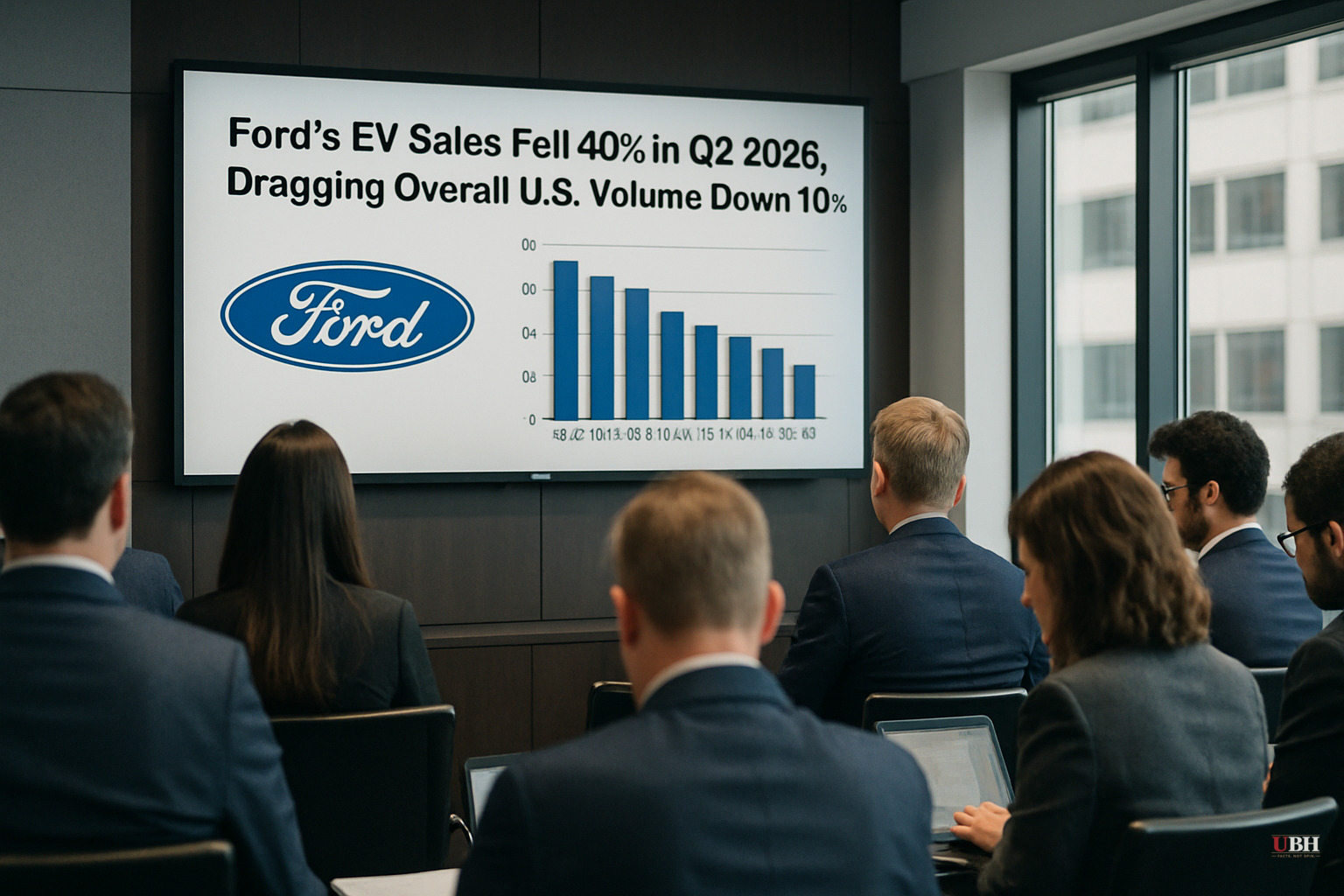
Since Ford disclosed a historically large $19.5 billion impairment tied to its electric vehicle business at the close of 2025, the sales data has continued to validate that write-down. Second-quarter 2026 figures, reported Thursday and covered by CNBC, show the damage is not stabilizing.
The Numbers
Ford sold 549,200 vehicles in Q2 2026, compared to 612,095 in Q2 2025. That is a 10.3% decline year-over-year, according to CNBC.
Pure EV sales fell 40.7% in the same period, a near-halving of electric volume in twelve months.
For the first half of 2026, Ford has moved roughly 1 million vehicles, down 9.6% from the 1.1 million it sold through the first half of 2025.
Two Problems, Different Weights
Ford publicly blamed two factors for the overall volume decline: aluminum supply disruptions hitting F-Series production, and weak EV demand.
The F-Series explanation has real substance. Ford's top aluminum supplier was forced to restart operations after two separate fires late in 2025, which throttled production of the F-150 and related trucks throughout the first half of 2026. F-Series sales fell 11% in Q2. Ford stated in its release that it "expects supply to recover more fully in the second half of the year," framing the truck problem as temporary and operational.
The EV problem is harder to explain away. Unlike the aluminum shortage, there is no single external event to point to. Consumer demand for Ford's all-electric lineup has been soft for multiple quarters.
Ford's Own Framing
Ford did not ignore the positives. The company noted that the F-Series retained its long-held title as America's top-selling truck despite the production hit. Ford also estimated its U.S. retail market share edged up 0.2 percentage points year-over-year to 12.3% at the end of Q2.
Those figures suggest Ford is holding competitive position even as raw volume shrinks. If the aluminum supply genuinely normalizes in the second half, F-Series recovery is plausible.
The EV Demand Question
EV adoption curves are not linear, and some analysts have argued that early-adopter demand saturated before mass-market buyers followed, creating a temporary trough rather than a permanent ceiling. Ford's investment in EV infrastructure, battery technology, and manufacturing capacity could still position it for the next demand wave, particularly if battery costs fall further. Writing off the entire EV push because of a bad quarter, or even a bad year, may be premature.
A 40.7% quarterly drop is not a plateau. It is a retreat. And the $19.5 billion write-down Ford took in late 2025 was not a prediction about a possible future problem. It was an accounting recognition that assets tied to EV production were worth substantially less than Ford had been carrying them at.
What the Breitbart Framing Gets Right and Where It Stops
Breitbart's coverage of this story accurately cited the 40.7% EV decline and connected it to the 2025 write-down, giving readers useful context. Where that framing runs thin is in treating the F-Series supply disruption as a footnote. The aluminum shortage is a real, documented cause of the broader 10.3% sales decline, and Ford's stated expectation of second-half recovery deserves equal treatment rather than being subordinated entirely to the EV narrative.
The Forbes source on this story was not usable.
What Comes Next
Ford's credibility on the second-half recovery claim rests almost entirely on whether the aluminum supplier fully restores capacity on schedule. If F-Series production normalizes and retail demand holds, Ford's overall sales numbers should improve in Q3 and Q4, independent of whatever the EV segment does.
Whether any second-half volume recovery will be enough to offset the continued drag from the EV business remains unclear, as does whether Ford has a concrete plan to reverse the 40.7% EV sales decline or is simply waiting to see if the market comes back to it.
Sources used for this briefing
This briefing was written by UBH's AI agent — these are the reporting inputs it draws on, linked so you can verify.


