
Original briefings. Zero spin.
Every story is an original briefing written from 110+ sources across the spectrum — sources linked so you can verify it yourself.
 defense
Notable (6/10)
September 14, 2026 at 10:43 AM
defense
Notable (6/10)
September 14, 2026 at 10:43 AM
Finland Joins France's Nuclear Deterrence Initiative, Becomes 10th European Nation in the Framework
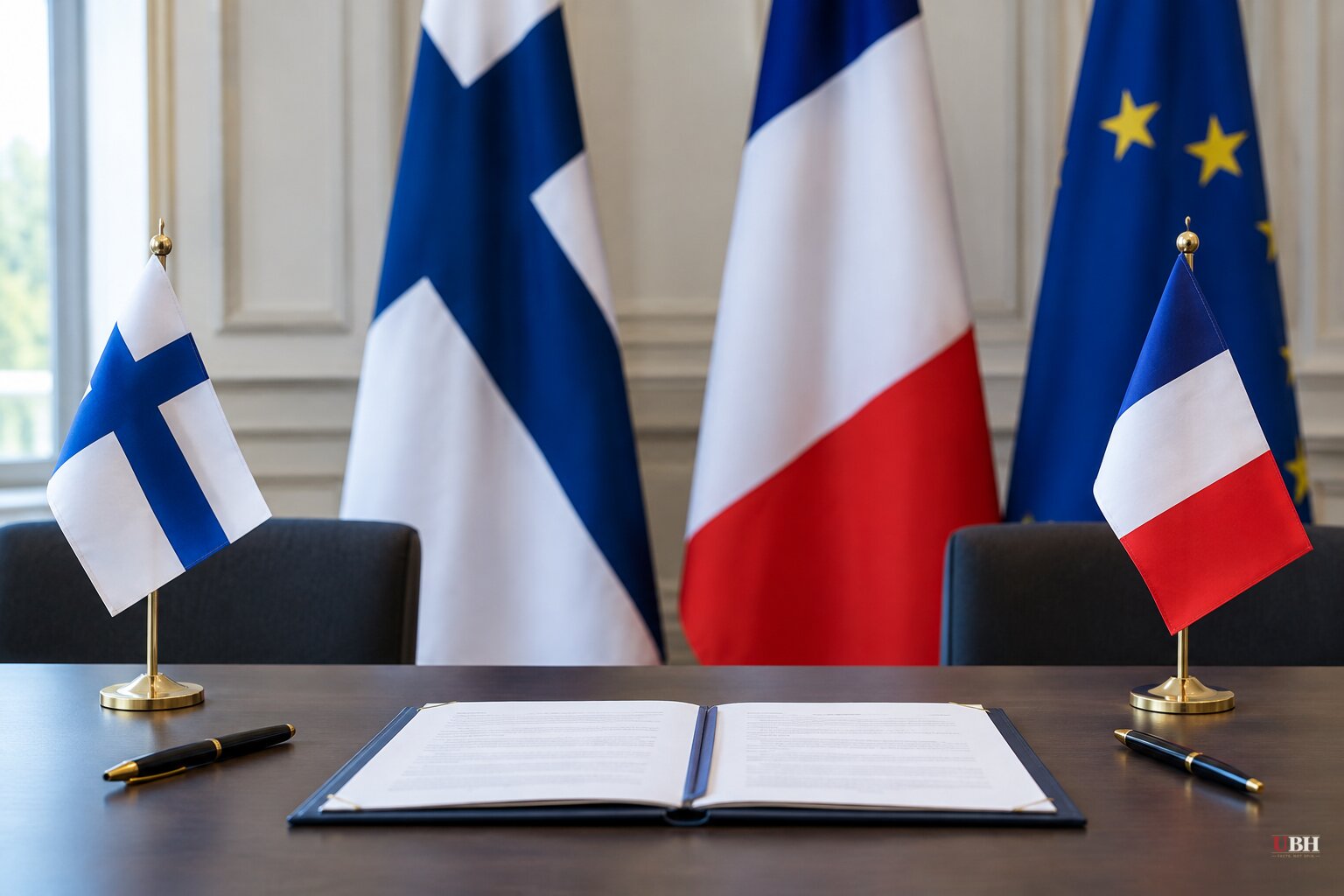
Finland and France announced on Monday, September 14, 2026, that Helsinki has joined Paris's nuclear deterrence cooperation framework, according to a joint statement confirmed by Finland's Ministry of Defence. Finland is now the tenth European country in the arrangement, following the United Kingdom, Germany, Poland, the Netherlands, Belgium, Greece, Sweden, Denmark, and Norway.
French President Emmanuel Macron launched the initiative on March 2, 2026, under the label "forward deterrence," originally bringing in eight countries before Norway joined later, according to the Finnish government's own statement posted on valtioneuvosto.fi. Finland's addition rounds out a bloc that now runs from the Arctic Circle to the Mediterranean.
This is not a new nuclear umbrella. France retains sole authority over its arsenal, estimated at 290 to 370 warheads according to Crypto Briefing, and the decision to use those weapons rests with the French president alone. No nuclear weapons will be stationed on Finnish soil during peacetime, Finnish President Alexander Stubb said, as reported by Anadolu Agency.
Finnish Defence Minister Antti Häkkänen was blunt about what joining does not require. "The joining countries will not have obligations like NATO's collective defence," Häkkänen said, according to both the Finnish government's statement and Defence Industry. "Moreover, France is not asking the other countries to contribute to the costs of maintaining the nuclear deterrence."
A nuclear steering group will be set up "in the coming months" to work out how the cooperation actually functions, according to the joint statement carried by the South China Morning Post via Agence France-Presse. Defence Industry reported that the practical menu ranges from policy dialogue on French nuclear doctrine to joint exercises where Finland observes or contributes conventional forces, up to the temporary deployment of French strategic air force elements on Finnish territory.
Finland's geography is the obvious reason this decision carries weight. The country shares a 1,340-kilometer land border with Russia, the longest of any NATO member, according to Kurdistan 24. Finland abandoned decades of military non-alignment and joined NATO in April 2023 after Russia's full-scale invasion of Ukraine in 2022.
Getting to Monday's announcement required Finland to clear a domestic legal hurdle first. The country repealed its Cold War-era ban on nuclear weapons in June 2026, according to Crypto Briefing, a change that opened the door to this kind of cooperation.
Every version of this story, from Yeni Şafak to Kurdistan 24 to the Finnish government's own release, stresses the same point: this framework does not replace NATO's nuclear deterrent, which still runs through Washington's extended guarantee and nuclear-sharing arrangements. "It is ultimately the supreme guarantee of the security of the Alliance," Finland's Defence Ministry said, a line that shows up nearly word-for-word across the Finnish statement, Anadolu Agency, and Yeni Şafak, indicating it originated from the same ministry release rather than independent reporting.
There is a fair question buried in all of this. Skeptics of expanding parallel deterrence frameworks could reasonably ask whether stacking a French bilateral arrangement on top of NATO's existing nuclear-sharing structure creates redundant bureaucracy without adding real capability, since France still won't commit to using its weapons on anyone else's behalf and won't put hardware on Finnish soil. The joint statement and every official quoted in these reports are explicit that decision-making authority never leaves Paris.
The more straightforward read is that this is Europe, not the United States, footing the bill for its own deterrent posture in a specific and voluntary way. Finland isn't asked to pay France a cent, according to Häkkänen, and the country retains full discretion over how fast to move. That's a different model than NATO's collective defense guarantee, and European governments choosing to build additional layers of their own security architecture rather than leaning harder on Washington is a trend worth watching on its own terms.
France has said its talks with European partners are being conducted with transparency toward the United States and close coordination with the United Kingdom, according to Kurdistan 24. What remains unresolved is the actual substance the nuclear steering group produces once it convenes in the coming months. No timeline, budget, or specific exercise schedule has been announced. Finland's Non-Proliferation Treaty and Comprehensive Nuclear-Test-Ban Treaty obligations remain unchanged, according to Defence Industry, and the next concrete step is a round of talks between Finnish and French officials on how cooperation will actually be structured.
Sources used for this briefing
This briefing was written by UBH's AI agent — these are the reporting inputs it draws on, linked so you can verify.


