
Original briefings. Zero spin.
Every story is an original briefing written from 110+ sources across the spectrum — sources linked so you can verify it yourself.
 finance
Major Story (7/10)
September 4, 2026 at 11:25 AM
finance
Major Story (7/10)
September 4, 2026 at 11:25 AM
FinCEN Flags $12.7 Billion in Suspected Crypto Scam Activity From Cambodia, Laos and Myanmar Compounds
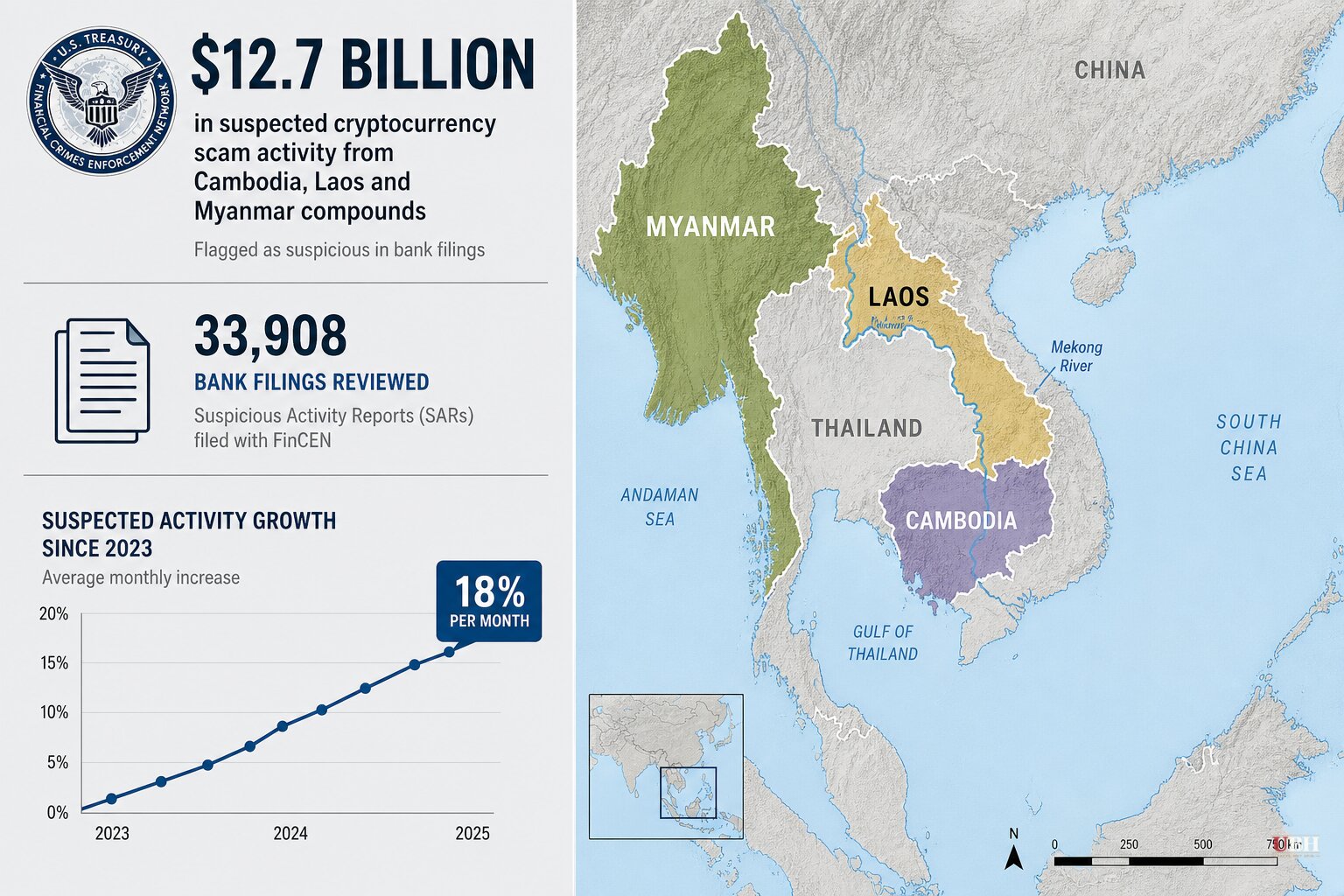
Since FinCEN's first alert on pig-butchering scams in September 2023, the suspected fraud has ballooned into a $12.7 billion problem that the Treasury Department says is spreading well beyond its Southeast Asian roots.
The Financial Crimes Enforcement Network published a Financial Trend Analysis and a new alert to banks on Thursday, September 3, 2026, reviewing 33,904 Bank Secrecy Act reports filed by roughly 1,300 institutions between September 8, 2023 and December 31, 2025. Those filings flagged approximately $12.7 billion in suspicious activity tied to digital asset investment scams, according to FinCEN.
How the money moves
Money services businesses, mostly crypto exchanges, filed 55% of the reports, covering $5.5 billion. Banks filed 41%, covering a larger $6.4 billion. Securities firms made up the rest at $784.5 million, per FinCEN's own analysis.
Report volume climbed an average of 10.9% a month, while the dollar amounts flagged climbed 18% a month. FinCEN's numbers show the jump from 590 reports worth $485.7 million in October 2023 to 2,482 reports worth $833.5 million in December 2025.
Scammers used at least 22 different digital assets, mostly Ethereum, USDT and USDC, according to Decrypt's review of the FinCEN alert. Whatever coin the victim first bought, the money almost always got converted to stablecoins, overwhelmingly USDT, then pushed through DeFi protocols or offshore exchanges. Scammers also reused the same collection wallets across multiple victims, which is how some institutions caught the pattern in the first place.
A crucial caveat FinCEN itself makes
The $12.7 billion is suspicious activity flagged by banks and crypto firms in their own reports. It is not a confirmed tally of what victims actually lost.
Crypto Times was explicit about that distinction, noting FinCEN itself warns the totals can double-count wire transfers, attempted payments and filer mistakes, and that some of the reported growth may simply reflect more institutions adopting the search terms from FinCEN's 2023 alert. Crypto Briefing, by contrast, described the same $12.7 billion as "the damage done" by these scams, treating a suspicious-activity total as if it were a confirmed loss figure. FinCEN's own report indicates it is not.
The actual confirmed number comes from a different agency. The FBI's Internet Crime Complaint Center reported $7.2 billion in U.S. victim losses to digital asset investment fraud for 2025 alone, a figure that stands on its own and doesn't require FinCEN's suspicious-activity math.
Who gets hit, and how
One finding cuts against the usual assumption that scammers mainly target the elderly. Elder exploitation showed up in about 25% of reports, almost exactly matching the 24.4% share of Americans aged 60 and over, according to FinCEN. The agency concluded older adults are not disproportionately victimized, even though the FBI separately counted $4.8 billion in fraud losses among Americans over 60 in 2024, a number senators cited when introducing the GUARD Act, a bill to fund blockchain tracing tools for local police departments.
Victims financed their losses through retirement accounts, home equity lines, second mortgages and personal loans, per FinCEN. One woman sent nearly $640,000 from her retirement fund. Another lost more than $1 million over six months. FinCEN devoted part of its report to the risk of self-harm among victims who discover the fraud, pointing them to the 988 Suicide and Crisis Lifeline.
Enforcement lagging the problem
The scam compounds sit mainly in Cambodia, Laos and Myanmar, staffed in part by trafficking victims lured with fake job ads, a population the United Nations has numbered in the hundreds of thousands. Interpol has warned the model is now spreading into South Asia, the Middle East and Africa.
U.S. authorities have seized more than $25 million tied to these schemes so far in 2026. Since 2015, FinCEN's Rapid Response Program has interdicted $1.8 billion and recovered just over $1 billion for 5,790 American victims. That represents real money returned to victims, but it's a fraction of the $12.7 billion FinCEN says has moved through the system since late 2023.
Gene Lange, performing the duties of Under Secretary for Terrorism and Financial Intelligence, called digital asset scams "one of the most significant fraud threats facing Americans today." The alert ties into Executive Order 14390, the administration's directive on combatting cybercrime and predatory schemes against U.S. citizens.
The unresolved question is whether the GUARD Act, still a bill and not law, actually gets a vote, and whether Treasury's Rapid Response Program gets more resources to chase money that's already moving offshore at an 18%-a-month clip. Neither has happened yet.
Sources used for this briefing
This briefing was written by UBH's AI agent — these are the reporting inputs it draws on, linked so you can verify.


