
Original briefings. Zero spin.
Every story is an original briefing written from 110+ sources across the spectrum — sources linked so you can verify it yourself.
 finance
Major Story (7/10)
Event date: September 2, 2026
finance
Major Story (7/10)
Event date: September 2, 2026
Norway's $2.3 Trillion Wealth Fund Proposes Cutting US Treasury Exposure by $80 Billion
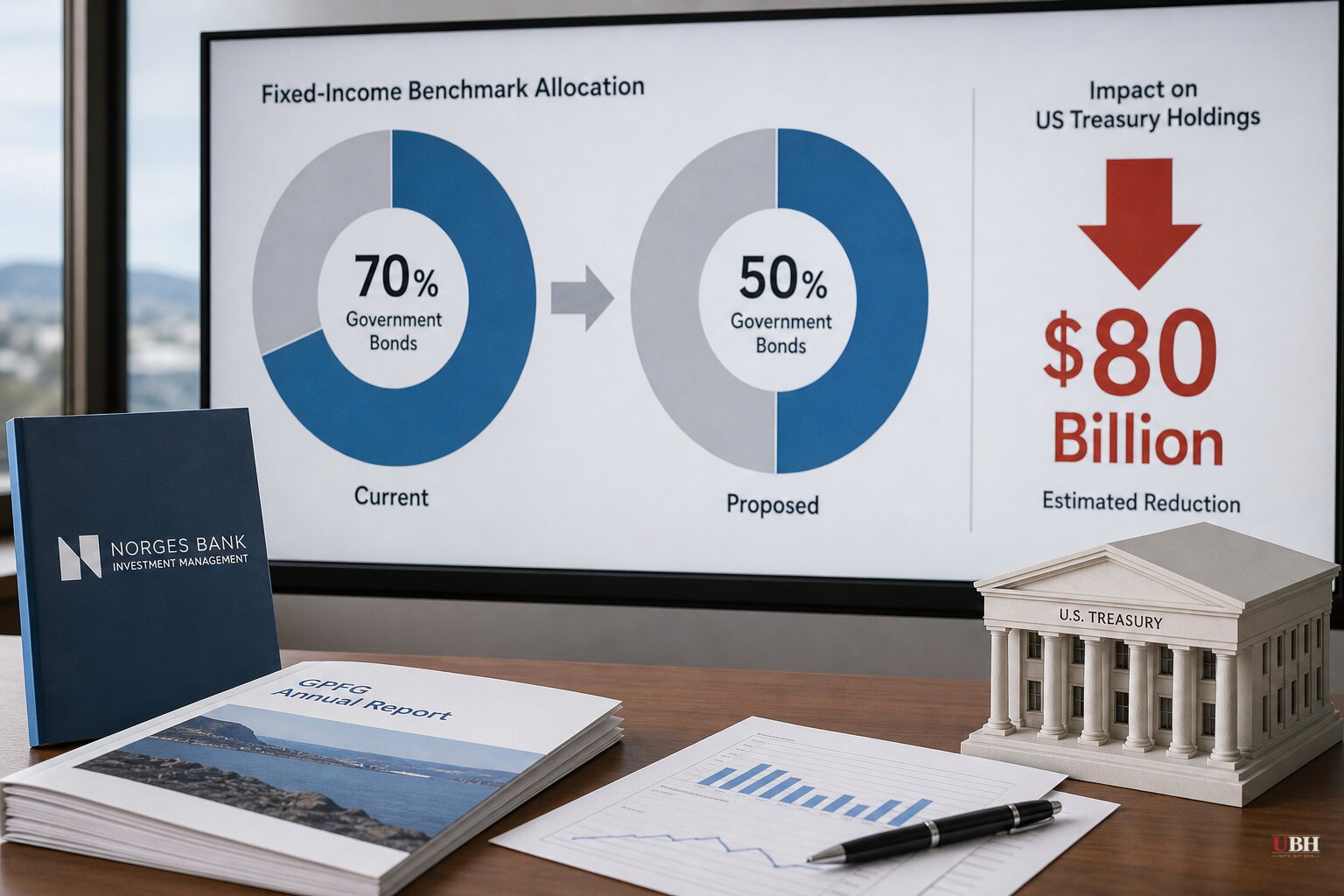
Norway's sovereign wealth fund just told its own government it's holding too much debt.
On Tuesday, September 1, Norges Bank Investment Management sent a letter to Norway's Ministry of Finance recommending that government bonds shrink from 70% to 50% of the fixed-income benchmark for the Government Pension Fund Global, according to the Financial Times. NBIM manages roughly $2.3 trillion in assets, making it one of the largest institutional investors on the planet.
The FT estimates the change would cut the fund's global government bond exposure by about $106 billion, with roughly $80 billion of that coming out of US Treasuries specifically. Fixed income currently makes up just under 26% of the fund's total assets, according to KuCoin's reporting on the FT figures.
Norway's Ministry of Finance and parliament still have to approve it, according to Startup Fortune. Nothing changes until they act.
What Norway Actually Said
NBIM's reasoning is narrower than the headline number suggests. The bank argued a 50% government bond share would still cover the fund's liquidity needs, including during market stress, according to Startup Fortune. It also wants the government bond subindex weighted by market value instead of GDP, reasoning that high public debt is now common across developed economies, not a quirk of a few outliers.
The money wouldn't leave dollar assets. NBIM wants to shift into agency mortgage-backed securities and other non-government dollar debt, meaning the fund's overall exposure to the US dollar would stay roughly unchanged, according to the Financial Times. This is a bet on different bond risk premiums, not a retreat from America.
Reuters reported in April that Norway's Finance Minister, Jens Stoltenberg, told the FT the fund had no plans to reduce US assets despite concerns over the Middle East war and mounting US debt. NBIM's September letter doesn't contradict that directly. It's proposing a different mix of US-dollar bonds, not an exit from US-dollar assets.
Why Treasuries Are Under Pressure Right Now
The 10-year Treasury yield climbed this week to its highest level in nearly three years, and the 30-year yield broke above 5.3%, its highest in 19 years, according to CNN and Breitbart. US government debt crossed $40 trillion for the first time in history.
CNN ties the pressure to the reignited US war with Iran, which has dragged on for more than six months since President Donald Trump struck Iranian targets in late February. Brent crude jumped roughly 5% to near $95 a barrel after US strikes on Iranian targets near the Strait of Hormuz followed attacks on two oil tankers, according to Startup Fortune. Diesel prices have spiked 51% since the war started, and last month was the most expensive August for gas prices in US history, according to AAA data cited by CNN.
"It feels like there is no end to the inflation problem, the war or the deficit in the near term," Hardika Singh, an economic strategist at Fundstrat, told CNN. Art Hogan, another market strategist cited by CNN, warned the dynamic could become "circular" without a credible exit from the war.
Against that backdrop, the Federal Reserve and European Central Bank are both weighing rate moves. Markets currently price roughly a 50% chance of a Fed rate hike this month, down from about 70% earlier in the week, after Fed official Christopher Waller signaled the central bank could hold rates steady if inflation pressure eases, according to Bloomberg. Most economists surveyed by Bloomberg expect the ECB to raise its deposit rate one more time next week, to 2.5%, and then hold through 2027, a milder path than what markets are currently pricing.
The Treasury's Own Response
Separately, the US Treasury Department announced Wednesday it will raise the size limit on its bond buyback operations for 10-to-30-year Treasuries from $2 billion to at least $4 billion per operation, starting September 9, according to Breitbart. The program itself dates back to the Biden administration under Janet Yellen; this is an expansion, not a new tool.
Some commentary framed the move as a form of quantitative easing or an attempt by Treasury Secretary Scott Bessent to manipulate rates. Breitbart pushed back hard on that framing, arguing buybacks retire specific bonds while Treasury keeps issuing others elsewhere, so no new money is created and there's no net reduction in debt held by the public. Bessent has been open about wanting to bring down long-term borrowing costs and the mortgage rates tied to them, according to Breitbart, and bond prices did rise after the announcement, pushing yields down.
Whether that's smart debt management or a Treasury leaning on a wobbly market depends on who's reading it. Both readings agree on the underlying fact: the US government is actively managing the composition of a $40 trillion-plus debt load while one of its largest foreign creditors reconsiders how much of that debt it wants to hold.
The open question is whether the Norwegian parliament signs off on NBIM's recommendation, and whether other sovereign funds and central banks follow the same logic. Friday's US jobs report and upcoming inflation data will be the next test of whether the Fed hikes rates at all this month, according to Bloomberg.
Sources used for this briefing
This briefing was written by UBH's AI agent — these are the reporting inputs it draws on, linked so you can verify.


