
Original briefings. Zero spin.
Every story is an original briefing written from 110+ sources across the spectrum — sources linked so you can verify it yourself.
 finance
Major Story (7/10)
Event date: August 31, 2026
finance
Major Story (7/10)
Event date: August 31, 2026
Employer Health Premiums Set to Rise 8.2% in 2027, the Most Since 2003, as Insurers Push Trillions Into Private Markets
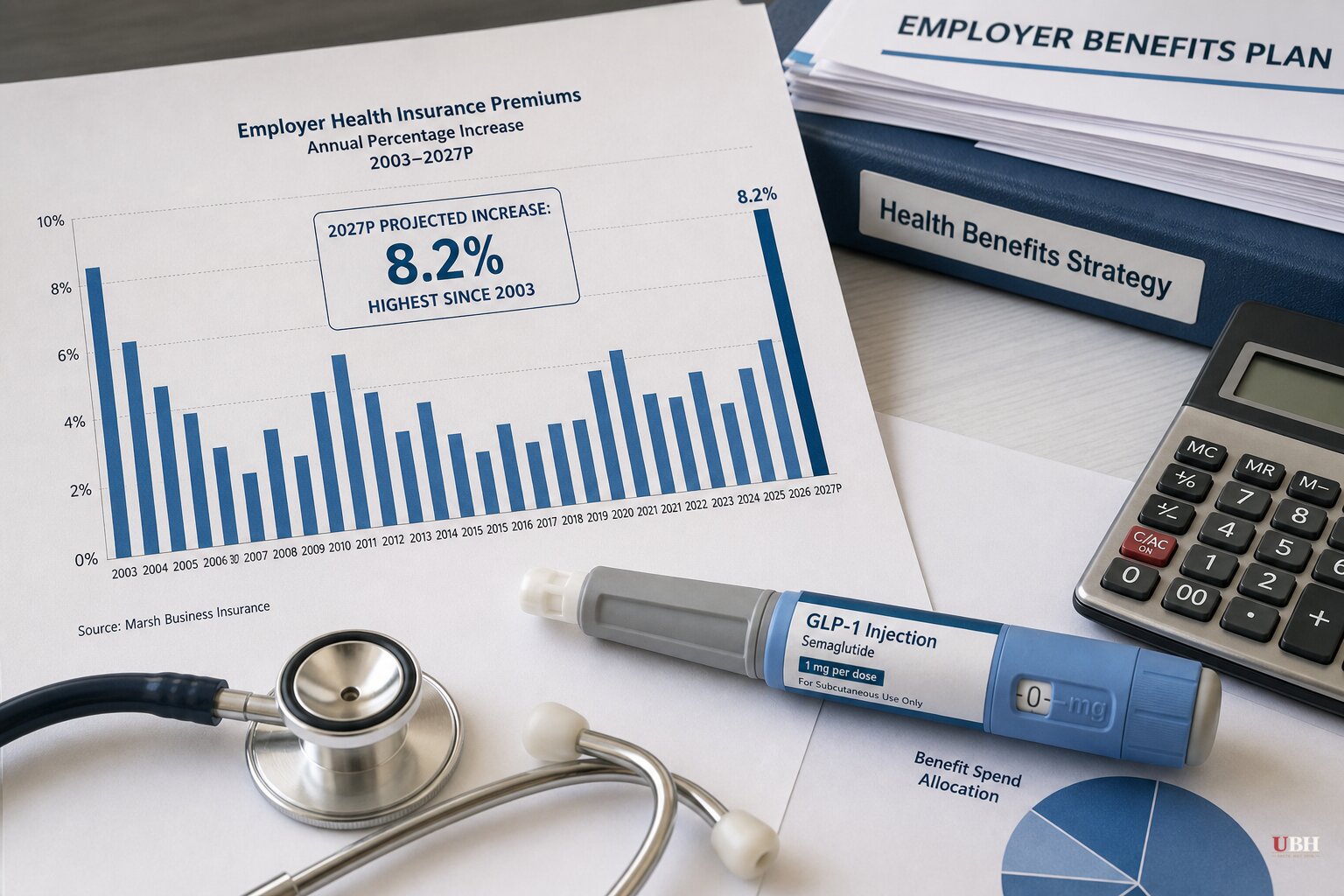
Your Premiums Are About to Jump the Most Since George W. Bush's First Term
Employer-sponsored health benefit costs are projected to rise an average of 8.2 percent in 2027, according to an Aug. 31 report from consulting firm Marsh based on responses from more than 1,800 employers. That would be the largest increase since 2003, and the fifth straight year of elevated cost growth after a decade of milder increases, Marsh found.
Workers won't be shielded from it. About two-thirds of large employers plan to raise employees' share of premiums next year, and many are eyeing higher deductibles too. Marsh says that means paycheck deductions for many workers could climb by more than the headline 8.2 percent.
Employers aren't sitting still. Marsh found 59 percent plan cost-cutting moves for 2027, and without any action at all, the cost of keeping current plans in place would have risen 11 percent. That's the baseline before anyone tries to control it.
What's driving it: expensive new weight-loss drugs, better but pricier cancer and rare-disease treatments, and consolidation among hospital systems that gives providers more leverage in price negotiations with insurers. Marsh also points to something newer: AI-enabled software that helps medical providers document care and submit claims, which has pushed up both the volume of claims and the dollar amounts billed by roughly a full percentage point, more than expected.
Government reimbursement hasn't kept pace with inflation either, according to Marsh, which pushes providers to shift more cost onto private payers to cover the gap. That's a policy choice with a real price tag for anyone getting insurance through work.
Meanwhile, the Industry Sits on $9.6 Trillion and Keeps Going Private
While employers and workers absorb rising claims costs, the insurance industry's own investment portfolio looks less and less like the boring bond book it used to be.
U.S. insurers held $9.58 trillion in cash and invested assets at the end of 2025, up 6.7 percent for the year and about 65 percent over the past decade, according to the National Association of Insurance Commissioners (NAIC), cited by Forbes contributor Mayra Rodriguez Valladares. On paper it still looks conservative: roughly 60 percent bonds, 14 percent stock, 6.2 percent cash.
Underneath that, the mix has shifted hard into private credit, mortgage loans, CLOs, structured securities and private placements — assets that don't trade on public markets and carry far less disclosure. Mortgage loans alone total $868 billion, or 9.1 percent of assets, Valladares reports. Collateralized loan obligations hit $276.8 billion at the end of 2024, more than double the 2018 level, with life insurers holding 82 percent of that exposure and the ten largest insurer groups holding 43 percent of it. The Federal Reserve has documented life insurers' growing exposure to risky corporate debt since the 2008 financial crisis, putting their CLO exposure alone at roughly $212 billion by the end of 2023.
No regulator has announced an investigation into this shift. Valladares, who has spent years tracking bank capital exposure, raises a structural concern: private credit is opaque and hard to price, and it's now concentrated in a handful of the largest insurer groups. Insurers would counter, reasonably, that private credit and mortgage assets match well against long-duration liabilities like annuities, and that diversifying funding sources is standard portfolio management.
The Deals Making It Real
This isn't abstract. Chariot Reinsurance, a Bermuda-based life and annuity reinsurer sponsored by MetLife and General Atlantic, closed a $700 million oversubscribed capital raise on Sept. 2, 2026, bringing its total funding since its July 2025 launch to over $2 billion. Chubb led the round. Chariot Re now backs roughly $20 billion in reinsured liabilities across three completed transactions.
"This capital raise reflects the strong business momentum Chariot Re has built in just over a year," said CEO Cynthia Smith. MetLife CEO Michel Khalaf said the deal supports MetLife's "New Frontier" growth strategy in retirement and asset management. General Atlantic Chairman Bill Ford said the firm is bringing "four and a half decades of global investing experience" to help Chariot Re "build on that foundation for the long term."
At Lloyd's, Oak Global CEO Cathal Carr told the trade outlet Artemis ahead of the 2026 Monte Carlo Rendez-vous that his firm is deliberately diversifying its capital stack beyond its private equity backer, Bain Capital, to include "newer financial investors" entering the reinsurance space, citing geopolitical risk, climate losses and AI's impact on casualty products as reasons the industry needs more flexible capital.
And it's not limited to underwriting. CVC Capital Partners announced Sept. 3, 2026 it will acquire a controlling stake in Ambrose Construct Group, an Australian insurance repair and restoration firm, from CPE Capital and founders Brett and Melissa Ambrose. That deal is expected to close by early 2027 pending regulatory approval, according to CVC.
What's Actually Unresolved
None of this means insurers are in trouble. Premiums are rising for documented reasons — drug costs, AI-driven billing, provider consolidation — and private capital allocation is a separate trend playing out across the industry's balance sheet, not its claims costs. The two stories share an industry, not a cause.
The open question is whether state regulators, who set capital charges through the NAIC, will update how they treat CLO and private credit holdings before the next reporting cycle, given how fast that exposure has grown since 2018. Nobody in these reports says that update is coming.
Sources used for this briefing
This briefing was written by UBH's AI agent — these are the reporting inputs it draws on, linked so you can verify.


