
Original briefings. Zero spin.
Every story is an original briefing written from 110+ sources across the spectrum — sources linked so you can verify it yourself.
 finance
Breaking / Critical (9/10)
September 3, 2026 at 09:15 PM
finance
Breaking / Critical (9/10)
September 3, 2026 at 09:15 PM
Oil Nears $100 a Barrel as Iran War Escalation Rattles Markets and Bond Yields
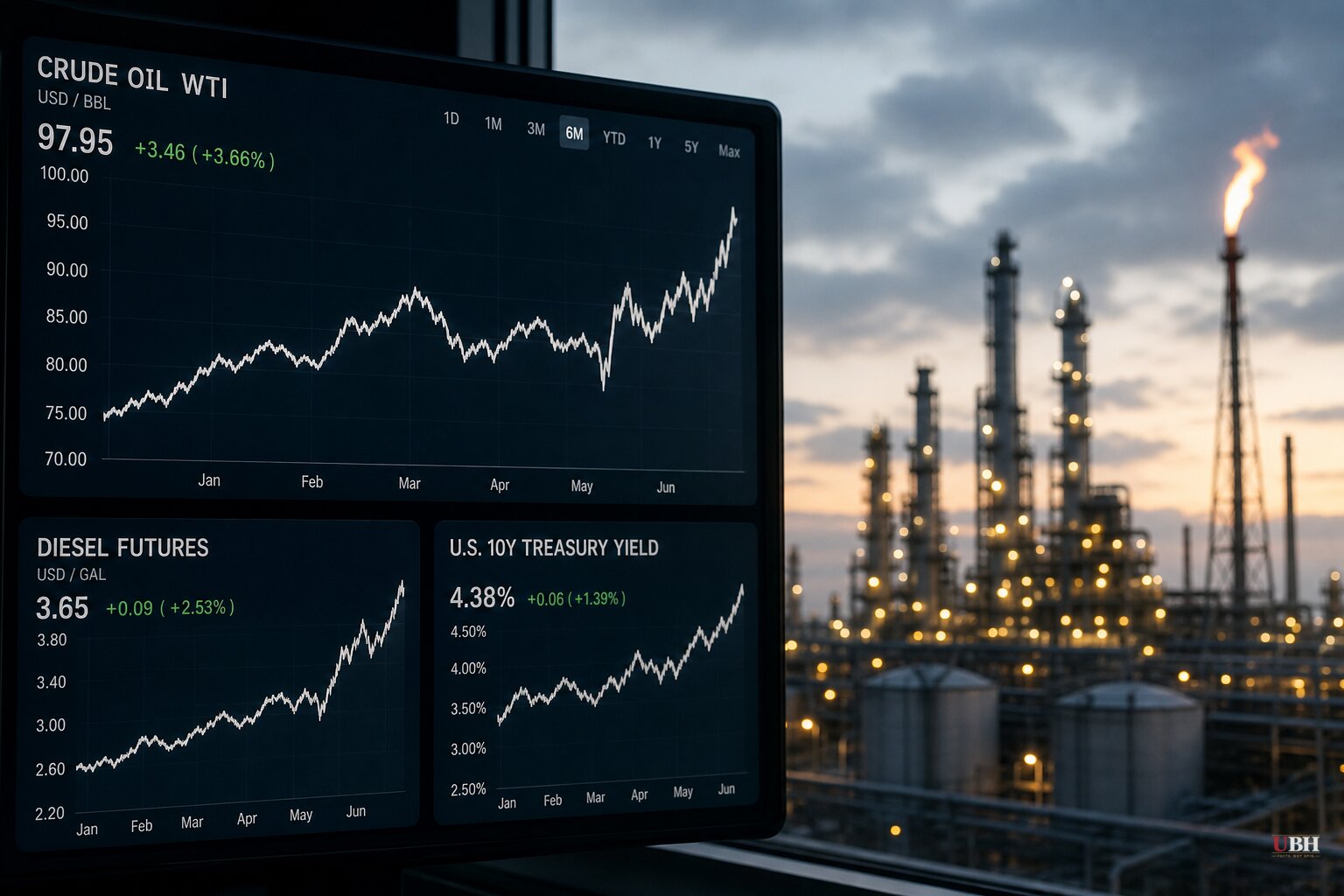
Oil markets registered the Iran war as more than a temporary disruption. Crude prices are heading back toward $100 a barrel and diesel futures hit an all-time high of $4.73 a gallon this week, according to Axios. Brent crude traded around $95 on Wednesday, up from the low $80s a month earlier, Tipp Insights reported, citing Axios data.
The 10-year Treasury yield, the benchmark that sets mortgage rates and corporate borrowing costs, was hovering around 4.8% Wednesday after touching its highest level in nearly three years, Axios reported. Government bond yields worldwide are at multiyear highs too. Morgan Stanley's analysis found the correlation between oil prices and the 10-year yield is close to its strongest point in five years, meaning the two are now moving up in lockstep.
Axios is careful to note yields aren't rising for oil reasons alone. Unsustainable federal deficits, geopolitical uncertainty and the AI infrastructure buildout are also pushing borrowing costs higher. But investor Bob Elliott put it bluntly in a note Wednesday: "For global markets the oil pain has become too great to ignore."
How We Got Here
Oil prices fell from their initial war highs earlier this year, then reversed course in July after attacks on commercial vessels in the Strait of Hormuz reignited fighting, according to Axios. President Trump declared at the time that the earlier "memorandum of understanding" between the U.S. and Iran was "over." Tensions have intensified further in recent days.
Crude before the war began around February 28 traded at roughly $70 a barrel. It has since climbed to roughly $90 or more, and the average U.S. gas price has risen from about $2.98 a gallon before the war to roughly $4.14, according to the Daily Wire.
The Administration's Counter-Narrative
The Trump administration is pushing back hard on the idea that the war has choked off supply. Energy Secretary Chris Wright told CNBC that more than 17 million barrels of oil crossed the Strait of Hormuz on a single day this week, and that total regional exports, including pipeline oil that bypasses the strait entirely, now exceed pre-war levels. "With or without Iran, oil and gas will flow out of the Arabian Gulf region," Wright said.
U.S. officials told CNN that 40 commercial vessels carrying roughly 18 million barrels moved through the strait on Tuesday, a wartime high. Before the war, about 20 million barrels a day moved through the waterway, which historically carried roughly a fifth of the world's oil shipments.
Independent tracking firm Kpler recorded just five confirmed crossings through Hormuz on Monday, down by half from the day before, the Daily Wire reported. That's a massive gap from the administration's numbers. U.S. officials say the difference comes down to tankers moving covertly at night with their transponders switched off, sometimes with Navy assistance, through a shipping corridor the U.S. military has set up along Oman's coast. No independent verification of that explanation is available in the current reporting, and the discrepancy between official and third-party tanker counts remains unresolved.
Whatever the true flow number is, it hasn't translated into cheaper gas. The Daily Wire's own reporting shows pump prices climbing even as the administration touts record throughput, and the U.S. military says it cleared Iranian sea mines from the strait last month, though Trump said Wednesday that Iran had been developing missiles capable of deploying new ones.
Diversifying Away From Hormuz
The war has pushed Gulf states and the U.S. to look for ways around the strait altogether. Treasury Secretary Scott Bessent said last month that new pipeline capacity could eventually make shipping through Hormuz "irrelevant," and the UAE is expanding its pipeline to the port of Fujairah on the Gulf of Oman to move crude without touching the chokepoint.
Separately, the administration has moved to bring new non-Middle East supply online. Under a deal Trump announced last week, Venezuela agreed to give the U.S. majority control over 65 billion barrels of its reserves, according to Reuters. North American Blue Energy Partners, a private Venezuelan producer now controlled by businessman Alejandro Betancourt, is taking over 17 oil fields for 100-year concessions previously held by Chinese and Russian firms. NABEP is expected to pay $200 billion in royalties and taxes over 25 years, and the Pentagon's Office of Strategic Capital will hold a 35% equity stake in the company's parent.
Where This Leaves Things
On the military side, Trump ruled out using a nuclear weapon against Iran when asked by reporters in the Oval Office, calling it "a stupid question" because Iran's military is "totally defeated." He has also threatened retaliation on Kharg Island, a major Iranian oil export terminal, after Iran struck U.S. bases in Jordan.
For markets, the open question is whether the administration's supply numbers hold up against independent tracking, and whether the Venezuela deal and Gulf pipeline expansions actually bring prices down before diesel costs work their way through the entire supply chain. Diesel powers most of American farming and freight. At $4.73 a gallon, that cost is already baked into everything grown or shipped in the country, regardless of what happens next in the strait.
Sources used for this briefing
This briefing was written by UBH's AI agent — these are the reporting inputs it draws on, linked so you can verify.


