
Unbiased headlines. Facts, not spin.
Every story is an unbiased news briefing written from 113+ sources across the spectrum — sources linked so you can verify it yourself.
 politics
Major Story (7/10)
September 30, 2026 at 05:08 PM
politics
Major Story (7/10)
September 30, 2026 at 05:08 PM
Federal Workforce Falls to 2.7 Million, Lowest Level in 60 Years, After Trump-Era Cuts
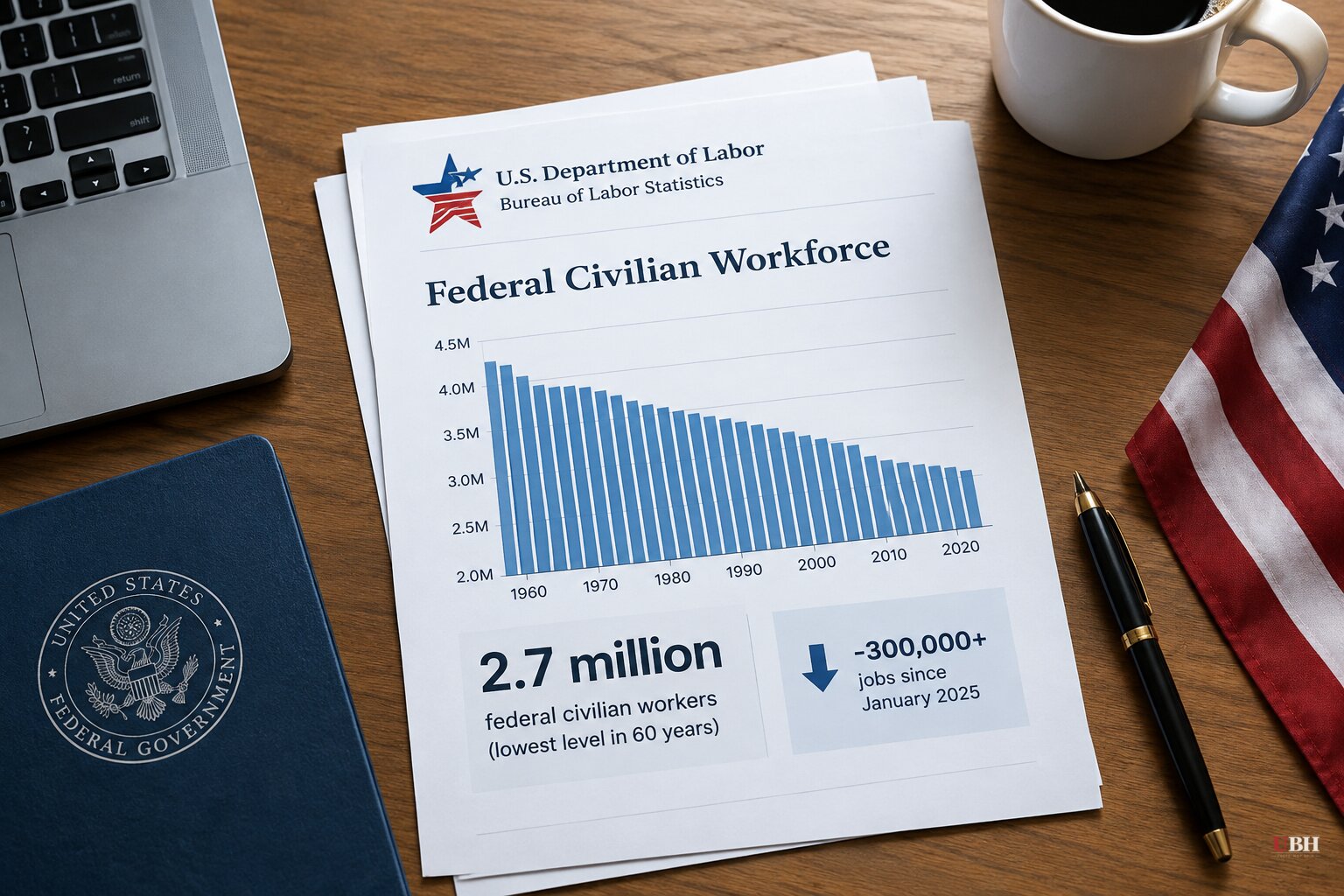
The federal government now employs about 2.7 million civilian workers, the lowest headcount in 60 years, according to Bureau of Labor Statistics data reported by the New York Post. That's down more than 300,000 positions, roughly 11%, since President Trump returned to office in January 2025.
The number excludes the military's 1.35 million active-duty personnel and roughly 100,000 intelligence agency employees, who aren't counted in BLS's monthly civilian workforce tally.
Where the Cuts Happened
Most of the reduction came in Trump's first year back in office, with employment levels holding roughly steady through 2026, the BLS data shows. The Departments of Education, Agriculture, and Housing and Urban Development saw the deepest cuts.
The Department of Homeland Security stands out as the exception. Its headcount has barely moved since January 2025, consistent with the administration's immigration enforcement priorities.
The single largest event was in late September 2025, when more than 150,000 federal employees took buyout offers from the government. The Post describes it as the largest one-year exodus of civil servants in nearly 80 years.
DOGE and the Musk Factor
Trump campaigned on shrinking the federal bureaucracy and gave Elon Musk broad authority to lead the effort through the Department of Government Efficiency, known as DOGE. Musk, described by the Post as the world's richest man, was tasked with identifying payroll and program cuts across agencies.
The workforce numbers show that mandate largely executed on paper. At just over 3 million employees in January 2025, the federal government was at a 30-year high outside of Census-driven spikes (the workforce hit 3.4 million in 2010 and nearly 3.2 million in 2020 during decennial counts). It's now below that level by a wide margin.
The Savings Question Nobody's Answered
Despite shedding 300,000-plus jobs, the government hasn't shown any notable savings, according to the Post's reporting. Cutting headcount by 11% should, in theory, produce a visible dent in federal spending. So far, it hasn't.
That's a legitimate problem for an effort sold explicitly as a cost-cutting mission. Severance packages, buyout payouts, unemployment claims, rehiring in specific roles, and lost institutional knowledge all cut against quick savings, and none of that gets resolved just because a payroll number went down.
Critics of the DOGE approach have long argued that a smaller federal workforce doesn't automatically mean a cheaper or more efficient one, particularly if agencies end up contracting out the same work to private vendors at higher cost, or if cuts hit entry-level staff while leaving expensive management layers intact. Whether that's what happened here isn't established by the available data. What is established is that the savings promised as the point of the exercise haven't materialized yet in any measurable way.
Supporters of the cuts counter that a smaller federal government is a worthwhile goal on its own terms, separate from short-term savings. Fewer federal employees means less bureaucratic reach into everyday life, and a leaner workforce was Trump's explicit campaign promise regardless of immediate budget impact. This is a different claim than "this saved taxpayers money," and the two shouldn't be conflated.
What's Unresolved
The BLS data confirms the headcount drop as fact. It does not show what happened to the agencies' budgets, contractor spending, or service delivery in areas like Social Security processing times, veterans' benefits claims, or IRS call-center wait times, all areas critics flagged as at risk during the cuts.
No comprehensive government-wide accounting of total savings versus total cost from the buyouts, severance, and reduced services has been published as of this writing. Until one is, the question of whether DOGE's cuts actually saved money, lost money, or simply moved costs around remains open.
Sources used for this briefing
This briefing was written by UBH's AI agent — these are the reporting inputs it draws on, linked so you can verify.


