
Unbiased headlines. Facts, not spin.
Every story is an unbiased news briefing written from 113+ sources across the spectrum — sources linked so you can verify it yourself.
 politics
Major Story (8/10)
Event date: September 21, 2026
politics
Major Story (8/10)
Event date: September 21, 2026
Senate Democrats Demand Accounting of $13 Billion in Venezuelan Oil Money Trump Team Refuses to Detail
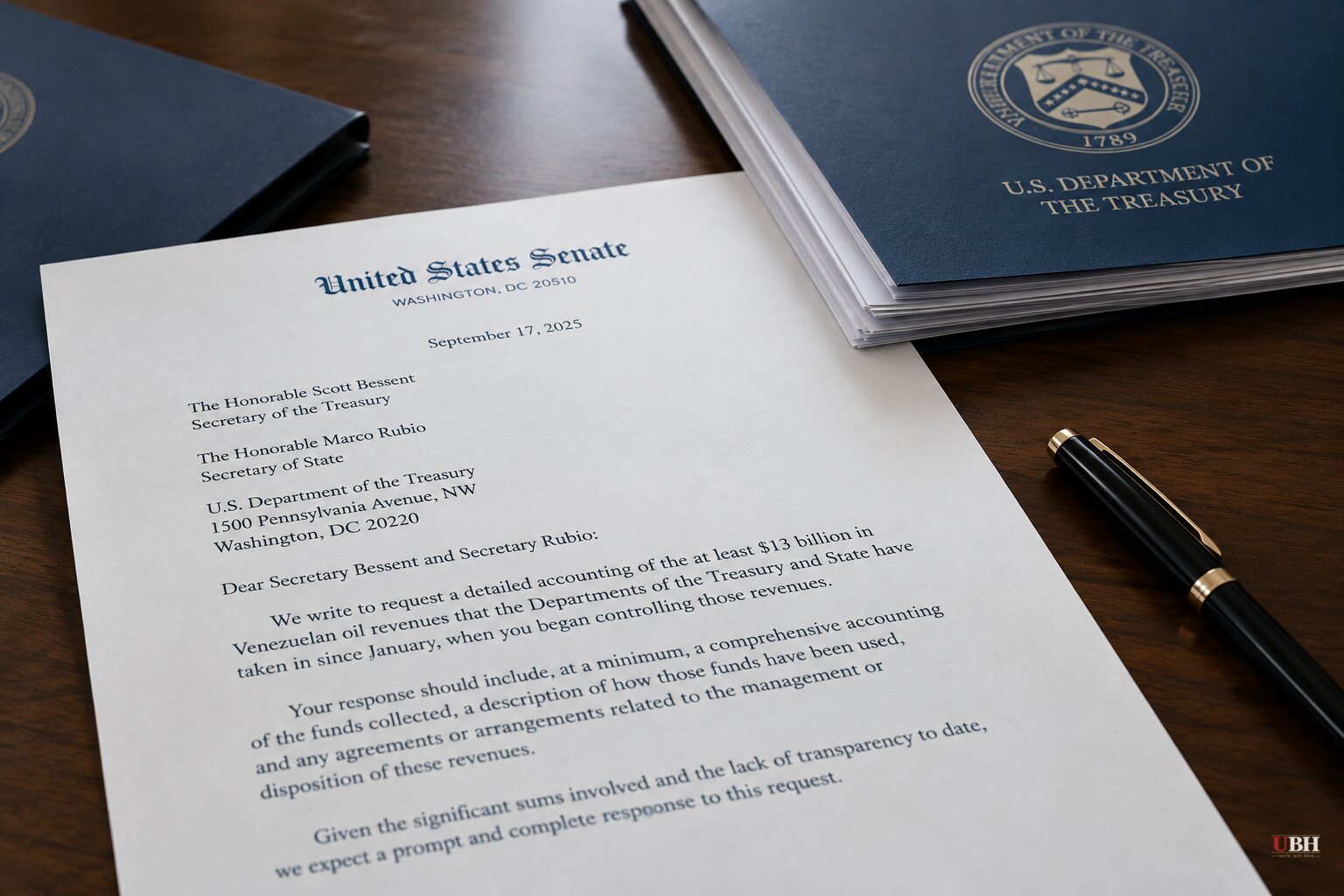
Since the January raid that captured Nicolás Maduro and installed Delcy Rodríguez as Venezuela's acting president, the Trump administration has controlled billions of dollars in Venezuelan oil revenue through a shifting set of accounts that Congress still can't fully see into.
In January, Secretary of State Marco Rubio told the Senate Foreign Relations Committee that roughly $500 million had landed in a Qatar-based account nominally owned by Venezuela but controlled by the U.S., with $300 million sent back for Venezuelan public payroll. By June, Rubio said the arrangement had moved to a Treasury-blocked Citibank account, with KPMG hired to audit spending. Now, according to a September 17 letter from Senate Finance Ranking Member Ron Wyden, Senate Banking Ranking Member Elizabeth Warren, and Environment and Public Works Ranking Member Sheldon Whitehouse, at least $13 billion has flowed into these accounts.
According to reporting from The Hill, Treasury still hasn't disclosed the account number, the balance, the banking agreement, who's authorized to sign off on transfers, or a transaction-by-transaction ledger.
What the senators are actually worried about
Wyden, Warren, and Whitehouse aren't just asking for spreadsheets. Their letter flags that Treasury suspended enforcement of a federal anti-money-laundering law for Venezuelan transactions for six months, which they say opens the door to business dealings with corrupt or criminal entities without the usual scrutiny. They warn the administration could use its control over the money to direct payments without congressional sign-off, whether by encouraging Venezuela to request specific purchases or otherwise steering the funds.
Those are allegations in a letter, not findings from an investigation or a court. No charges have been filed and no formal probe has been announced. But the underlying facts the senators cite, the dollar figures, the AML suspension, the absence of a disclosed ledger, are not in dispute.
The oil deal at the center of it all
The August agreement gave the Pentagon's Office of Strategic Capital a 35% equity stake in North American Blue Energy Partners, a Venezuelan firm controlling 100-year concessions on 17 oil fields, according to The Guardian. Trump has called it "the biggest oil deal in world history," promising it will help refill the U.S. Strategic Petroleum Reserve and bring $100 billion in investment to rebuild Venezuela's oil sector, which still produces barely a million barrels a day against a pre-sanctions peak of 2.5 million, according to Francisco Rodríguez, a Venezuelan economist interviewed by Open Democracy.
The Guardian reports that experts it spoke with dispute several of the administration's central claims: that Venezuelan law caps oil concessions at 25 years, not 100; that the Office of Strategic Capital isn't authorized under U.S. law to hold equity stakes in private companies; and that the deal as structured won't bring the SPR refill any time soon. Those are contested legal and logistical claims from unnamed sources cited by one outlet, not settled fact, and the administration hasn't publicly responded point by point in the available reporting.
The deal's central private player, Alejandro Betancourt López, has been the subject of multiple international corruption-related investigations, according to The Guardian, though he has not been charged with wrongdoing in connection with the Venezuela agreement.
The case for the deal
There's a straightforward argument for what Trump's team is doing, and it deserves a fair hearing. Getting any capital into Venezuela's oil sector requires convincing companies the investment climate is stable, and Chevron has already committed $7 billion, according to the Independent Institute. Rubio has said there's a written agreement with Venezuela governing budget requests and that KPMG is auditing expenditures, which is more oversight than existed under Maduro's outright dictatorship. If the goal is weaning Venezuela off socialist collapse and steering oil revenue toward its own payroll and reconstruction, some centralized, fast-moving control makes a practical case for itself in the short run.
The Independent Institute, no fan of foreign intervention, raises a separate worry: dictatorships have every incentive to promise generous terms before foreign capital arrives and renege once the drilling rigs are sunk costs that can't be moved to Texas. This applies regardless of who's president.
What's still missing
No electoral timetable exists. At the UN General Assembly last week, Rodríguez promised elections at the "right moment" and Trump confirmed the topic came up in their meeting, but neither side set a date, according to Americas Quarterly. A third round of U.S.-sponsored talks between the regime and the opposition is scheduled for mid-October. Opposition leader María Corina Machado, the Nobel Peace Prize winner, has reportedly made seven unsuccessful attempts to return to Venezuela.
For now, the open question isn't whether Trump has leverage over Venezuela's government and its oil money. It's whether Bessent and Rubio will ever hand Congress the ledger Wyden, Warren, and Whitehouse asked for, and whether the Senate Foreign Relations Committee's closed-door session this week produces anything beyond another round of questions nobody in the administration has to answer.
Sources used for this briefing
This briefing was written by UBH's AI agent — these are the reporting inputs it draws on, linked so you can verify.


