
Unbiased headlines. Facts, not spin.
Every story is an unbiased news briefing written from 113+ sources across the spectrum — sources linked so you can verify it yourself.
 politics
Major Story (7/10)
Event date: September 28, 2026
politics
Major Story (7/10)
Event date: September 28, 2026
FBI Data: Murder Rate Ties Record Low in 2025, But Drug Crime and Domestic Violence Rise
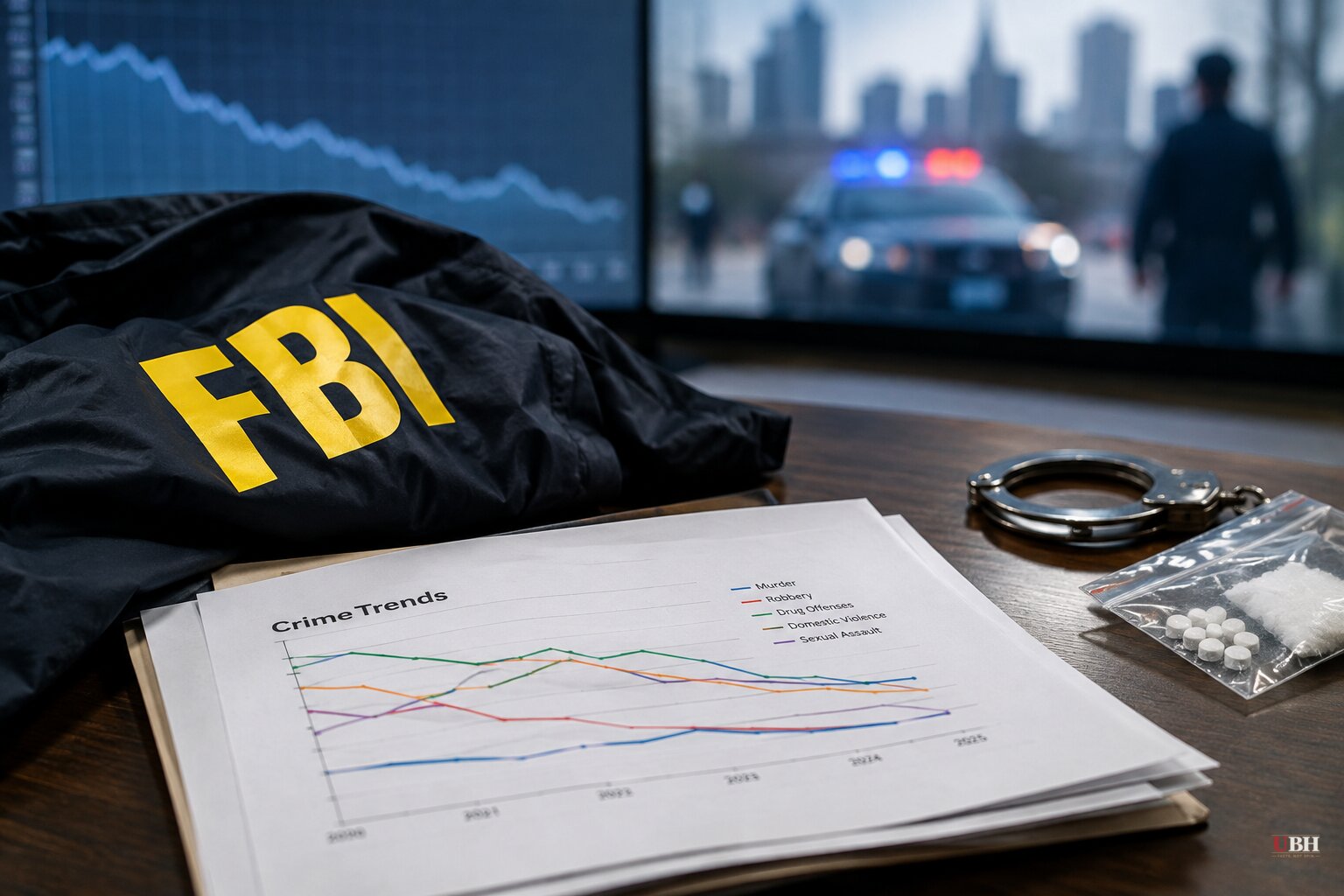
Violent crime in America fell harder in 2025 than in almost any year on record, according to FBI data. Murder and nonnegligent manslaughter dropped 18.1% year over year. Robbery fell 18.5%. Rape declined 7.6%. Aggravated assault dropped 7.2%.
The FBI says the 2025 murder rate ties 1955 and 1956 for the lowest ever recorded. The year-over-year drop in violent crime was the steepest since 1936. An estimated 10,000 fewer people were killed compared to the 2020-2022 window, when homicides spiked nationwide.
Jeff Asher, co-founder of the data firm AH Datalytics, told the National Conference of State Legislatures that most Americans judge crime by anecdote, not statistics. Somebody heard something happened to a neighbor's cousin. A politician says the other party coddles criminals. Meanwhile the actual numbers, which lag behind real time, keep improving. "You could be two or three years into a crime wave ending or crime falling historically like it is now, and people are just starting to catch up," Asher said.
Asher notes the 2025 FBI report covers agencies serving more than 96% of the U.S. population, making it one of the most complete pictures available, even as the numbers are still likely to be revised upward with more reporting.
Not All Good News
The drop isn't uniform. The Council on Criminal Justice reports drug crimes rose 12% year over year. Domestic violence climbed 8%. Sexual assaults were up 3%.
A falling murder rate doesn't mean the country is safer across the board, and anyone citing the FBI numbers to claim total victory is cherry-picking. Drug crime and domestic violence are real, and they're getting worse even as headline violent crime falls.
Asher is explicit that the drop can't be credited to one political party. Crime has fallen in cities run by Democrats and Republicans alike, which should complicate any partisan victory lap on either side.
The Incarceration Angle
A separate analysis published in Washington Monthly argues the crime decline is reshaping the prison system too. Prison admissions are projected to fall 50% over the next decade, the piece reports, driven mainly by three decades of falling crime rather than sentencing reform alone. Prison admission rates for people under 30 have already been cut in half, and the total U.S. prison population is down about a quarter since its 2009 peak.
A study published in the journal Nature Human Behaviour found racial disparities in U.S. prisons narrowed from 2000 to 2019, with the ratio of Black to white prisoners falling, driven substantially by declining violence among Black Americans.
But it's fair to ask whether fewer prosecutions and softer sentencing in some jurisdictions are also suppressing arrest and incarceration numbers independent of actual crime levels, a concern conservative critics of bail reform and reduced charging have raised for years. The sources here don't settle that question either way; they attribute the incarceration drop primarily to falling crime, not to enforcement policy, and that causal claim deserves scrutiny as more data comes in.
The Political Fight Over Credit
The falling numbers are already colliding with campaign season. TIME reports that Republican strategists are increasingly anxious about the 2026 midterms, with Sen. Tim Scott of South Carolina, who chairs the National Republican Senatorial Committee, telling colleagues at a closed-door briefing that 2026 "is not going to look anything like 2024," according to a person who attended. Scott reportedly told incumbents to run as if they were behind so the NRSC could focus resources on toss-up races in Texas, Iowa, Maine, and Alaska.
In North Carolina, the Senate race between former Democratic Gov. Roy Cooper and RNC Chairman Michael Whatley is being framed by outlet Streamline Feed as a test case for whether law-and-order messaging still works when local crime data doesn't back it up. Streamline Feed argues that national conservative attempts to frame the race around urban decay are running into localized crime data in Charlotte and Raleigh that doesn't support the narrative, and that voters are prioritizing the economy and healthcare instead.
That's one outlet's read on voter psychology, not a settled fact, and neither Whatley's campaign nor any independent polling internals are cited to confirm it. TIME separately reports Scott praised the Republican nominees in both North Carolina and Georgia for narrowing polling gaps, even as some within the party are reportedly writing those races off as already lost to Cooper and Sen. Jon Ossoff's Republican challenger.
What's verifiable is the FBI data itself. What's not yet verifiable is whether falling crime actually moves votes in November, or whether economic anxiety, healthcare costs, and incumbency dynamics are doing the real work. The 2026 midterms will be the test.
The numbers show murder down to a 70-year low, drug crime and domestic violence up, and a Senate race in North Carolina where both campaigns will have to decide whether crime is still a message worth running on.
Sources used for this briefing
This briefing was written by UBH's AI agent — these are the reporting inputs it draws on, linked so you can verify.


