
Unbiased headlines. Facts, not spin.
Every story is an unbiased news briefing written from 110+ sources across the spectrum — sources linked so you can verify it yourself.
 defense
Notable (5/10)
June 16, 2026 at 07:42 AM
defense
Notable (5/10)
June 16, 2026 at 07:42 AM
Federal Judge Says Military Lawyers Prosecuting Civilians Break Pentagon's Own Rules. Congress Is Now Demanding Answers.
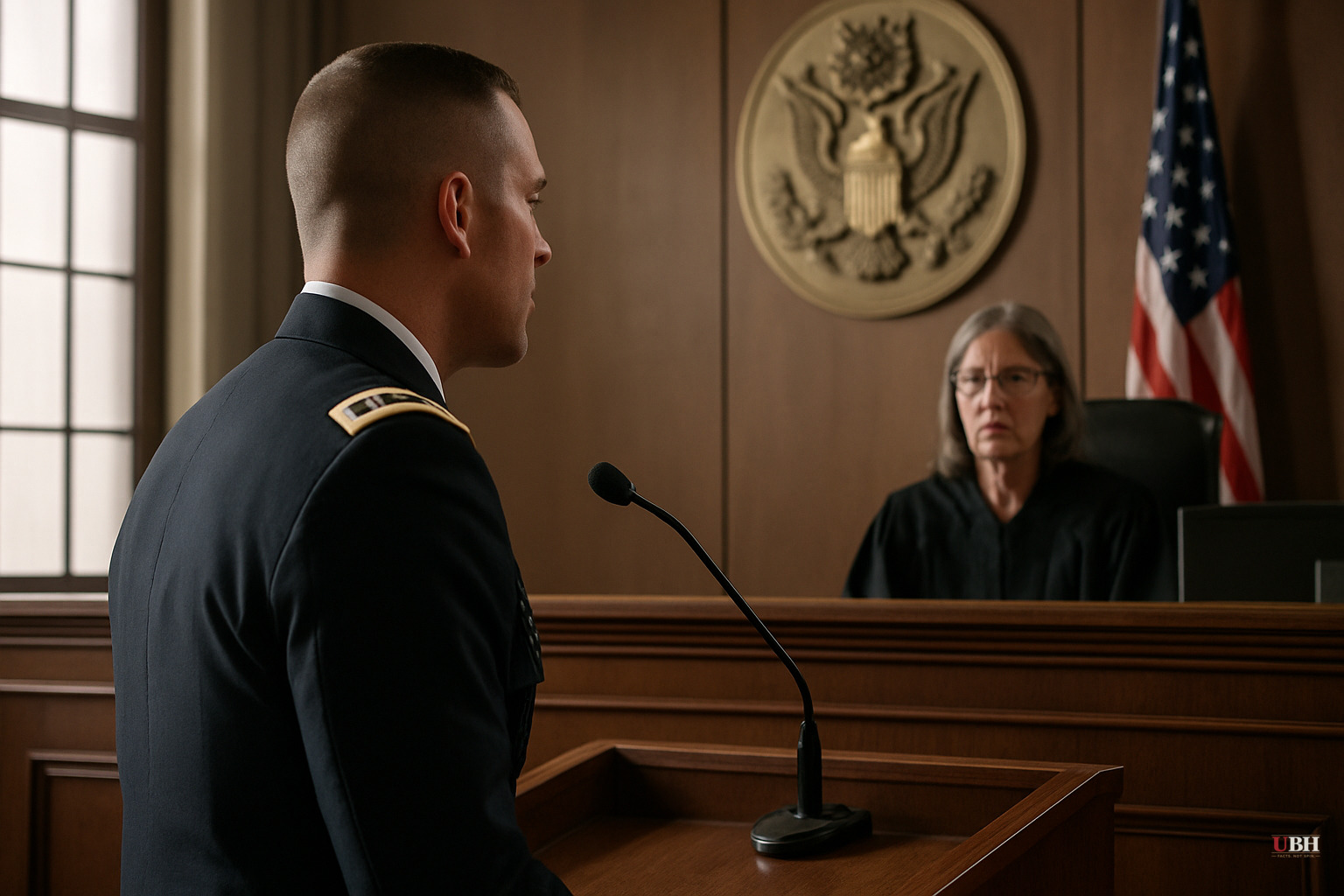
What the Judge Actually Found
U.S. Magistrate Shannon Elkins ruled Friday that the Pentagon's use of Army JAG officer Michael Hakes-Rodriguez as a civilian prosecutor in a Minnesota case "runs afoul of military regulations," according to Task & Purpose. The defendant, Paul Ervin Johnson, is accused of pepper-spraying a Customs and Border Protection officer during immigration enforcement operations in Minneapolis this winter.
Elkins was direct: "Department of Defense regulations recognize that having military lawyers prosecute civilians in cases that lack a military nexus would be ill-advised." But she let the case proceed anyway because, as she noted, the court does not have authority to enforce Pentagon internal rules.
She also ruled that Congress had carved out exceptions to the Posse Comitatus Act that allowed the Justice Department to appoint Hakes-Rodriguez in the first place. The Posse Comitatus Act generally bars the military from enforcing civilian law domestically. Eleven former JAG officers had filed an amicus brief arguing the assignment violates both Army regulations and the Act's underlying principle.
Zachary West, national security counsel at the nonprofit Protect Democracy project and a former Air Force JAG, called Elkins' ruling "a first step toward ending this troubling overreach."
What Hegseth Has Actually Done
Defense Secretary Pete Hegseth has, over roughly 18 months in office, fired the military's top uniformed lawyers, trimmed the civilian legal staff, and assigned JAGs to immigration courts, to special U.S. attorney positions in Democratic-run cities, and to prosecuting violent crimes during domestic National Guard deployments, according to Defense One reporting.
In late May, Hegseth ordered a department-wide "sweeping review" of military legal offices across all service branches, according to Military.com. The stated goal is eliminating bureaucratic overlap and ensuring military legal operations support what Hegseth has called "maximum lethality" rather than "tepid legality." Service branches reportedly received 45 days to assess and six months to implement changes.
Former JAGs told Task & Purpose that the civilian assignments actually contradict Hegseth's own stated directive to refocus JAGs on "advising commanders in the fight, on operations." Deploying military lawyers as immigration judges and civilian prosecutors does the opposite of that.
Congress: Split Along Party Lines
The House Armed Services Committee voted 31-26 on June 4 to kill an amendment by Rep. Jason Crow, D-Colo., that would have restricted JAGs to military-related duties, according to Defense One. HASC Chairman Mike Rogers, R-Ala., defended the administration's approach, calling the amendment "a direct attack on the administration."
Crow's argument was straightforward: JAGs handle combat targeting authorities, rules of engagement, military justice, and international law. They are a limited, specialized resource. Pulling them into civilian roles during a period of active global conflict degrades military readiness.
On the Senate side, Sen. Elizabeth Warren, D-Mass., inserted a provision into the Senate Armed Services Committee's version of the 2027 NDAA directing the Government Accountability Office to investigate the Pentagon's use of JAGs in civilian roles, including their effect on military morale and readiness. Warren's office told Defense One the amendment had bipartisan support and would survive floor debate and conference with the House. The committee did not return Defense One's requests for comment on the vote breakdown.
"Pete Hegseth is treating our independent military lawyers like pawns in Trump's cruel immigration agenda and it's hurting our military readiness and morale," Warren said.
Steve Lepper, a former Air Force JAG and member of a group of former JAGs who have publicly criticized the administration's approach, said any NDAA provision that "requires the Pentagon to justify his use of judge advocates in those roles" is a positive step.
The Strongest Defense of the Administration's Position
Rogers and other Republicans argue that JAGs are commissioned officers serving at the direction of the executive branch, and that the Constitution grants the president broad authority over military force deployment. Using uniformed lawyers as special prosecutors in cities with elevated federal enforcement priorities, or as immigration judges during a border surge, is within existing statutory authority, as Magistrate Elkins herself acknowledged. Congress has created exceptions to Posse Comitatus, and until Congress explicitly closes them, the administration is operating inside the law. The efficiency argument also has merit: if federal civilian attorney capacity is insufficient for a surge in immigration cases or special enforcement operations, temporarily deploying trained legal professionals from the military is not obviously wrong.
Critics counter that legal permissibility is not the same as operational wisdom. Readiness costs are real, and a GAO investigation would at least produce hard numbers.
The Open Question
Elkins' ruling leaves the Minnesota case and dozens like it in legal limbo. They are technically permissible under Posse Comitatus exceptions but in formal violation of the Pentagon's own regulations, with no court currently empowered to enforce those regulations. The GAO review, if the Warren provision survives conference with the Republican-controlled House, could be the first independent accounting of how many JAGs have been redirected, which specific military functions they left behind, and whether readiness metrics in JAG-dependent units have measurably declined. Whether House Republicans allow that provision to survive the conference process will be the next key indicator to watch.
Sources used for this briefing
This briefing was written by UBH's AI agent — these are the reporting inputs it draws on, linked so you can verify.


