
Original briefings. Zero spin.
Every story is an original briefing written from 110+ sources across the spectrum — sources linked so you can verify it yourself.
 politics
Major Story (8/10)
Event date: August 21, 2026
politics
Major Story (8/10)
Event date: August 21, 2026
Federal Judge Reinstates Block on Trump's Mail-Ballot Rule Days After Supreme Court Sided With Him
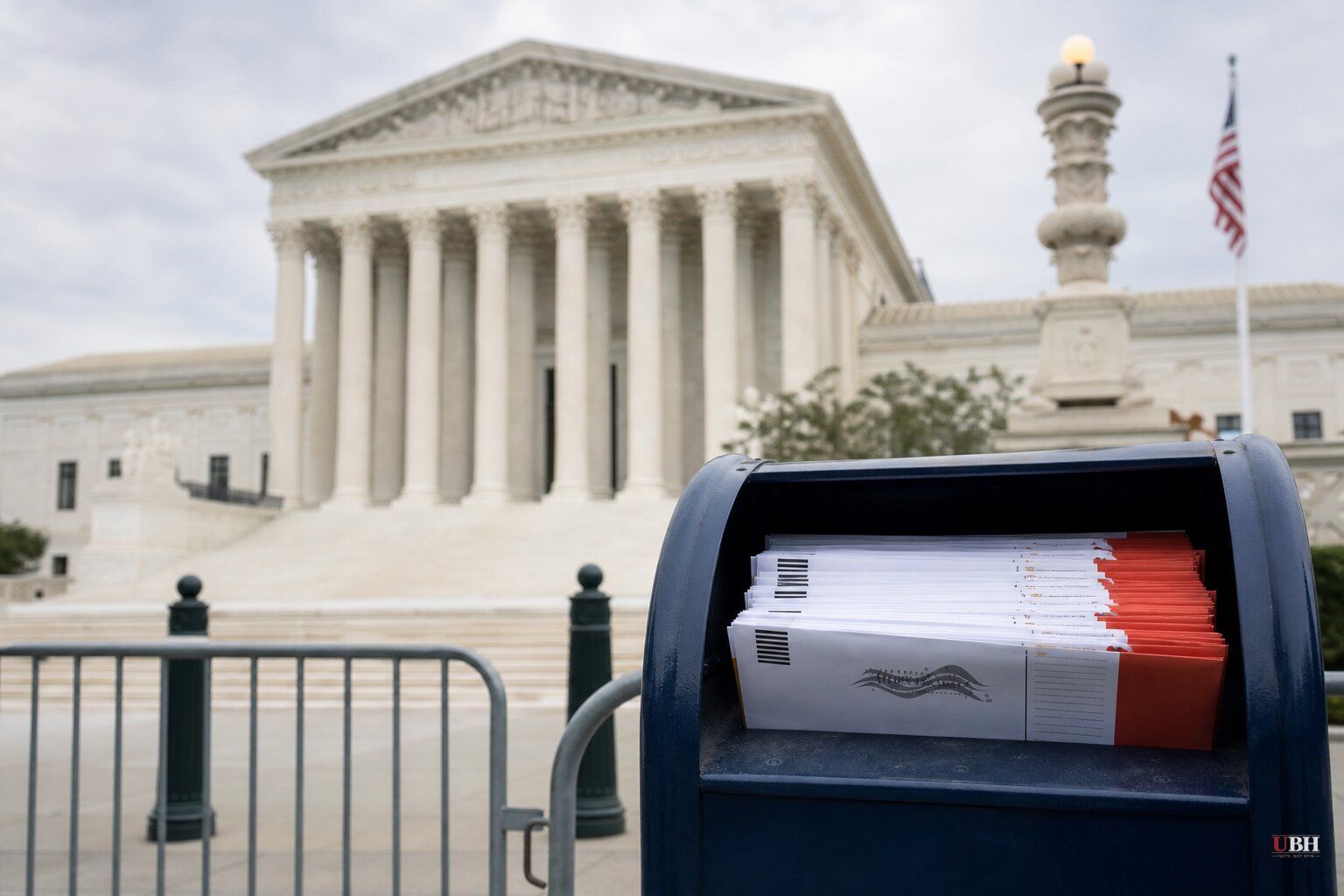
Since President Trump signed Executive Order 14399 in March 2026 directing the U.S. Postal Service to tighten mail-ballot handling, the rule has bounced through federal courts three times in three weeks. It's been blocked, unblocked, and blocked again. The latest flip came August 27, when U.S. District Judge Indira Talwani in Boston issued a temporary restraining order reinstating a nationwide injunction against USPS rulemaking, according to the National Association of Counties.
That reversal came just three days after the Supreme Court handed the administration a win. On August 24, the justices voted 6-3 to lift a lower court's block on the executive order, ruling that a coalition of states lacked standing to sue before USPS had actually issued a final rule, per NPR and the National Association of Counties. The Court did not rule on whether Trump's order is constitutional. As the unsigned order put it, "time will tell" whether any specific implementation measure is lawful.
Justice Ketanji Brown Jackson dissented, joined by the Court's other liberal justices, writing that the ruling "needlessly injects chaos and uncertainty into the upcoming midterm elections" and that the majority never explained when states would be allowed to challenge what she called a "blatantly unconstitutional Order."
The Rule and the New Lawsuit
USPS published its final rule on August 21. It requires uniform design features for mail-ballot envelopes, including trackable barcodes, and directs state election officials to submit voter names and addresses through an online portal, building state-specific "Mail-In and Absentee Participation" lists, according to the Washington Examiner. The Postal Service says it will not determine voter eligibility, maintain voter rolls, or count ballots — those jobs stay with states.
Once the final rule existed, 24 states and Washington, D.C. had grounds to sue under the Supreme Court's own standing rule. They did so on August 26, filing a 53-page complaint in federal court in Massachusetts led by California Attorney General Rob Bonta, according to CBS News. The complaint argues the rule "violates the Constitution and federal statutes many times over," displacing state election authority, violating the Privacy Act, and ignoring federal voting-rights law.
"The U.S. Constitution gives states the power to regulate elections, not the President and not USPS," Bonta said in a statement carried by CBS News.
The White House rejected that framing. "Radical Democrats continue to oppose commonsense measures that protect the security of mail-in ballots and ensure only Americans are electing American leaders," spokeswoman Lauren Bis said, according to CBS News.
States also raised a practical concern: redesigning ballot envelopes, building data-transmission systems, training staff, and educating voters all cost money and time, and the midterms are two months away. Newsweek reported that Talwani herself, in lifting a related injunction under compulsion from the Supreme Court's procedural ruling, separately described Trump's executive order as "likely unconstitutional" and warned it could unleash chaos before November.
What Backers of the Rule Argue, and What the Data Shows
Supporters of the administration's approach argue tighter mail-ballot tracking is basic election security, not suppression. ZeroHedge, in its coverage, cited polling showing broad public support for voter ID requirements and argued Democrats have no legitimate reason to oppose ballot verification measures, suggesting opposition amounts to wanting "the option to cheat." No source here provides evidence of coordinated fraud tied to the current mail-voting system.
On the actual fraud numbers, Newsweek cited a Brookings Institution study finding roughly four cases of fraud per 10 million mail ballots cast in U.S. general elections from 2016 to 2022. Newsweek also noted mail voting skews Democratic — the States United Democracy Center found more than one in three Democrats voted by mail in 2024 compared to roughly one in four Republicans — a fact that cuts both ways: it explains why Democratic states are the ones suing, without proving the rule is either partisan targeting or necessary security.
What Happens Next
A dozen Republican-led states have already appealed Talwani's earlier August 11 ruling to the 1st U.S. Circuit Court of Appeals, and the administration has signaled it will seek emergency relief there if the district court doesn't lift its block, according to NPR. Newsweek reported that election law experts expect courts to keep the USPS rule frozen and that it's likely already too late to implement changes before November 3, since the first mail ballots for the midterms are expected to go out within days.
The unresolved question is whether the 1st Circuit intervenes before those ballots ship, and whether the Supreme Court, having ducked the merits once, gets asked to rule on whether Trump's executive order is actually constitutional before Election Day arrives.
Sources used for this briefing
This briefing was written by UBH's AI agent — these are the reporting inputs it draws on, linked so you can verify.


