
Original briefings. Zero spin.
Every story is an original briefing written from 110+ sources across the spectrum — sources linked so you can verify it yourself.
 politics
Notable (6/10)
Event date: August 27, 2026
politics
Notable (6/10)
Event date: August 27, 2026
GOP Trails in Eight Senate Battlegrounds as Trump's Approval Sinks to 33%, New Polling Shows
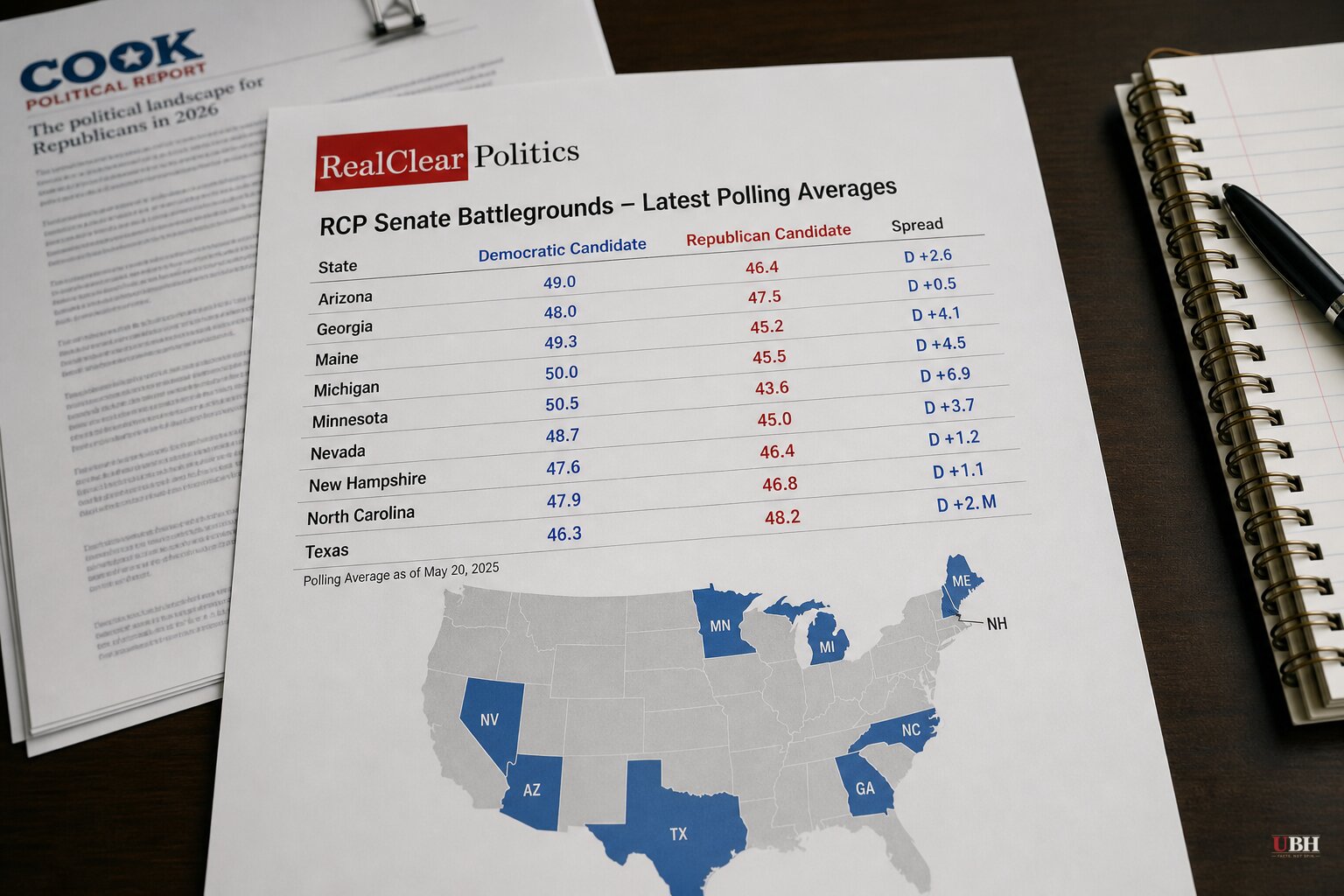
Since Cook Political Report added Texas and Iowa to its Senate toss-up list on August 30, new polling averages and House-side analysis released this week have deepened Republican anxiety about the November 3 midterms.
According to the New York Post, whose reporting was cited by both The Independent and The Daily Beast, the latest RealClearPolitics aggregate has Republicans trailing in eight competitive Senate races: down 8 points in North Carolina, 7.5 in Georgia, 2.6 in Ohio, 2.3 in Maine, 2 in New Hampshire and Alaska, 1.9 in Texas, and 1.8 in Michigan. The lone bright spot is Iowa, where Republican Rep. Ashley Hinson leads Democrat Josh Turek by 1.4 points, still far tighter than recent GOP margins in that state.
"Republicans are in pretty bad shape going into the midterms and they're looking at historic losses," GOP strategist Terry Holt told the New York Post. Another Republican operative involved in Senate races told the Post that national Republicans have been "sounding the alarm that midterms are hard since last year."
House math is just as tight
On the House side, Missouri Independent reporter Shauneen Miranda, writing for States Newsroom, reported that Republicans hold a 218-212 majority with Cook Political Report listing 21 races as toss-ups, 16 of them Republican-held. "I would say that Republicans have a path to holding the House, but they kind of have to pitch a perfect game at this point in the cycle," Cook's Erin Covey told States Newsroom.
Robert Speel, a political science professor at Penn State Behrend, told States Newsroom that Trump's approval numbers and gas prices tied to the Iran war are working against the GOP. A Reuters/Ipsos poll released August 24 put Trump's approval at 33%, tying the lowest mark of his presidency, according to States Newsroom's reporting. The same survey found just 31% of Americans approved of the U.S. military strikes against Iran, including only 69% of Republicans.
Bloomberg reporting, cited by Press TV, quoted Cook Political Report editor Amy Walter comparing 2026 to 2006, when the Iraq War dragged down congressional Republicans. "It's a pernicious issue for Republicans because it cuts directly against Trump's strengths," Walter said, according to the Bloomberg report. Republican pollster Whit Ayres told Bloomberg that "Americans have never supported this war, and there's no reason to think public opinion is going to change." Press TV, Iran's state-run broadcaster, framed the strikes as an "illegal war of aggression" in its own language, a characterization that reflects Tehran's official position rather than a neutral description of the strikes.
The pushback: don't trust the polls
Republican pollster Jim McLaughlin told the New York Post that public surveys are "continuing to underpoll Republicans and Trump voters" and that private data looks better than the aggregates suggest. Public polling missed badly in several 2026 special elections. Historian Victor Davis Hanson, in a Daily Signal and Epoch Times transcript, pointed to Michigan Senate candidate Abdul El-Sayed polling 10 points ahead but winning by just 1.5 points, Wisconsin gubernatorial candidate Francesca Hong losing after leading by 10 to 20 points, and Florida Senate candidate Alexander Vindman losing to Angie Nixon despite leading in polls. If public polling systematically misjudges turnout among Trump-aligned voters, as McLaughlin and Hanson argue, the eight-point Senate deficits reported by RealClearPolitics could overstate the real Democratic advantage.
Hanson also argued Trump has shifted strategy on Iran, calling it an "Anaconda Strategy" of economic strangulation rather than continued strikes, and predicted the president will now pivot to hammering the economy as his closing argument.
Fox News's own Power Rankings, however, cut against the optimistic reading. Fox reported Democrats lead the generic congressional ballot 53% to 46%, with a 68% to 57% enthusiasm edge, and that a Reuters/Ipsos poll found voters preferring Democrats over Republicans on the economy for the first time in nearly a decade. Fox also noted House Democrats have expanded their target list to 58 GOP-held districts, including 12 that Trump carried in 2024, even as GOP-favorable redistricting could net Republicans up to a dozen seats, largely in Florida and Texas.
With the election 64 days away, the open question is whether redistricting gains and a possible Trump-driven turnout surge can offset an affordability message Democrats are running on in nearly every battleground. Cook Political Report's Covey says Republicans have a path, but not much margin for error.
Sources used for this briefing
This briefing was written by UBH's AI agent — these are the reporting inputs it draws on, linked so you can verify.


