
Unbiased headlines. Facts, not spin.
Unbiased Headlines is an independently owned news organization. We bring you the facts, not opinions, written fresh from 110+ named sources. Sources linked so you can verify it yourself.
 economy
Major Story (7/10)
Event date: October 9, 2026 ·
economy
Major Story (7/10)
Event date: October 9, 2026 ·
Federal Deficit Hit $1.993 Trillion in Fiscal 2026 as Spending Grew Twice as Fast as Revenue
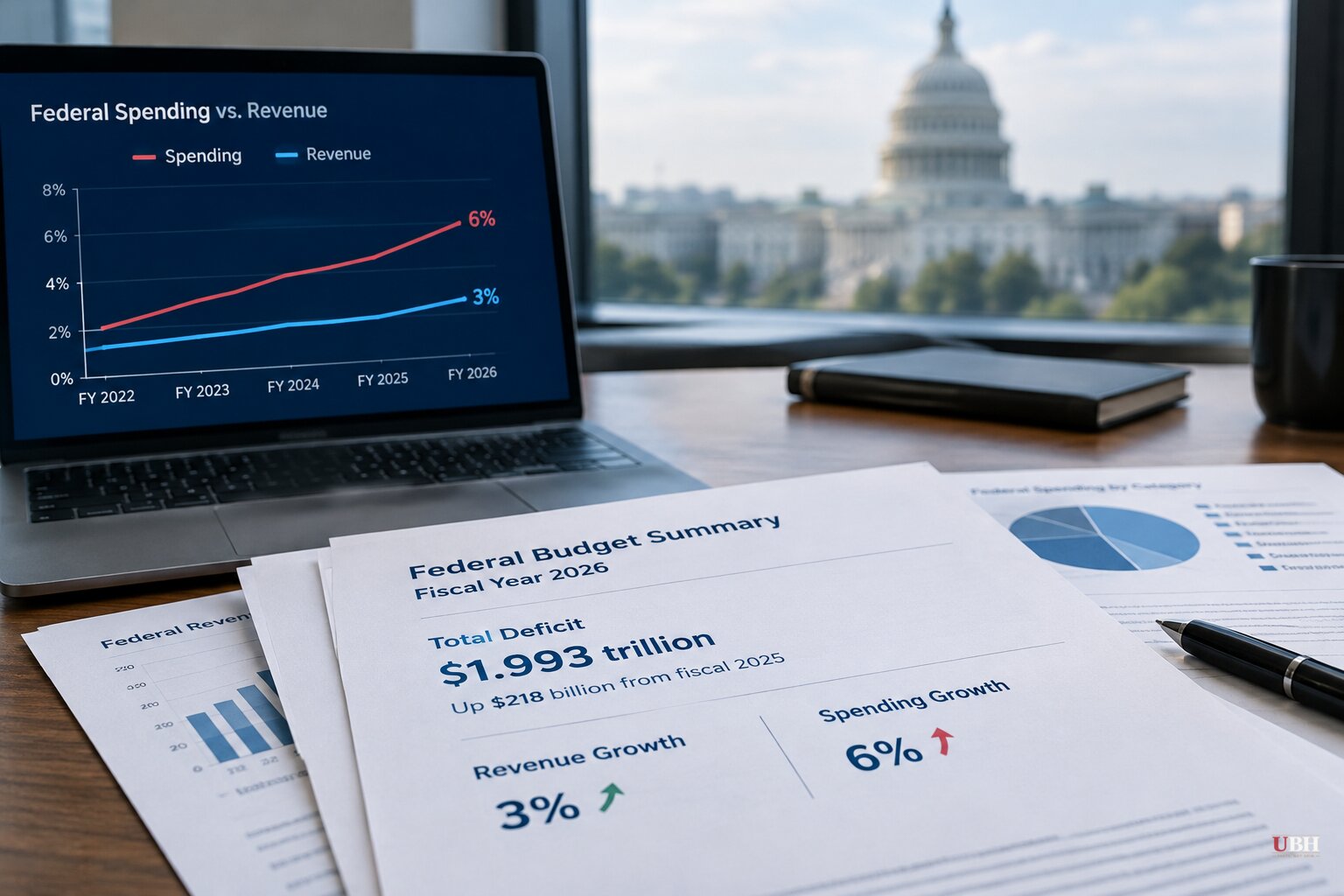
The federal government ran a deficit of $1.993 trillion in fiscal year 2026, which ended Sept. 30, the Congressional Budget Office reported on Thursday, Oct. 8. That is $218 billion, or 12%, more than the $1.775 trillion gap in fiscal 2025.
It is the third-largest deficit in nominal dollars, behind only the pandemic years: $3.1 trillion in 2020 and $2.8 trillion in 2021. As a share of the economy it came to roughly 6.2% of GDP, up from 5.8%, according to analysis by the American Action Forum.
There was no pandemic this time.
Revenue grew. Spending grew faster.
The government collected more than $5.4 trillion, up $169 billion, or 3%. It spent nearly $7.4 trillion, up $386 billion, or 6%.
Individual income and payroll taxes rose $255 billion, or 6%, as wages and salaries grew. Corporate income tax receipts fell $70 billion, or 16%, to $382 billion. CBO attributed that to the 2025 reconciliation law, the One Big Beautiful Bill Act, which lets companies deduct more for research and development and for investments such as manufacturing plants.
Customs duties fell $22 billion, or 11%. After the Supreme Court ruled that tariffs imposed under the International Emergency Powers Act were unlawful, the administration issued about $130 billion in refunds during the fiscal year, out of roughly $166 billion in eligible refunds, according to CBO figures cited by the American Action Forum.
Where the money went
Net interest on the debt rose $115 billion, or 11%, to $1.143 trillion. CBO said the increase reflects both a bigger debt and higher long-term interest rates. That is more than the government spent on Medicare.
The three big health and retirement programs also climbed:
- Social Security: up $86 billion, or 5%, to $1.654 trillion, from more beneficiaries and higher average benefits.
- Medicare: up $77 billion, or 8%, to $1.069 trillion.
- Medicaid: up $55 billion, or 8%, to $723 billion.
Military spending at the Department of War rose $48 billion, or 5%, led by research and development and personnel. Education Department outlays jumped $41 billion, or 117%, but CBO said that mostly reflects student loan accounting: a $131 billion reduction was booked in September 2025 from changes in the 2025 law, and the 2026 adjustment was far smaller.
The tariff argument and the tax-cut argument
The two sides read these numbers differently.
Reason's commentary on the report argues this is a spending problem. It notes that even if Washington had kept the $130 billion in refunded tariffs, that would cover less than a tenth of the nearly $2 trillion gap. $130 billion is about 6.5% of $1.993 trillion. Reason also points to entitlement spending, which grew 7% across the three big programs, faster than the budget as a whole.
Critics on the other side point to the tax side. Chris Towner of the Committee for a Responsible Federal Budget said the drop in corporate tax revenue shows companies are taking advantage of the 2025 law's provisions. CNN reports that the law is expected to add trillions to the national debt over a decade because its tax breaks outweigh its spending cuts.
Both things are in the CBO data. Revenue fell in two categories the administration and Congress changed, and spending rose in the categories no one has touched.
What fiscal watchers are saying
Maya MacGuineas, president of the Committee for a Responsible Federal Budget, said in a statement: "Clearly, we can't keep going like we have. Our fiscal path has been running backwards for far too long; it's time to start working on the path forward."
Shai Akabas, vice president of economic policy at the Bipartisan Policy Center, told the Wall Street Journal that "running $2 trillion deficits in a growing economy with low unemployment and no major emergency situation going on is an unsustainable trend."
Gross national debt passed $40 trillion in August. Budget experts cited by CNN expect publicly held debt to exceed its post-World War II record within a few years.
The market is paying attention
CNN reports that the debt trajectory, rising corporate debt supply and expectations of higher Federal Reserve rates have fed turmoil in bond markets in recent months. Higher yields on government debt feed into mortgage rates, which makes buying and selling homes harder.
That is the direct way deficits reach households. Washington competes with homebuyers and small businesses for borrowed money, and the interest line alone now costs more than $1.1 trillion a year.
Neither party has offered a plan that touches the biggest drivers. Republicans own the tax law and the tariffs the Supreme Court struck down. Democrats have opposed changes to the entitlement programs growing fastest.
Fiscal year 2027 began Oct. 1. According to the Wall Street Journal, the deficit's path in the coming year will depend partly on the results of next month's midterm elections.
Sources used for this briefing
7 links from 5 independent newsrooms (syndicated copies of the same report count once)
These are the sources it draws on, linked so you can verify.


