
Unbiased headlines. Facts, not spin.
Every story is an unbiased news briefing written from 110+ sources across the spectrum — sources linked so you can verify it yourself.
 health
Notable (5/10)
September 16, 2026 at 12:40 AM
health
Notable (5/10)
September 16, 2026 at 12:40 AM
FDA Holds Rare Public Hearing on Psychedelic Drugs, Takes No Vote on Approval
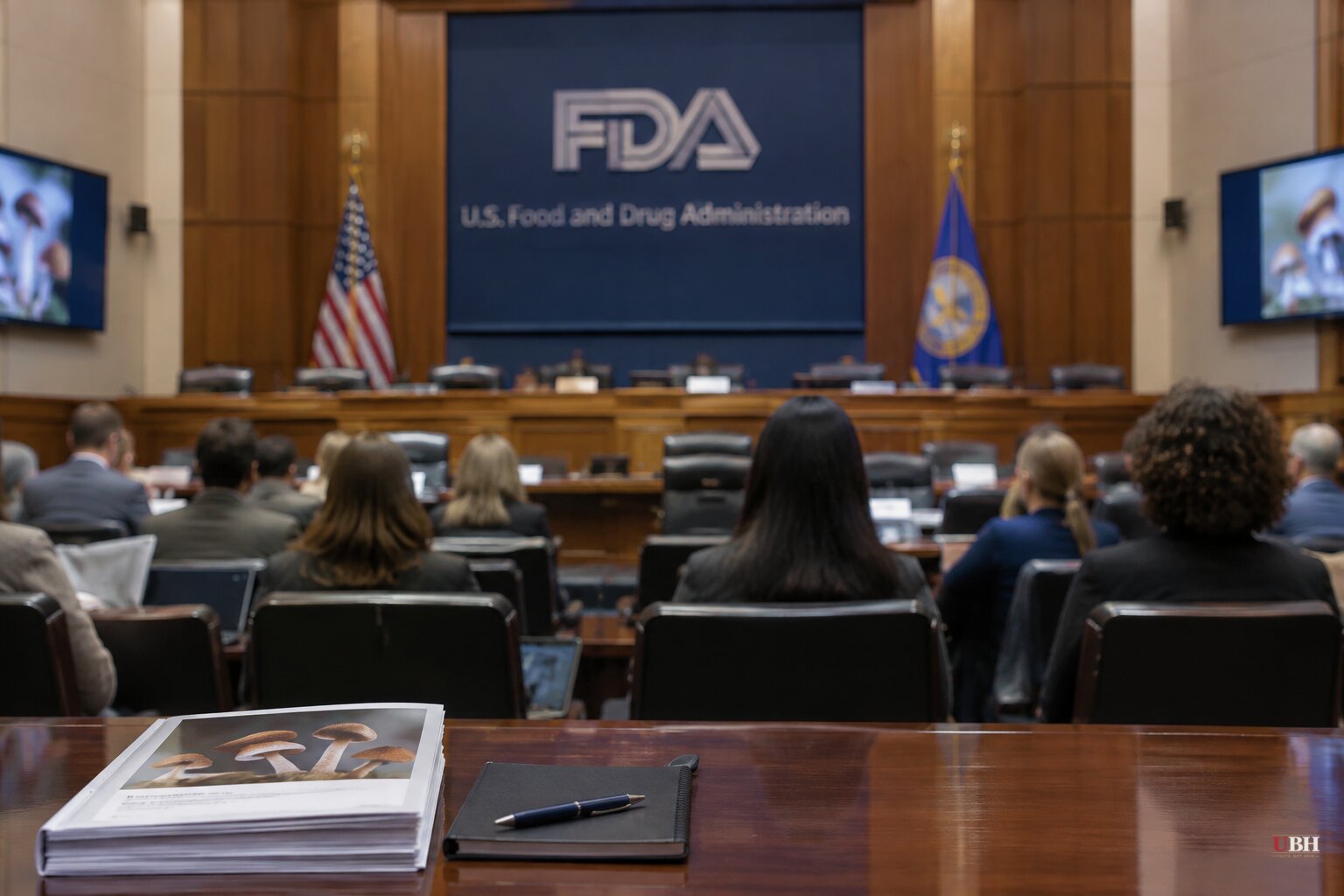
The FDA convened one of its rarest public forums Monday at its White Oak campus in Maryland: a four-hour "Part 15" hearing on the future of psychedelic drug therapy. According to psychedelicalpha, the agency has held just two such informal hearings since 2020. About 300 people showed up in person, with another 1,000 watching a livestream.
Roughly 80 speakers each got two minutes to make their case, according to psychedelicalpha and MedPage Today. Most backed psychedelic medicine for conditions like major depressive disorder and PTSD. But plenty raised hard questions about safety, training standards and who actually gets access once, or if, a drug gets approved.
Marta Sokolowska, deputy center director for substance use and behavioral health at the FDA's Center for Drug Evaluation and Research, ran the session. "Today's hearing is part of a whole-of-government effort to better understand the opportunities, challenges, and public health considerations associated with this evolving area of psychedelic drug treatment," she said, according to MedPage Today. "Most importantly, we are here today to listen."
Not an Approval Meeting
Medindia flagged an important fact for anyone reading headlines about this hearing: this was not a vote and it did not establish that psilocybin, MDMA or ibogaine is safe or effective. The FDA said it wanted feedback on the "potential future therapeutic use" of these drugs in supervised settings. No product left this meeting closer to a green light.
Fierce Biotech's framing that the FDA is "marching toward the likely first approval of a psychedelic medicine" reflects that outlet's own read of momentum in the sector, not a decision made at this hearing. The FDA did not announce any timeline for approval Monday.
Trump's Executive Order Is Driving the Clock
This hearing didn't happen in a vacuum. President Trump signed an executive order in April 2026 directing the FDA to accelerate research and approvals for psychedelic drugs targeting serious mental illness, according to Sokolowska's own remarks reported by MedPage Today. Since then the agency has awarded priority review vouchers to companies studying psilocybin for major depressive disorder and treatment-resistant depression, plus a voucher for methylone, an MDMA-related compound, for PTSD. It also cleared an early-phase trial of noribogaine hydrochloride for alcohol use disorder.
Days before the hearing, FDA officials including Center for Drug Evaluation and Research head Michael Davis published a framework in the New England Journal of Medicine addressing one of the field's thorniest technical problems: keeping trials properly blinded when patients can usually tell whether they got a psychoactive drug or a sugar pill. KSL News reported Jefferies analysts read the framework as a signal the FDA is willing to accept flexible trial designs to work around that problem. The FDA authors themselves warned that unblinding "may also induce a disappointment effect, wherein participants experience negative outcomes because they believe they received an inactive treatment."
The Real Fight: Therapy Requirement vs. Access
The most consequential disagreement at the hearing wasn't about whether psychedelics work. It was about how they should be delivered, and that split has real financial stakes.
Companies like Compass Pathways and Definium Therapeutics have built their drug-development models around having a trained monitor supervise dosing sessions, deliberately separating the drug's effect from formal psychotherapy, according to Fierce Biotech. Critics at the hearing pushed back hard. Geoff Bathje, a clinical psychologist and co-founder of Sana Healing Collective, said he's been "disappointed to see the FDA minimize the importance of the therapeutic relationship in psychedelic research for the sake of isolating drug effects in clinical trials." Lawrence Leeman of the University of New Mexico argued the treatment should be built around psychedelic-assisted therapy, not just a drug with a babysitter in the room.
Peter Hendricks, a professor at the University of Alabama at Birmingham, offered the strongest counterargument. He warned that requiring psychotherapy across the board "would fall hardest on the people least able to find care elsewhere," noting his own trial patients are disproportionately low-income and uninsured. He pointed out, correctly per the FDA's own guidance, that the actual contribution of psychotherapy to psychedelic treatment outcomes hasn't been scientifically nailed down yet. His proposed fix: let product labels specify which of three models the evidence actually supports, safety monitoring, psychological support, or full psychotherapy, rather than mandating the most expensive option for everyone.
Mandating therapy might improve outcomes for some patients. It also raises costs, and costs get passed to patients who can least afford them.
Access Concerns Went Beyond the Therapy Debate
Lynn Watkins, a U.S. Air Force veteran with the Psychedelics and Pain Association, put the access problem bluntly, according to KSL News: "Approval alone is not access. A breakthrough therapy nobody can reach is not a breakthrough, it is a press release." Melissa Lavasani, CEO of the Psychedelic Medicine Coalition, pushed for the FDA to collect outcome data broken out by menstrual phase, pregnancy status, and hormonal status, warning that averaged results could hide real safety or efficacy differences between patient groups.
Edward Jacobs, a Johns Hopkins researcher, argued the FDA should hold the line on strong safeguards rather than loosen them for convenience, per NPR. Lida Fatemi, a hospice physician who runs a psychedelic training program in New Mexico, stressed to NPR that these are not drugs a doctor simply prescribes and sends a patient home with: "The psychedelic care touches perception, memory, identity, profound and vulnerable territory."
None of this was resolved Monday. The FDA collected the input; it did not commit to any specific credentialing rule, reimbursement policy, or trial design standard. The agency has not announced when, or whether, it will issue new formal guidance based on what it heard, leaving providers, insurers, and patients waiting on a regulatory framework that still doesn't exist.
Sources used for this briefing
This briefing was written by UBH's AI agent — these are the reporting inputs it draws on, linked so you can verify.


