
Unbiased headlines. Facts, not spin.
Every story is an unbiased news briefing written from 110+ sources across the spectrum — sources linked so you can verify it yourself.
 health
Notable (5/10)
Event date: September 14, 2026
health
Notable (5/10)
Event date: September 14, 2026
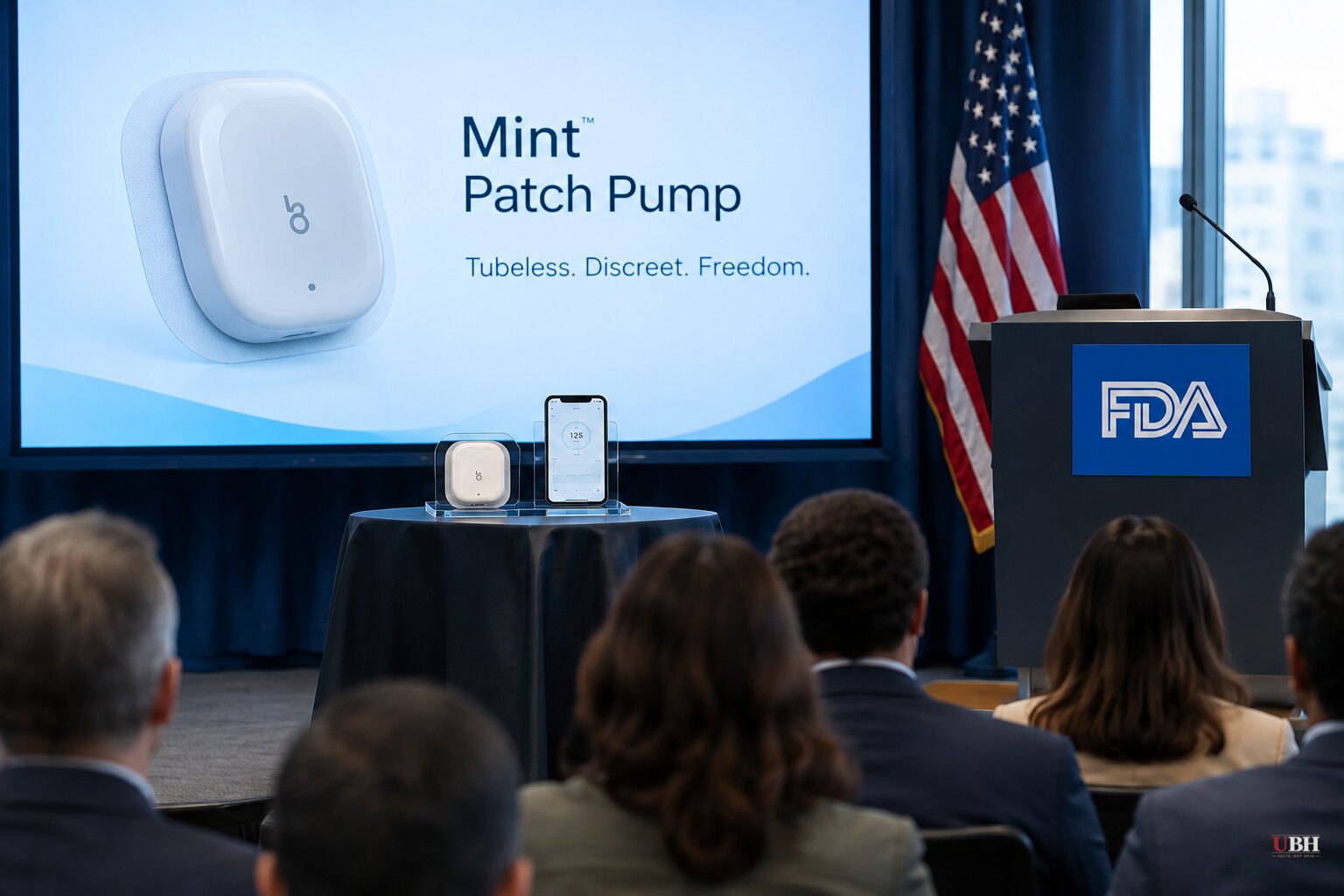
FDA Clears Beta Bionics' Mint Patch Pump as Global Experts Roll Out First Type 1 Diabetes Screening Guidance
A new player finally challenges Insulet
Beta Bionics, Inc. (Nasdaq: BBNX) announced on September 14 that the FDA cleared Mint, its first tubeless insulin patch pump. The device runs up to three days without recharging, plus a 12-hour grace period, and packs a 200-unit insulin reservoir into a smaller footprint than rival pumps, according to Healio. It syncs with an iOS or Android phone and integrates with Dexcom's G7 and G7 15-day sensors as well as Abbott's FreeStyle Libre 3 Plus.
Beta Bionics is only the second company to bring a tubeless patch pump to market, according to MedTech Dive, which quoted analyst commentary from Kratky calling it "a major product enhancement" since patch-versus-tube is one of the biggest decision points for patients choosing a pump. Until now, Insulet's Omnipod line had that market largely to itself.
Beta Bionics also filed a 510(k) application for 3D Intelligence, a next-generation dosing algorithm with three separate settings: one carrying over the current iLet algorithm, one refined using real-world iLet data, and a third designed to respond more conservatively when correcting high blood sugar. Combined with Mint, the company is branding the pairing "Mint 3D" and "iLet 3D", though both remain subject to FDA clearance, per the company's investor release.
Faster launch, smaller 2026 revenue
Beta Bionics said it now expects to begin the full U.S. commercial launch of Mint in the first quarter of 2027, which the company describes as ahead of its original target of late 2027. Manufacturing is planned to hit at least 1.5 million disposable units in 2027, with executives saying they could exceed that by adding staff and automation.
The catch: Mint will launch exclusively through the pharmacy channel, and only about 40% of insured U.S. patients will initially be able to buy it using pharmacy benefits, according to the company's own release. Beta Bionics expects that to climb to at least 50% within Mint's first year on the market.
That pharmacy-channel rollout comes with a near-term cost. Beta Bionics cut its 2026 full-year revenue guidance to a range of $121 million to $126 million, down $10 million from its earlier forecast of $131 million to $136 million, according to the Orange County Business Journal. The company said the cut reflects prospective customers holding off on its current iLet pump to wait for Mint instead, a dynamic confirmed by MedTech Dive's reporting on the same guidance change.
Investors didn't punish the stock for it. Shares rose 3.4% to $17.14, giving Beta Bionics a market cap of roughly $769 million, per the Orange County Business Journal. Separately, Senseonics announced its year-long implantable CGM will integrate with Beta Bionics' current tubed iLet pump, though MedTech Dive noted the company hasn't said whether that partnership extends to Mint.
Catching type 1 diabetes before it becomes an emergency
On September 10, a Breakthrough T1D-convened panel of nearly 30 international experts published the first consensus framework for general-population screening for type 1 diabetes in the journal Diabetologia, according to PR Newswire. The guidance lays out a specific schedule: initial screening for islet autoantibodies at ages 2 to 4, rescreening at 6 to 8 for kids who tested negative, and a final rescreen at 10 to 15.
The science behind this: type 1 diabetes develops in stages, and a blood test can detect islet autoantibodies, signals the immune system is attacking insulin-producing cells, years before a child ever needs insulin. Two or more persistent autoantibodies mean a child is already in stage 1 or 2 disease and will very likely progress to full clinical (stage 3) diabetes, per the guidance.
Anastasia Albanese-O'Neill, Breakthrough T1D's vice president of medical affairs, said the guidance "moves us one step closer to a world where everyone is screened and has the opportunity to realize the benefits of screening." Those benefits include a lower risk of diabetic ketoacidosis at diagnosis, a life-threatening complication, plus access to therapies like teplizumab, which is already approved to delay the onset of stage 3 disease in high-risk patients, and entry into clinical trials for newer disease-modifying drugs, according to PR Newswire.
This is guidance for doctors and families, not a federal mandate. Parents still decide whether their kids get screened, and the panel's own framework calls for building it into routine preventive visits rather than forcing it on anyone.
What's still open
Beta Bionics has not yet said when 3D Intelligence or Mint 3D will clear the FDA, only that both remain "subject to regulatory clearance." With Mint launching through the pharmacy benefit rather than the durable medical equipment channel most competitors use, whether insurers expand coverage past that initial 40% as fast as the company is projecting will be a key measure of success in early 2027.
Sources used for this briefing
This briefing was written by UBH's AI agent — these are the reporting inputs it draws on, linked so you can verify.


