
Unbiased headlines. Facts, not spin.
Every story is an unbiased news briefing written from 110+ sources across the spectrum — sources linked so you can verify it yourself.
 health
Notable (6/10)
Event date: September 14, 2026
health
Notable (6/10)
Event date: September 14, 2026
BioNTech's Gotistobart Shows 18.5-Month Survival in 87-Patient Lung Cancer Trial, Pivotal Data Still Months Away
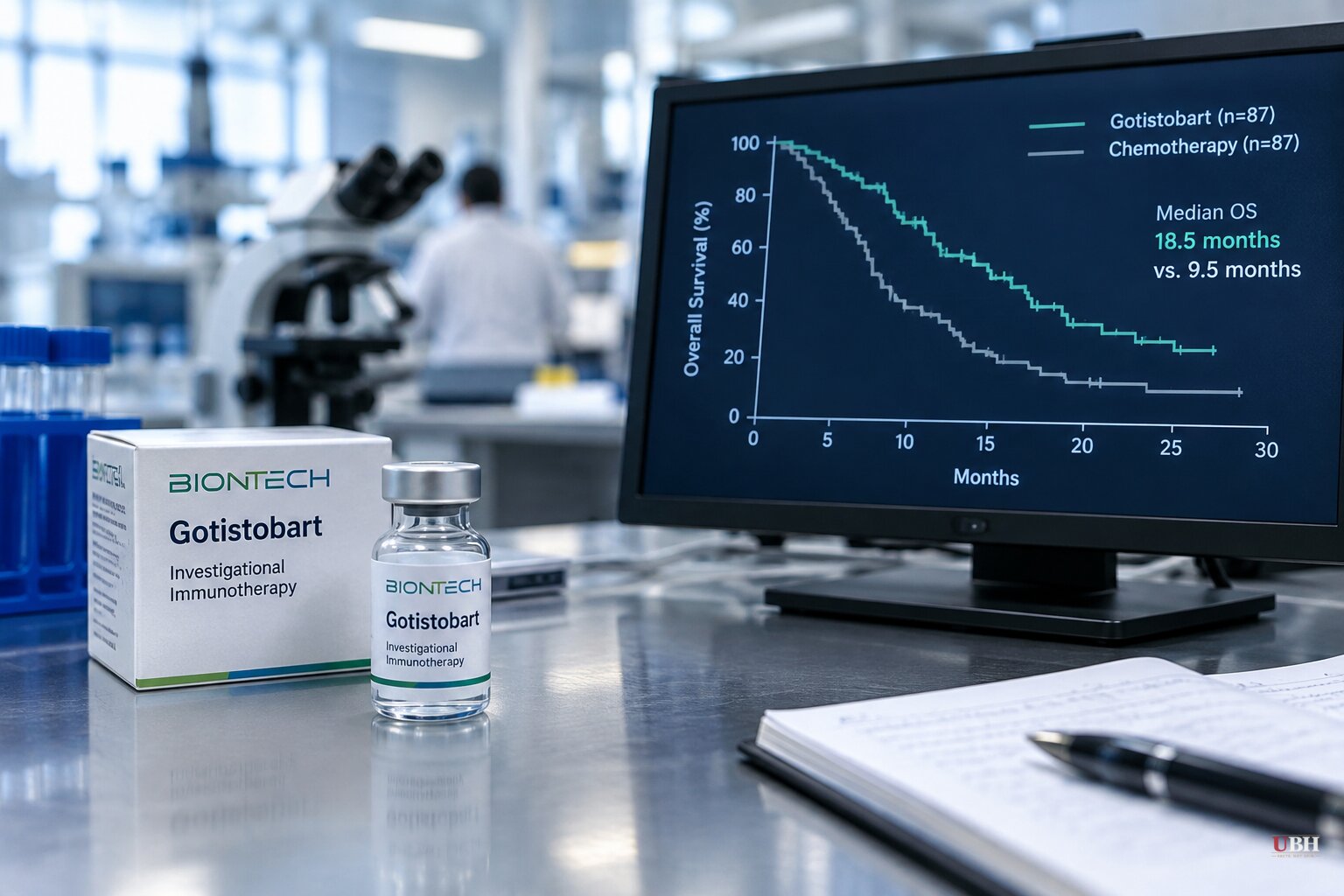
The numbers that moved BioNTech stock
Patients with metastatic squamous non-small cell lung cancer who got BioNTech and OncoC4's experimental drug gotistobart lived a median of 18.5 months. Patients who got standard docetaxel chemotherapy lived a median of 10.0 months. That's according to updated data both companies released Monday, September 14, at the International Association for the Study of Lung Cancer's 2026 World Conference on Lung Cancer in Seoul, South Korea.
The hazard ratio was 0.56, with a nominal p-value of 0.0295, translating to a 44% reduction in risk of death, according to OncoDaily and BigGo Finance. That's a real number, but it's worth flagging that an earlier readout of this same trial, cited by The Japan Times, showed a 54% risk reduction before median survival had even been reached. The risk-reduction figure has come down as more data matured. Risk reduction figures typically change as additional data is collected in oncology trials.
BioNTech shares rose as much as 6.4% in premarket trading Monday before settling to a roughly 2% gain during the regular session, according to BigGo Finance.
Small sample, big asterisk
This is 87 patients. Forty-five got gotistobart, 42 got docetaxel, according to Medical Daily. This data comes from Stage 1 of the PRESERVE-003 Phase III trial, which the companies themselves describe as non-pivotal.
The pivotal Stage 2 portion is ongoing across more than 160 global sites, with overall survival as the primary endpoint, according to OncoDaily. BigGo Finance reports the first interim analysis is expected toward the end of 2026. Until that reads out, this is encouraging early data, not proof.
The patient population matters too. These were people whose cancer had already progressed on both a PD-1/PD-L1 immunotherapy and platinum chemotherapy, a group where current median survival typically runs under a year, according to Medical Daily. Rama Balaraman, a medical oncologist at Ocala Oncology Center in Florida and a principal investigator on the trial, said chemotherapy has held the standard-of-care spot in this setting for more than a decade "despite numerous development efforts," per The Japan Times.
Safety was a wash. Grade 3 or higher treatment-related adverse events hit 44.4% of gotistobart patients versus 48.8% of docetaxel patients, according to Medical Daily. BigGo Finance adds that 15.6% of gotistobart patients discontinued treatment. Data cutoff was July 17, 2026, with median follow-up of 25.4 months.
Gotistobart, also called BNT316/ONC-392, is a pH-sensitive antibody targeting CTLA-4, designed to deplete regulatory T cells inside tumors while sparing normal checkpoint function elsewhere in the body, according to OncoDaily. It has FDA Fast Track Designation from 2022 and Orphan Drug Designation for squamous NSCLC from 2025.
Özlem Türeci, BioNTech's co-founder and outgoing chief medical officer, said the data show gotistobart's "potential to redefine treatment for patients with hard-to-treat squamous NSCLC," according to BigGo Finance. Türeci and co-founder Ugur Sahin are both leaving BioNTech by the end of 2026 for a new venture, with Guido Oelkers set to take over as CEO by February, per The Japan Times, which also notes BioNTech scrapped a personalized colorectal cancer vaccine study last month.
Two more drugs, same conference
Gotistobart wasn't the only lung cancer data out of Seoul this week.
MediLink Therapeutics, a China-based company, presented Phase III results for tambotatug pelitecan (Tam-Peli), a B7-H3-targeted antibody-drug conjugate, in relapsed small cell lung cancer, according to AllSci. In the 451-patient TAISHAN-302 trial, median overall survival was 13.3 months versus 9.4 months for topotecan, with a hazard ratio of 0.46 and a p-value under 0.0001, published simultaneously in The New England Journal of Medicine. Roche licensed the drug outside Greater China in January 2026 for $570 million upfront and near-term milestones, and China's regulator has accepted it for priority review.
Separately, Memorial Sloan Kettering's Adam Schoenfeld presented early data on pumitamig combined with elfetabart drozuntecan, a PD-L1/VEGF bispecific antibody paired with an ADC, showing response rates as high as 92.3% in first-line small cell lung cancer patients, according to MedPage Today. But invited discussant Mariana Brandão of Institut Jules Bordet in Brussels pushed back on the premise, asking "what is pumitamig doing here" when ADCs alone have already shown survival benefits in this disease. That remains an open question the field hasn't answered yet, and Brandão's skepticism deserves to sit alongside the response-rate headline, not underneath it.
None of these three drugs has FDA approval for these indications yet. The gotistobart pivotal readout is the one to watch, expected around the end of 2026.
Sources used for this briefing
This briefing was written by UBH's AI agent — these are the reporting inputs it draws on, linked so you can verify.


