
Unbiased headlines. Facts, not spin.
Every story is an unbiased news briefing written from 110+ sources across the spectrum — sources linked so you can verify it yourself.
 health
Notable (6/10)
Event date: September 11, 2026
health
Notable (6/10)
Event date: September 11, 2026
Drug-Resistant Fungus Landed on Hospital Workers' Gloves and Gowns in 29% of Patient Contacts, Study Finds
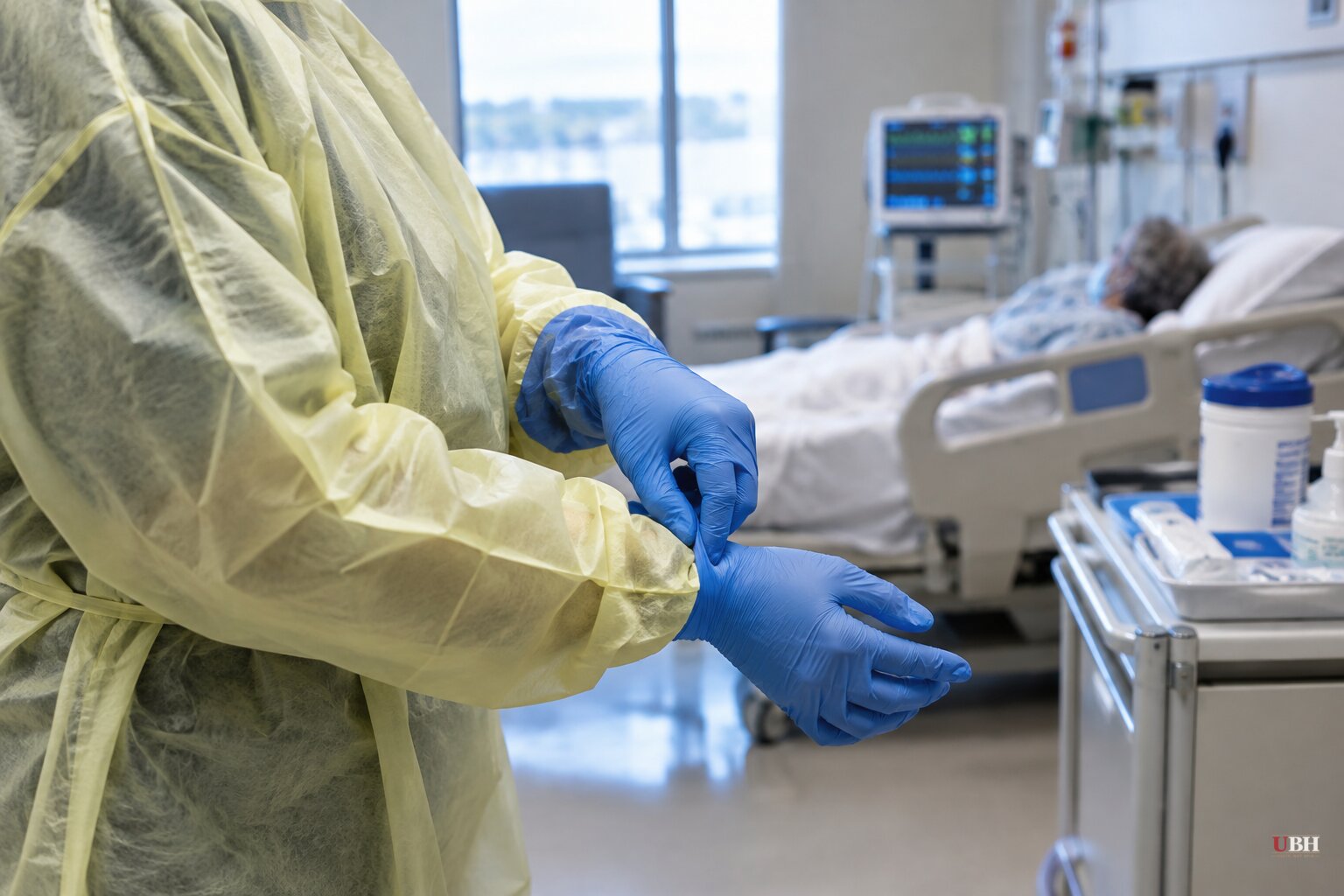
A multidrug-resistant fungus that the CDC has flagged as an urgent threat is landing on hospital workers' protective gear far more often than similar superbugs, according to a study published September 8 in Open Forum Infectious Diseases.
Researchers led by Lyndsay O'Hara, PhD, MPH, of the University of Maryland School of Medicine, along with colleagues at Rush University and Weill Cornell Medical College, tracked 1,083 interactions between healthcare personnel and 109 patients who currently had or previously had Candida auris colonization. The fungus, recently reclassified as Candidozyma auris, transferred to workers' gloves and/or gowns in 29% of those interactions, the study found.
That rate far exceeds comparable numbers for other hospital superbugs. MRSA transfers to gloves and gowns in about 16% of similar interactions, and carbapenem-resistant Enterobacterales in about 10%, according to prior studies cited alongside this one.
Who's at Highest Risk, and Why
The study, conducted between July 2022 and May 2024 across nine acute-care hospitals in California, Illinois, Maryland and New York, found transfer rates varied sharply by job and by contact type.
Nursing assistants and patient care technicians had roughly five times the odds of transfer compared with environmental services staff (odds ratio 5.2). Occupational and physical therapists came in at 4.8, and respiratory therapists at 4.7. Direct physical contact with a patient more than tripled the odds of transfer compared with touching only a room surface (odds ratio 3.32, per the MedPage Today report on the findings).
How colonized a patient was mattered enormously. Patients carrying C. auris at all five tested body sites, the armpits, groin, finger webs, nose and stool, were 15 times more likely to pass it to a worker's gear than patients colonized at just one site (odds ratio 15.1, 95% CI 7.5-30.5).
Those high-risk roles—turning, bathing, repositioning and exercising patients—all involve sustained hands-on contact, which the study's authors point to as the likely driver.
A Caveat Worth Taking Seriously
O'Hara told MedPage Today that the study measured contamination, not confirmed onward infection. "Transmission rates to gloves and gowns seen in the study are higher than subsequent transmission rates to patients and subsequent infection rates among patients," she said.
A worker's gown picking up the fungus is not the same as a patient getting sick from it. Researchers used glove and gown contamination as a stand-in, or surrogate, measure for transmission potential, not as direct proof that patients were infected as a result.
Still, the CDC's own numbers show why this matters. The agency recorded 6,304 clinical C. auris cases nationwide in 2024, up from zero when the first U.S. case surfaced in 2016. Invasive infections kill 29% to 62% of patients who get them, according to figures cited by CIDRAP, though those patients typically already have serious underlying illness.
State-level data compiled by Becker's Hospital Review show the burden isn't spread evenly. California logged 961 clinical cases in 2024, Texas 719, Nevada 690, Illinois 577, Florida 544 and New York 460. Maryland reported 100. Three of the four states in this study, California, Illinois and New York, rank among the nation's highest-burden states, meaning the findings reflect conditions at hospitals that deal with this fungus regularly.
What Hospitals Are Doing, and What They Aren't
Current prevention relies on contact precautions, gloves, gowns, and hand hygiene, plus chlorhexidine gluconate baths meant to reduce how much fungus a patient carries. But O'Hara said the science on the best CHG approach for decolonization "is a work in progress."
She also called for more federal funding to the CDC and NIH to develop better transmission-prevention tools. That's O'Hara's stated position as a researcher on the study, not an established fact about what those agencies need.
The study's authors concluded that new strategies are needed to interrupt transfer of the fungus to healthcare workers during routine care, and that broader C. auris screening could help identify colonized patients before contamination spreads. Separate CDC lab data referenced by CIDRAP found 95% of C. auris isolates resistant to fluconazole and 15% resistant to amphotericin B, underscoring why standard antifungal treatment often fails once an infection takes hold.
What remains unresolved is whether stricter glove-and-gown protocols, expanded screening, or better decolonization methods will actually cut the number of patients who develop invasive infections, rather than just reducing contamination on protective gear. That's the next question the researchers say still needs answering.
Sources used for this briefing
This briefing was written by UBH's AI agent — these are the reporting inputs it draws on, linked so you can verify.


