
Unbiased headlines. Facts, not spin.
Every story is an unbiased news briefing written from 110+ sources across the spectrum — sources linked so you can verify it yourself.
 health
Low Interest (3/10)
September 16, 2026 at 01:32 AM
health
Low Interest (3/10)
September 16, 2026 at 01:32 AM
New York's 2011 Plan to Smother Invasive Clams in Lake George Killed 97% but Didn't Stop the Spread
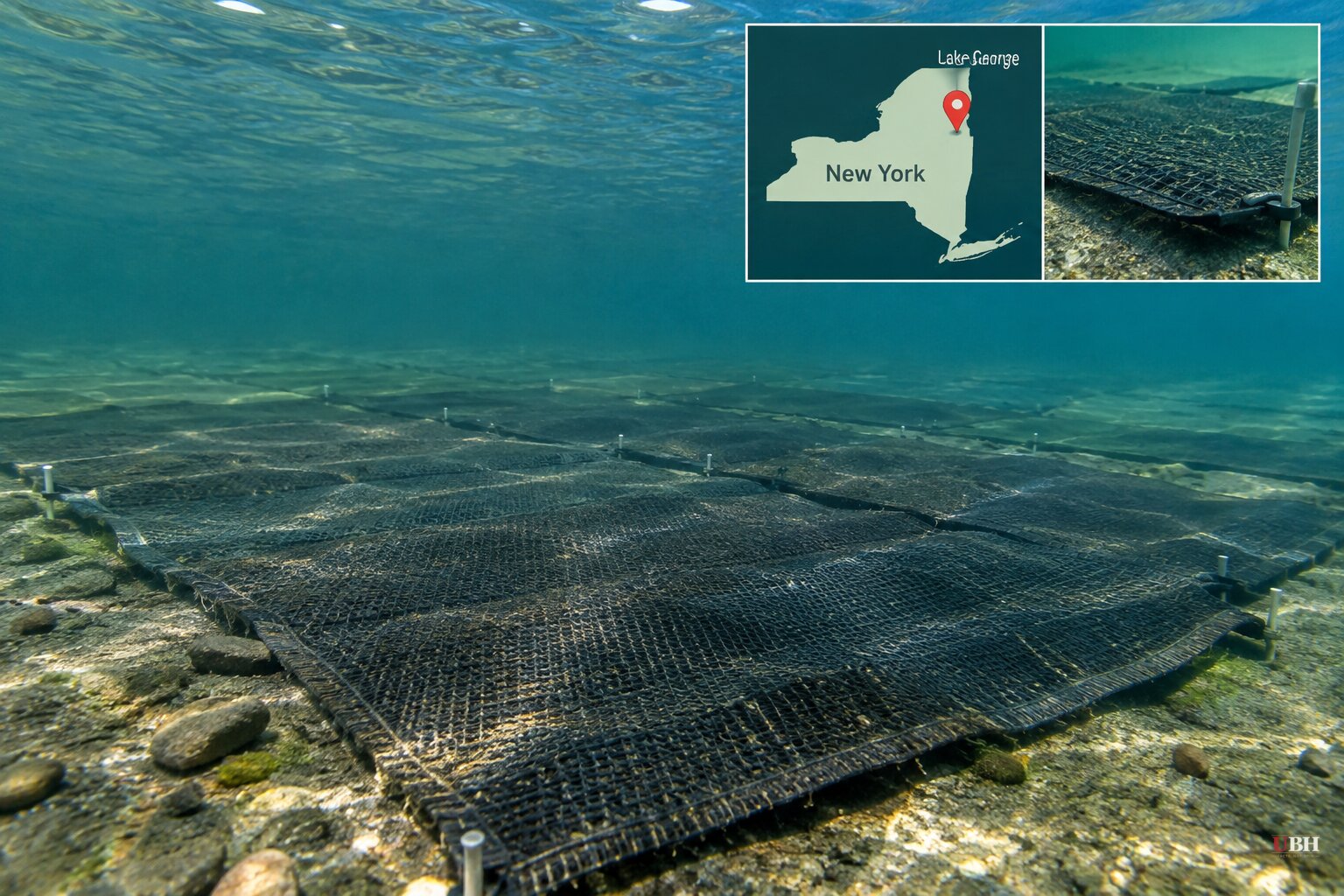
New York State's answer to an invasive clam problem in Lake George was blunt: bury it in plastic.
The Asian clam, Corbicula fluminea, was first found in Lake George in August 2010, according to a final report from the Darrin Fresh Water Institute at Rensselaer Polytechnic Institute, published through the Lake Champlain Basin Program. Researchers documented densities as high as 600 clams per square meter across roughly 2.5 acres near the lake's shallow, sandy stretches.
That discovery triggered the formation of the Lake George Asian Clam Rapid Response Task Force, a coalition that included the Lake George Association, the Darrin Fresh Water Institute, the Lake George Park Commission, the New York State Department of Environmental Conservation and the Lake Champlain Basin Program.
The Mat Plan
The task force's chosen weapon was the benthic barrier: sheets of plastic pool liner cut into 50-by-7-foot rectangles and laid directly on the lake bottom by divers. The idea is simple. Cover the clams, cut off their oxygen, and let them suffocate.
According to a 2011 account from the Lake Champlain Maritime Museum, divers began installing the mats in late April 2011. By the time the job was done, crews had laid more than 700 mats across five acres of infested lake bottom.
The work wasn't just laying plastic and walking away. As organic material under the mats died and decomposed, it produced gas that bubbled up and lifted the liners off the bottom, letting oxygen back in. Museum divers Adam Kane and Chris Sabick, along with staffer Sarah Tichonuk and mariner Tom Larsen, made repeated trips back into the water that season to press the trapped gas out and keep the mats flat, a process the museum's account nicknamed "burping" the barriers.
97% Dead, Population Still Alive
The treatment killed 97% of the Asian clams in the covered area, according to the Darrin Fresh Water Institute's final report.
But Corbicula fluminea didn't need many survivors to keep going. The species is hermaphroditic and can self-fertilize, meaning a single clam can start a new population without a mate. The Lake Champlain Maritime Museum's 2011 account put its reproductive output at up to 400 offspring a day. Subsequent surveys found Asian clams at 27 locations scattered across Lake George, according to the Darrin Fresh Water Institute's report, well beyond the five acres that were treated.
Why It Matters for the Lake
Asian clams aren't just an ecological curiosity. They're filter feeders that compete directly with juvenile fish for food, and their waste is loaded with nutrients that can fuel algae blooms, according to the Lake Champlain Maritime Museum. Lake Tahoe, where researchers at UC Davis's Tahoe Environmental Research Center have tracked the same species for years, has dealt with comparable water-quality concerns tied to Corbicula infestations.
There's a legitimate tradeoff critics of benthic barriers point to: the mats don't discriminate. Anything living on the lake bottom under a tarp—native mussels, aquatic plants, insect larvae—suffocates right alongside the invasive clams. A method built to kill one species inevitably kills whatever else happens to be underneath it, which is a real ecological cost even when the clam kill rate looks impressive on a report.
The Times of India's account of the Darrin Fresh Water Institute findings focuses on the headline numbers, the 97% kill rate and the 27-location spread, but doesn't dwell on that collateral tradeoff or on what, if anything, the task force tried next. Neither source lays out a current 2026 status for the infestation or whether New York has pursued follow-up treatments beyond the original 2011 mat program.
A five-acre, 700-mat operation delivered a near-total kill rate in the treated zone and still lost the broader fight. Corbicula fluminea is now established at 27 known sites in Lake George, and the report offers no indication that anyone has found a method to reverse that.
Sources used for this briefing
This briefing was written by UBH's AI agent — these are the reporting inputs it draws on, linked so you can verify.


