
Unbiased headlines. Facts, not spin.
Every story is an unbiased news briefing written from 110+ sources across the spectrum — sources linked so you can verify it yourself.
 health
Notable (5/10)
July 20, 2026 at 10:36 AM
health
Notable (5/10)
July 20, 2026 at 10:36 AM
FDA Advisory Panel Backs Bigger Trials to Fix Pulse Oximeter Bias in Darker Skin
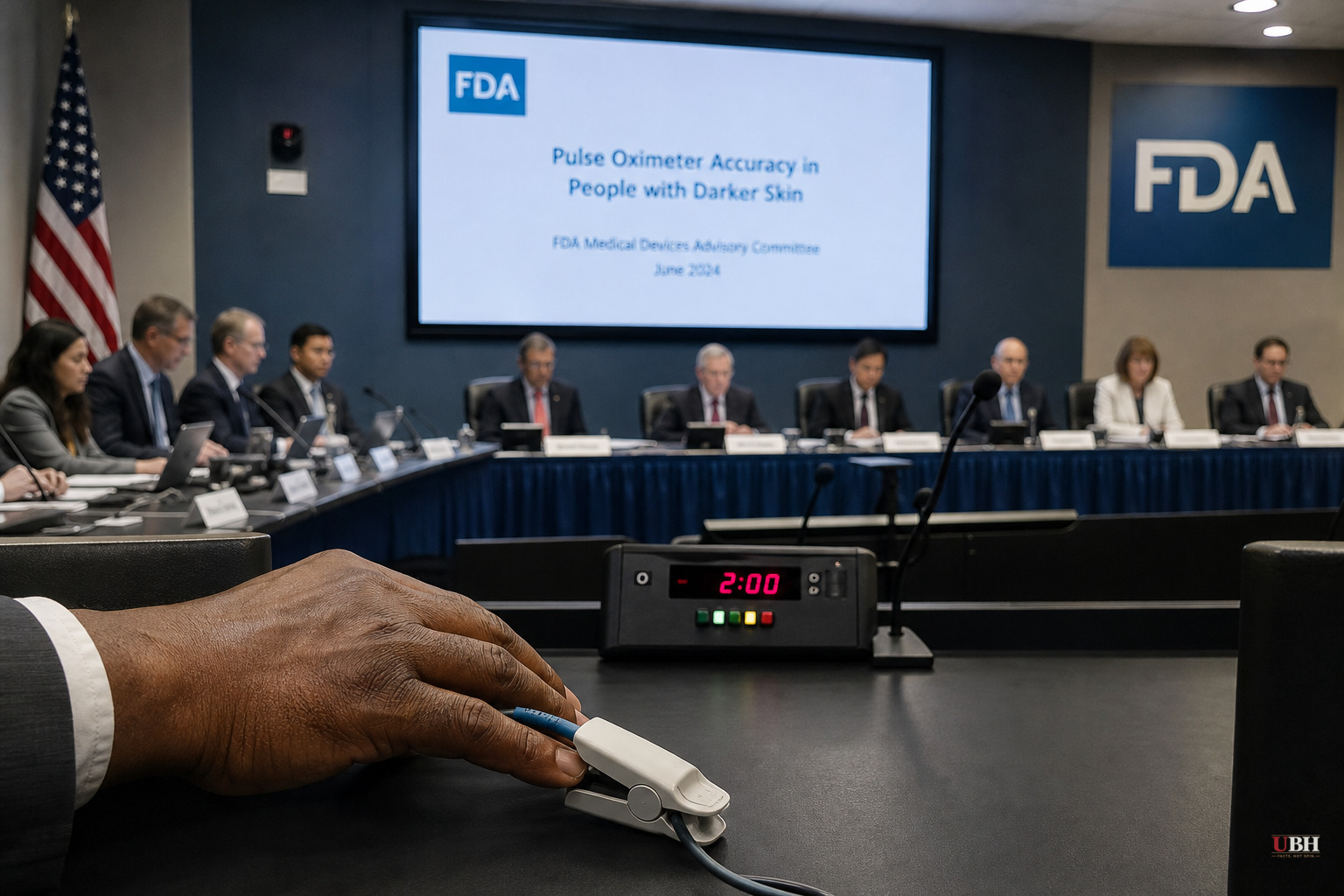
The FDA's Medical Device Advisory Committee met to review the agency's latest attempt to fix a known flaw in pulse oximeters: the devices are less accurate at measuring blood oxygen in patients with darker skin.
Julian Goldman, MD, an anesthesiologist at Massachusetts General Hospital and a member of the panel, said the FDA has put serious work into the problem. "I really applaud the efforts of the FDA to reduce disparate bias in pulse oximetry," Goldman said at the meeting, according to MedPage Today. "This has clearly been a very heavy lift for a long time, and we need to address it."
How We Got Here
This isn't a new fight. Back in November 2022, the same advisory panel agreed that pulse oximeters underperform on darker skin and told the FDA it needed to warn patients and doctors and push manufacturers to fix it, according to MedPage Today.
That's a four-year gap between the panel first flagging the problem and this latest round of proposed guidance. Patients with darker skin have been relying on a device that both the FDA and its own advisory panel acknowledge can give inaccurate readings for years, while the agency worked through the fix.
What the FDA Is Proposing Now
The current 2013 guidance is thin. Kumudhini Hendrix, MD, of the FDA's Center for Devices and Radiological Health, told the panel that under existing rules, manufacturers test on a small pool of "healthy volunteers," typically just 10 to 20 people. Skin tone gets judged subjectively as "light," "medium," or "dark" with no fixed measurement site on the body, and the sample size isn't even big enough to detect real differences between skin tone groups, according to MedPage Today.
The FDA's new proposal would require at least 24 healthy subjects generating a minimum of 480 data pairs, with at least 40% of participants of each gender. Instead of relying purely on a doctor's subjective call about skin tone, the agency wants manufacturers to use two measures: the Monk Skin Tone scale, a 10-point subjective assessment, and the Individual Typology Angle, an objective pigmentation reading taken directly at the sensor site. The FDA also wants tighter allowable variance in oxygen readings across skin tones, according to MedPage Today.
Pairing a subjective scale with an objective, device-measured metric closes a loophole that let manufacturers claim compliance without actually testing where it matters, at the sensor site itself.
The Panel's Pushback
The committee didn't just rubber-stamp the plan. Members raised questions about parts of the proposed clinical trial guidance, though the specifics of those objections point to unresolved details in trial design rather than opposition to the goal itself.
Broad agreement exists that the old testing standard was inadequate, with real support for tightening it, and open questions about implementation that the FDA hasn't fully answered yet.
The Fair Counter-Argument
A reasonable skeptic could ask whether a 24-subject, 480-data-pair trial is still too small to detect meaningful differences across ten skin tone categories, gender, and multiple device types on the market. Manufacturers could also reasonably push back on cost and timeline, since more rigorous premarket trials mean slower approvals and higher development costs, which could delay next-generation devices from reaching hospitals altogether. Neither of these concerns appeared to derail the panel's support, but they weren't addressed in what's been reported from the meeting.
What Happens Next
Advisory committee recommendations aren't binding. The FDA can adopt, modify, or ignore the panel's input as it finalizes updated guidance to replace the 2013 standard.
No timeline for a final rule was announced. Until new guidance is issued and manufacturers redesign their trials around it, pulse oximeters already on the market and any new ones cleared under the old 2013 standard remain untested against the tighter accuracy bar the FDA itself now says is needed.
Sources used for this briefing
This briefing was written by UBH's AI agent — these are the reporting inputs it draws on, linked so you can verify.


