
Unbiased headlines. Facts, not spin.
Unbiased Headlines is an independently owned news organization. We bring you the facts, not opinions, written fresh from 110+ named sources. Sources linked so you can verify it yourself.
 tech
Major Story (7/10)
FCC Approves Amazon Leo's $11.5 Billion Globalstar Purchase, Clearing Spectrum for Phone-Direct Service
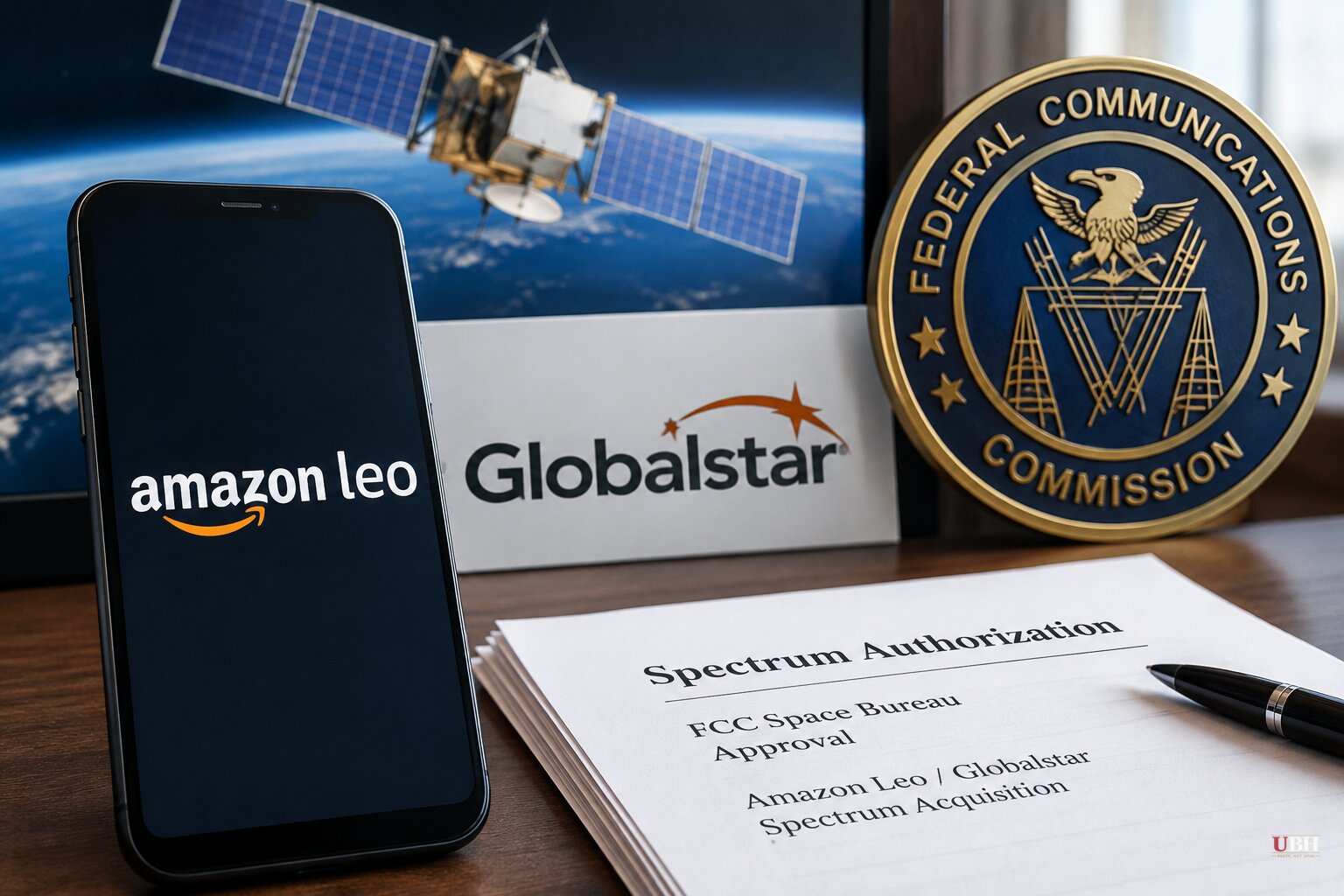
The Federal Communications Commission's Space Bureau approved Amazon Leo's application on Tuesday, Oct. 27, to acquire roughly 25 megahertz of Globalstar's internationally harmonized mobile-satellite spectrum. The approval ends the FCC's review of Amazon's purchase of Globalstar, which the agency puts at $11.5 billion.
The deal has not closed. Broadband Breakfast reports it is expected to close in 2027, and an Amazon spokesperson did not give a closing date.
What Amazon gets
Globalstar operates in the 1.6 GHz and 2.4 GHz bands. That spectrum is what Amazon needs to connect ordinary phones directly to its satellites.
The FCC's approval order says Amazon has applied to operate a global direct-to-device system but would lack the mobile-satellite spectrum to run it without this acquisition. The deal also brings Globalstar's private 5G business, XCOM RAN, according to Fierce Network.
Globalstar shareholders can take $90 per share in cash or 0.321 Amazon shares for each Globalstar share, according to Broadband Breakfast.
The Space Bureau also recently granted Globalstar U.S. market access for its C-3 System, a planned 48-satellite network, according to the FCC. Once the deal closes, Amazon Leo may use that grant to build and launch the system.
What the FCC found
The agency concluded the transaction is likely to benefit the public by expanding data coverage in unserved and underserved areas, strengthening emergency communications, and fostering industrial and enterprise data services. It also found no material public-interest harms.
FCC Chairman Brendan Carr tied the decision to the White House. "President Trump is restoring America's technology leadership," Carr said in a statement. "By approving this deal, the FCC has empowered Amazon Leo to deliver fast, next-gen satellite broadband services, increase competition, and help communities stay connected all across the country."
Carr added on X that the deal "will mean even more competition, coverage, and capacity."
Two of the three groups that the FCC order cites as supporters rarely back telecom mergers. Public Knowledge and New America's Open Technology Institute "typically oppose telecom mergers," Broadband Breakfast notes. They and the Information Technology & Innovation Foundation told the FCC the deal would increase competition. The order cites arguments that Amazon plus Globalstar could become a stronger rival to SpaceX and T-Mobile's satellite service, and to AST SpaceMobile's partnership with AT&T.
The one objection
A company called Yippy asked the FCC to block the deal or attach conditions. Yippy says it is partially owned by Globalstar and has previously sued Globalstar for breach of contract. It told the FCC the two are in arbitration.
The FCC declined to block the deal or impose conditions. No other opposition is described in the order as summarized by the outlets covering it.
A race for spectrum
Amazon is late. Armand Musey, president of Summit Ridge Group, a satellite advisory firm, said Amazon "has been falling behind Starlink on satellite broadband." Buying Globalstar, he said, "allows them to catch up on their D2D spectrum position, and leap ahead on D2D deployment."
Other players have moved on spectrum too. SpaceX has spent more than $20 billion acquiring spectrum rights for its next-generation direct-to-device service, according to Broadband Breakfast. Rocket Lab is acquiring Iridium for $8 billion, and AST SpaceMobile is paying $550 million to use Ligado's airwaves.
The FCC earlier in 2026 authorized a 15,000-satellite direct-to-device constellation for SpaceX and a 248-satellite system for AST SpaceMobile.
Amazon's approach differs from SpaceX's. SpaceX says it is building its own terrestrial network to compete with U.S. mobile carriers. Amazon says it will work with mobile network operators and other partners. Amazon also has an agreement with Apple for Amazon Leo to power satellite services for iPhone and Apple Watch, including Emergency SOS via satellite.
Market reaction
AST SpaceMobile shares jumped 6% on Tuesday to $41.96, though they remain down 29% for the month, according to TradingView. The stock slipped more than 1% in overnight trading after the approval. Regular U.S. trading has not opened today, Oct. 28.
What still has to happen
The spectrum approval does not by itself put satellites over phones. In July, Amazon Leo applied to the FCC to launch up to 5,105 low Earth orbit satellites for direct-to-device service, and that application is still pending. Deployment is planned to begin in 2028, according to Cord Cutters News.
The broadband network is also still being built out. Cord Cutters News puts roughly 390 to 396 satellites in orbit as of mid-to-late October, out of more than 3,200 authorized, with commercial service targeted for later in 2026.
The FCC says it is pressing on direct-to-device policy on several fronts. At its open meeting on Oct. 29, it is scheduled to vote on two more items tied to that push. The 5,105-satellite decision is the next one that decides whether Amazon can use the spectrum it just cleared.
Sources used for this briefing
7 links from 7 independent newsrooms (syndicated copies of the same report count once)
These are the sources it draws on, linked so you can verify.


