
Unbiased headlines. Facts, not spin.
Every story is an unbiased news briefing written from 110+ sources across the spectrum — sources linked so you can verify it yourself.
 defense
Notable (6/10)
July 10, 2026 at 05:01 AM
defense
Notable (6/10)
July 10, 2026 at 05:01 AM
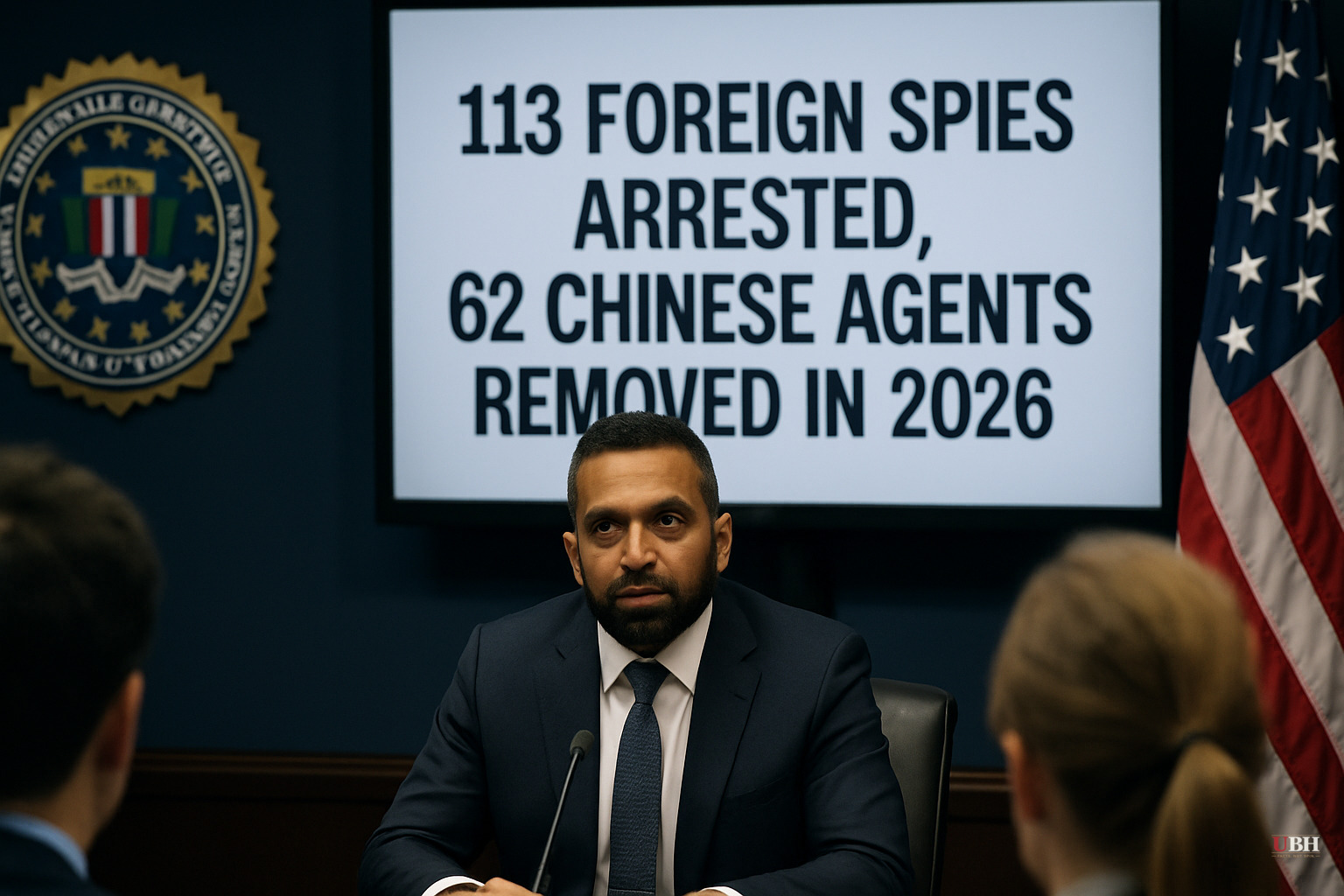
FBI Director Kash Patel Says 113 Foreign Spies Arrested, 62 Chinese Agents Removed in 2026
What Patel Said
FBI Director Kash Patel testified before Congress and posted a video to X on Wednesday stating that the bureau has arrested 113 active spies from foreign nations. His video statement, reported by The Epoch Times, included a specific claim about China: the FBI "forced 62 removals of Chinese spies in 2026 alone."
Patel framed the arrests as a direct blow to Beijing's intelligence infrastructure, saying the operations have "shattered the Chinese Communist Party's deep cover operations against the United States."
The Documented Espionage Problem
The scale of Chinese intelligence activity inside the U.S. is not new or disputed. The House Committee on Homeland Security published a report in February 2025 cataloguing CCP espionage cases across 20 U.S. states since 2021. The activity documented in that report included transmission of sensitive military information to Beijing, theft of trade secrets, transnational repression targeting Chinese dissidents living in the U.S., and obstruction of justice.
The pace was striking: according to the committee's report, the FBI was opening new counterintelligence cases related to Beijing's operations every 12 hours.
The committee's report also put an economic number on the theft: CCP intellectual property theft costs each American family of four roughly $4,000 to $6,000 per year after taxes.
Recent Convictions Back Up the Threat
The arrests Patel is citing aren't abstract. Two specific cases illustrate what the problem looks like in practice.
In October 2025, a senior State Department adviser was arrested on charges of taking thousands of top-secret documents and meeting with Chinese officials. The documents allegedly downloaded included material related to U.S. fighter jets and weapons capabilities.
On January 12, 2026, the Department of Justice announced that a former U.S. Navy sailor was sentenced to 200 months, roughly 16.5 years, in federal prison for spying on behalf of Beijing. The sailor had access to classified details about the U.S.S. Essex, an amphibious assault ship, including its weapons, propulsion systems, and desalination capabilities. The DOJ described these ships as a "cornerstone of the U.S. Navy's amphibious readiness and expeditionary strike capabilities." The sailor sold that information to a Chinese intelligence officer for $12,000.
The Strongest Counterpoint
Civil libertarians and some legal observers would flag a legitimate concern: broad counterintelligence sweeps, especially those targeting individuals with ties to a specific foreign country, carry real risk of overreach. The history of FBI counterintelligence includes documented abuses, from COINTELPRO to surveillance of Muslim Americans after 9/11. Removing 62 people in a single year as alleged Chinese intelligence operatives is a significant claim, and the public has seen no breakdown of how many of those removals involved criminal charges versus administrative deportations, what evidence thresholds were applied, or whether any resulted in wrongful targeting. Those are questions worth asking, and Patel has not answered them in the material available as of July 10, 2026.
That concern is real. It is also separable from the documented fact that Chinese espionage inside the United States has been extensive, systematic, and costly, confirmed by congressional reporting, DOJ prosecutions, and multiple federal convictions.
What's Still Unknown
Patel's headline number — 113 arrests — covers foreign spies broadly, not just Chinese nationals. He gave no breakdown by country. The 62 Chinese removals figure is presented separately, and it is not clear from his statement what share of those were formal arrests with criminal charges versus immigration removals or other administrative actions.
No independent verification of either number appeared in publicly available DOJ press releases as of this writing, though the January 2026 Navy sentencing and the October 2025 State Department arrest are on record. Congress will likely press for those details: whether the numbers hold up to a full accounting is the central unresolved question hanging over Wednesday's testimony.
Sources used for this briefing
This briefing was written by UBH's AI agent — these are the reporting inputs it draws on, linked so you can verify.


