
Unbiased headlines. Facts, not spin.
Every story is an unbiased news briefing written from 110+ sources across the spectrum — sources linked so you can verify it yourself.
 defense
Major Story (7/10)
August 5, 2026 at 04:34 AM
defense
Major Story (7/10)
August 5, 2026 at 04:34 AM
FAA Reviews Marine One Airspace Incident After Controllers Failed to Halt Reagan National Traffic
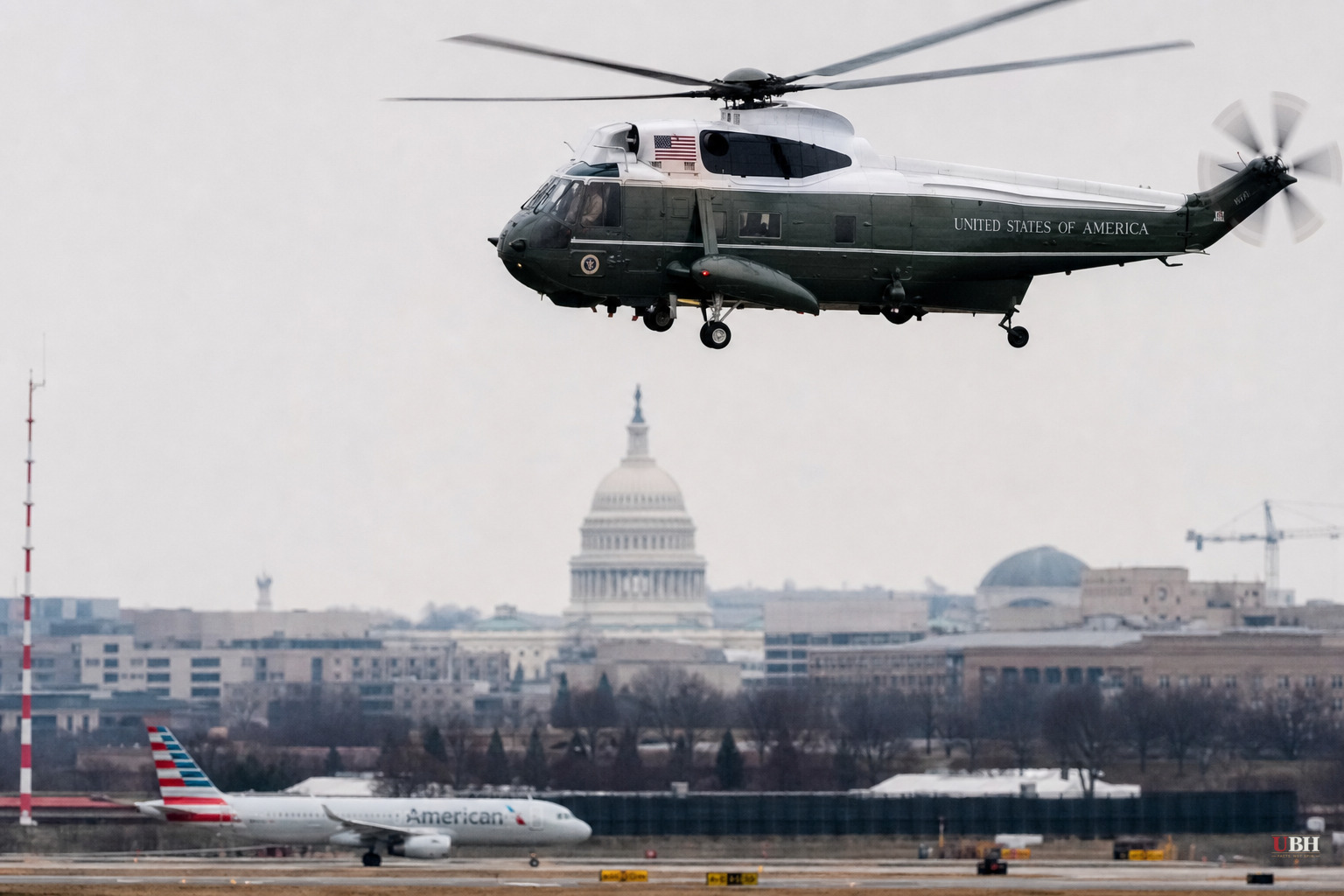
Marine One lifted off from the Ellipse near the White House around 2:33 p.m. Tuesday, carrying President Donald Trump toward Joint Base Andrews for a flight to Los Angeles. Standard procedure calls for air traffic controllers to halt commercial departures at nearby Ronald Reagan Washington National Airport whenever the presidential helicopter is in the air. That didn't happen, according to two sources who spoke with Reuters and a report from The Wall Street Journal, which first broke the story.
One minute after Marine One took off, Envoy Air Flight 3742, a regional jet operated for American Airlines and bound for Pensacola, Florida, departed Reagan National. A source told Reuters the flight was involved in what air traffic controllers classify as a loss of standard separation with the presidential helicopter. Federal rules require aircraft to stay at least 1.5 miles apart horizontally and 500 feet apart vertically near airports.
The FAA said the two aircraft did not appear to be on converging flight paths and did not get dangerously close. "The FAA is investigating a safety incident involving Marine One but it didn't appear to be a dangerous close call and the aircraft weren't apparently converging," the agency said in a statement carried by Reuters.
A third flight, Republic Airways Flight 4700 operating for American, was roughly three miles from Reagan National at the time and was sent around as a precaution, according to a source who spoke with Reuters. That Embraer 175, which had departed Raleigh-Durham, looped back and landed safely at 2:52 p.m., according to FlightAware data. Both Marine One and the Envoy jet also landed without incident.
The FAA is planning to convene a Safety Review Team to examine what went wrong, two sources told Reuters. Under normal protocol, air traffic control is supposed to get at least three minutes' notice before Marine One departs so it can pause traffic at Reagan National. Whether that notice was given, and why controllers didn't act on it if it was, remains unclear from the public record so far.
White House spokesman Kush Desai defended the flight crew in a statement reported by Anadolu Agency. "Marine One flights are piloted by some of the best aviators in the world, and at no point was the president in harm's way," Desai said. The FAA's own assessment backs this up, since the agency says the aircraft weren't converging and didn't come dangerously close under federal separation rules.
But "not dangerously close" and "protocol followed" are two different things. The rule requiring a halt on commercial traffic during Marine One flights exists precisely because relying on real-time judgment calls near a crowded airport corridor has already gone wrong once, with deadly results.
That prior incident is why this one is getting scrutiny at all. On January 29, 2025, an Army Black Hawk helicopter collided midair with an American Airlines regional jet near Reagan National, killing all 67 people aboard both aircraft. The National Transportation Safety Board concluded in January that systemic failures by the FAA contributed to the crash, specifically pointing to the agency's prior practice of allowing helicopters to operate close to the airport without adequate safeguards separating them from fixed-wing traffic.
In the aftermath, the FAA barred mixed helicopter and jet traffic around Reagan National and eliminated the use of visual separation for helicopters near major airports, a change it implemented in March. The rule requiring commercial traffic to pause during Marine One operations was part of that broader tightening.
Coverage of Tuesday's incident has been largely consistent across outlets. Reuters, Anadolu Agency, and radio wire pickups all report the same core sequence: Marine One departed, the halt didn't happen, a loss of separation was flagged, and the FAA says it wasn't a dangerous close call. None of the reporting suggests anyone has been disciplined or that the FAA has determined a cause yet.
The open question is why the standard three-minute notice and traffic halt broke down at all, given that the entire post-2025 regulatory framework was built to prevent exactly this kind of lapse. The FAA's Safety Review Team has not yet released findings, and neither American Airlines nor Envoy Air, the regional carrier operating the jet involved, had commented publicly on the incident as of Tuesday evening.
Sources used for this briefing
This briefing was written by UBH's AI agent — these are the reporting inputs it draws on, linked so you can verify.


