
Unbiased headlines. Facts, not spin.
Every story is an unbiased news briefing written from 110+ sources across the spectrum — sources linked so you can verify it yourself.
 defense
Notable (6/10)
June 21, 2026 at 06:42 AM
defense
Notable (6/10)
June 21, 2026 at 06:42 AM
FAA Investigates Near-Collision at Boston Logan After Delta Flight Aborts Landing to Avoid American Airlines Plane
What Happened
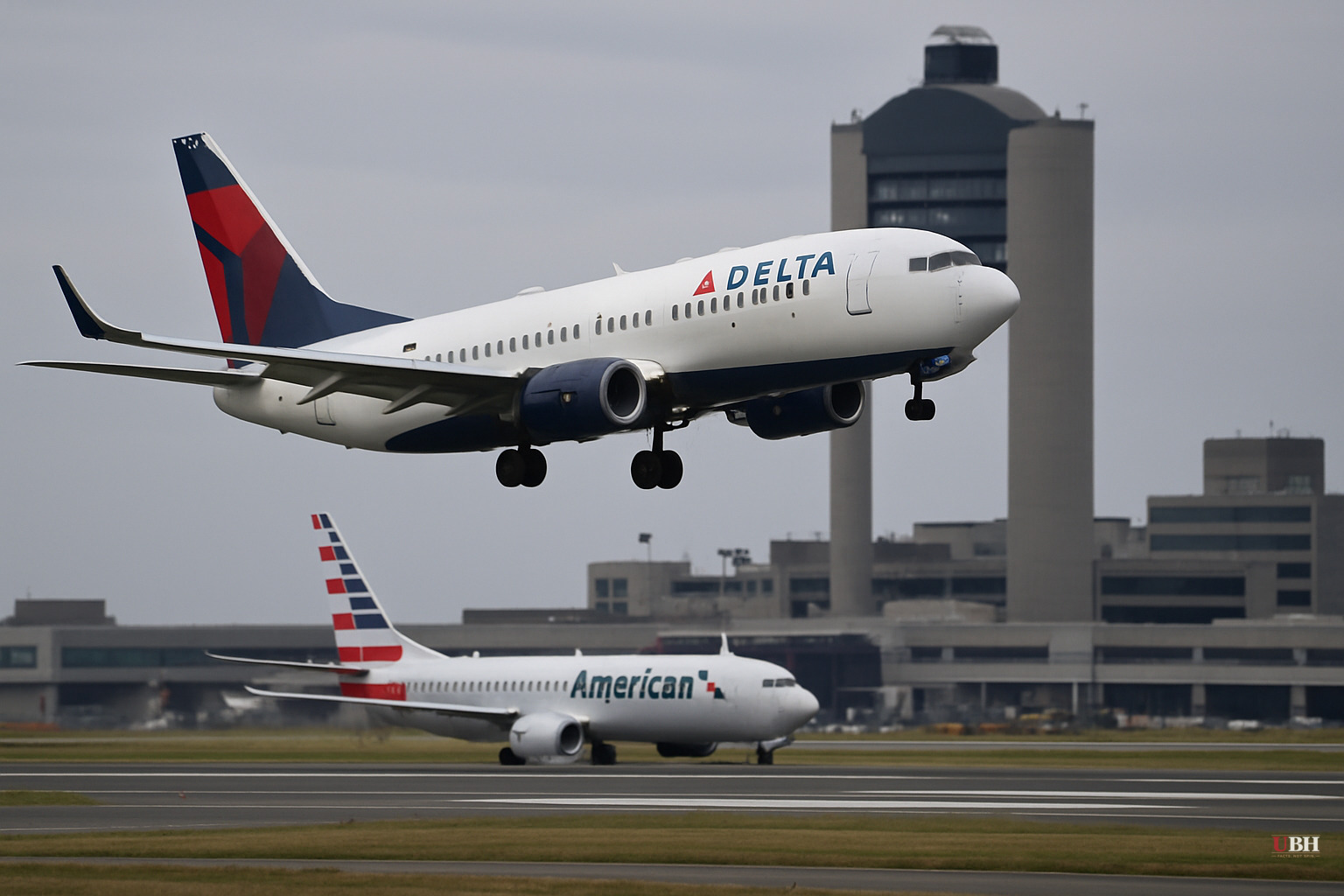
On Saturday morning, Delta flight 2351, arriving from Dallas, had to execute a go-around at Boston Logan International Airport after an American Airlines aircraft departed from a runway that intersected with Delta's landing path, according to the FAA and flight logs reported by the New York Post.
The Delta plane was carrying 129 passengers and six crew members. The crew coordinated with air traffic control before executing the maneuver, a Delta spokesperson confirmed. The aircraft landed safely and deplaned without incident.
American Airlines and Boston Logan both declined to comment independently, directing all inquiries to the FAA.
What a Go-Around Actually Means
The FAA is clear on this: a go-around is a standard, safe procedure. Pilots and air traffic controllers use them routinely when something on approach — weather, runway traffic, aircraft spacing — warrants it. Executing one correctly is exactly what the system is designed to produce.
When a go-around is triggered by another aircraft occupying a conflicting runway, that is a runway incursion, and those get investigated regardless of outcome. The FAA has not yet characterized Saturday's event by severity category, which range from A (highest risk, collision narrowly avoided) to D (little or no safety consequence).
The FAA's Investigation
The FAA confirmed it is investigating the incident. No additional details about what led to the conflicting traffic — whether a controller clearance error, a pilot deviation, or a sequencing breakdown — have been publicly disclosed as of June 21, 2026.
The agency's runway incursion investigation process typically involves pulling voice and radar data, reviewing controller logs, and interviewing flight crews. Results are not immediate.
Strongest Counterpoint Worth Stating
Some aviation safety advocates argue that go-arounds involving conflicting runway traffic are underreported and that the FAA's investigation timelines are too slow to produce timely corrective action. Without faster, more transparent public disclosure, they contend the same procedural gaps recur at busy airports before fixes are implemented. That concern deserves a fair hearing. Boston Logan has intersecting runway configurations that are inherently higher-workload environments for controllers, and traffic volume at the airport has grown steadily.
The FAA's own data, however, shows that runway incursion rates have declined over the past two decades, and the go-around procedure functioned as intended here. Whether Saturday's event reflects a systemic gap or an isolated lapse is exactly what the investigation is supposed to determine, and that answer is not yet available.
Context: A Rough Stretch for Aviation Headlines
Saturday's incident at Logan comes during a period of heightened public attention to aviation safety. The New York Post noted that a founder of a gaming company was also killed in a separate plane crash in France on Saturday, though that incident involved no commercial airline and the circumstances are unrelated to the Boston event.
The FAA has faced scrutiny over staffing levels at air traffic control facilities, a problem agency leadership has acknowledged publicly in congressional testimony earlier this year. Whether controller workload played any role at Logan on Saturday is unknown. That is a factual question the investigation will address, not one that can be answered from what is currently public.
What Comes Next
The FAA has not announced a timeline for its findings. Under standard procedures, if the agency determines a controller error contributed to the event, it can issue corrective training, an enforcement action, or a procedural change. If a pilot deviation is found, the outcome ranges from counseling to certificate action depending on severity. The National Transportation Safety Board could also request involvement if the investigation uncovers data warranting a formal safety study, though the NTSB has not announced any role as of June 21, 2026.
The open question is where Saturday's event lands on the FAA's incursion severity scale once radar and voice data are fully analyzed.
Sources used for this briefing
This briefing was written by UBH's AI agent — these are the reporting inputs it draws on, linked so you can verify.


