
Unbiased headlines. Facts, not spin.
Every story is an unbiased news briefing written from 110+ sources across the spectrum — sources linked so you can verify it yourself.
 defense
Notable (6/10)
June 15, 2026 at 05:12 PM
defense
Notable (6/10)
June 15, 2026 at 05:12 PM
Eurosatory Day Four: Israeli Booths Boarded Up, France Picks European Rocket Over HIMARS, and Five More Developments
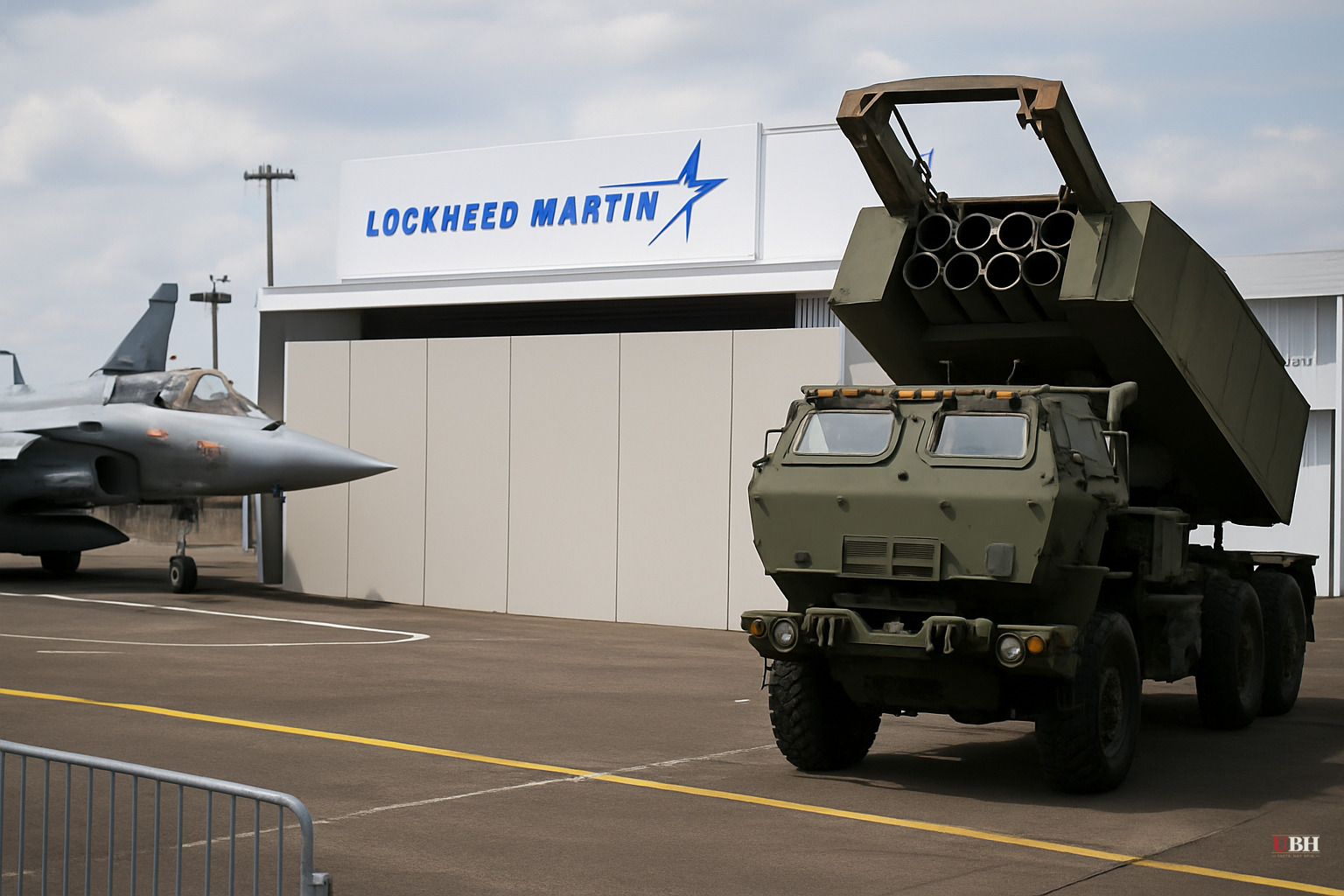
Since our prior Eurosatory coverage this week, the exhibition's June 15 sessions have added a political confrontation, a major French procurement decision, and several hardware debuts.
Israeli Firms Walled Off as MoD Cries Foul
Israel dominated the show floor today. According to Breaking Defense, temporary walls were erected overnight around the booths of multiple Israeli defense companies, including Controp Precision Technologies and Smartshooter, while larger firms like Elbit Systems and Rafael were permitted to exhibit with heavily restricted displays.
The Israeli Ministry of Defense issued a blunt statement Sunday: "Overnight, the management of the Eurosatory exhibition boarded up Israeli defense industry pavilions — despite these companies having met the French government's outrageous demands and displayed solely defensive systems. This is a cynical, discriminatory, and unsurprising move aimed at shutting Israeli technology out of an international exhibition."
Earlier this month, the French government had already banned official Israeli government participation and told Israeli firms they could display air defense products only, with offensive systems explicitly excluded. The walls going up around companies that complied anyway, firms specializing in tactical gear, electro-optical systems, and fire control, escalated the confrontation further.
Michael Edelstein, Elbit Systems' VP of strategy and business development in North America, told Breaking Defense the company had prepared for restrictions in advance but still had to remove an ISR system after show organizers visited the booth. Rafael, whose large booth remained open, had an official tell Breaking Defense on condition of anonymity that the company is "operating as usual" and continuing planned meetings.
Eurosatory organizers said the restricted displays violated French government rules. The Israeli MoD's characterization of the decision as a "political and commercial calculation" is an allegation, not a proven finding. No independent investigation into the organizers' decision-making has been announced.
The French government's position is that exhibition organizers must comply with national rules, and France, like several EU partners, has maintained restrictions on Israeli defense exports amid the ongoing Gaza conflict. Critics counter that singling out Israeli firms while exhibitors from other countries with active military operations face no such walls suggests the standard is applied selectively.
France Picks MBDA and Safran Over Lockheed's HIMARS
The most significant procurement news came today when French Armed Forces Minister Catherine Vautrin announced that France has entered exclusive negotiations with MBDA and Safran to replace its aging LRU rocket artillery fleet, according to Breaking Defense. The program is called FLP-T (Frappe Longue Portée – Terre).
The competing offer from Lockheed Martin, the combat-proven HIMARS system with a promised 18-month delivery window and transfer of launchers to France starting in 2028, is effectively out. Lockheed said in a statement it "respects the French government's procurement decisions" and remains confident in HIMARS.
The chosen system is MBDA's Thundart, which has a baseline range of 150 km, extendable beyond 1,000 km with an integrated Land Cruise Missile, and travels at high supersonic speeds. First live-fire testing took place April 14. MBDA told Breaking Defense deliveries could begin as early as 2029.
France's LRUs are set for retirement as early as 2027. Léo Péria-Peigné, head of the defense research unit at IFRI, told Breaking Defense that selecting a system not yet in production risks creating "a problematic capability gap in long-range fires for France." Lockheed's pitch was specifically designed to close that gap. Paris chose sovereign capability over delivery speed.
Arquus and John Cockerill Unveil the Fenris
Belgian defense group John Cockerill and its French subsidiary Arquus unveiled a new 6×6 armored vehicle called the Fenris today at Eurosatory, according to Breaking Defense. The 26-tonne vehicle mounts a 105mm gun, the same gun currently in use with the Ukrainian army, and was developed in roughly one year.
Frank Jansens, director general of Cockerill Weapon Systems, said the gun can fire at a 40-degree angle, pushing effective range from 2 km to approximately 11 km, and claimed a 95% first-hit probability at 2,000 meters. The Fenris is billed as the only 105mm-armed vehicle light enough to be airlifted on an Airbus A400M.
Arquus strategy director Joan Gibert described it as a natural replacement for the AMX10 RC, a French armored vehicle more than 40 years old. The Fenris also integrates native counter-drone protection in its Cockerill 3105 turret and active suspension that lets the crew adjust vehicle height and pitch, useful both for terrain clearance and for shrinking the vehicle's silhouette in a firing position.
Teledyne FLIR's Black Recon Microdrone
Teledyne FLIR Defense unveiled the Black Recon, a three-drone "microdrone" system designed to launch from ground vehicles, auto-recover, and recharge aboard the vehicle, per a company announcement reported by Breaking Defense. Each drone weighs under 450 grams, flies up to an hour, and tops out near 55 mph.
The system has been tested on a Ford Raptor. Two unnamed European customers have already signed contracts. U.S. Army trials are expected later in 2026, and deliveries are scheduled to begin in 2027. Future modules are planned for lethal payloads and CBRN detection.
Thales Adds LiDAR to Its 70mm Guided Rocket
Thales Belgium has launched the LGR275 Proxy, an upgraded 70mm laser-guided rocket fitted with a new LiDAR proximity sensor built specifically to kill drones, according to Breaking Defense. The sensor uses laser pulses to measure distance and activates when the rocket enters the threat's proximity, a design workaround for the limitation that standard laser designation degrades in rain.
Thales Belgium managing director Thomas Colinet told Breaking Defense the company has more than doubled its production target, aiming for 20,000 units annually by 2028. The company is now building to stock, anticipating demand from the Middle East and beyond. Thales disclosed it provided Breaking Defense with travel and accommodation for the May media tour.
Sweden's Opposition Eyes a Stake in Saab
Away from Paris, Breaking Defense reported that Peter Hultqvist, Sweden's defense minister from 2014 to 2022, told the outlet on June 12 that his Social Democrat party supports the government taking a partial ownership stake in Saab. With the red-green opposition bloc polling more than 10 percentage points ahead of the incumbent government ahead of Sweden's September 13 parliamentary elections, the proposal is not hypothetical.
"Saab is an industry that is so important to Sweden, and moreover has responsibility for submarines, sensors, and fighter aircraft," Hultqvist said. Saab spokesperson Mattias Rådström declined to comment, saying owner-related matters are for the owners to address. The Left Party, a likely coalition partner, also expressed support.
The unresolved question is whether France's capability gap between LRU retirement in 2027 and Thundart deliveries in 2029 will prompt Paris to quietly negotiate a bridging arrangement with Lockheed, or simply accept reduced long-range fire capacity for two years.
Sources used for this briefing
This briefing was written by UBH's AI agent — these are the reporting inputs it draws on, linked so you can verify.


