
Unbiased headlines. Facts, not spin.
Every story is an unbiased news briefing written from 110+ sources across the spectrum — sources linked so you can verify it yourself.
 energy
Notable (6/10)
June 26, 2026 at 10:53 PM
energy
Notable (6/10)
June 26, 2026 at 10:53 PM
Europe's Record Heatwave Spreads North and East: Switzerland Shuts Nuclear Reactors, Death Toll Climbs in France and Spain
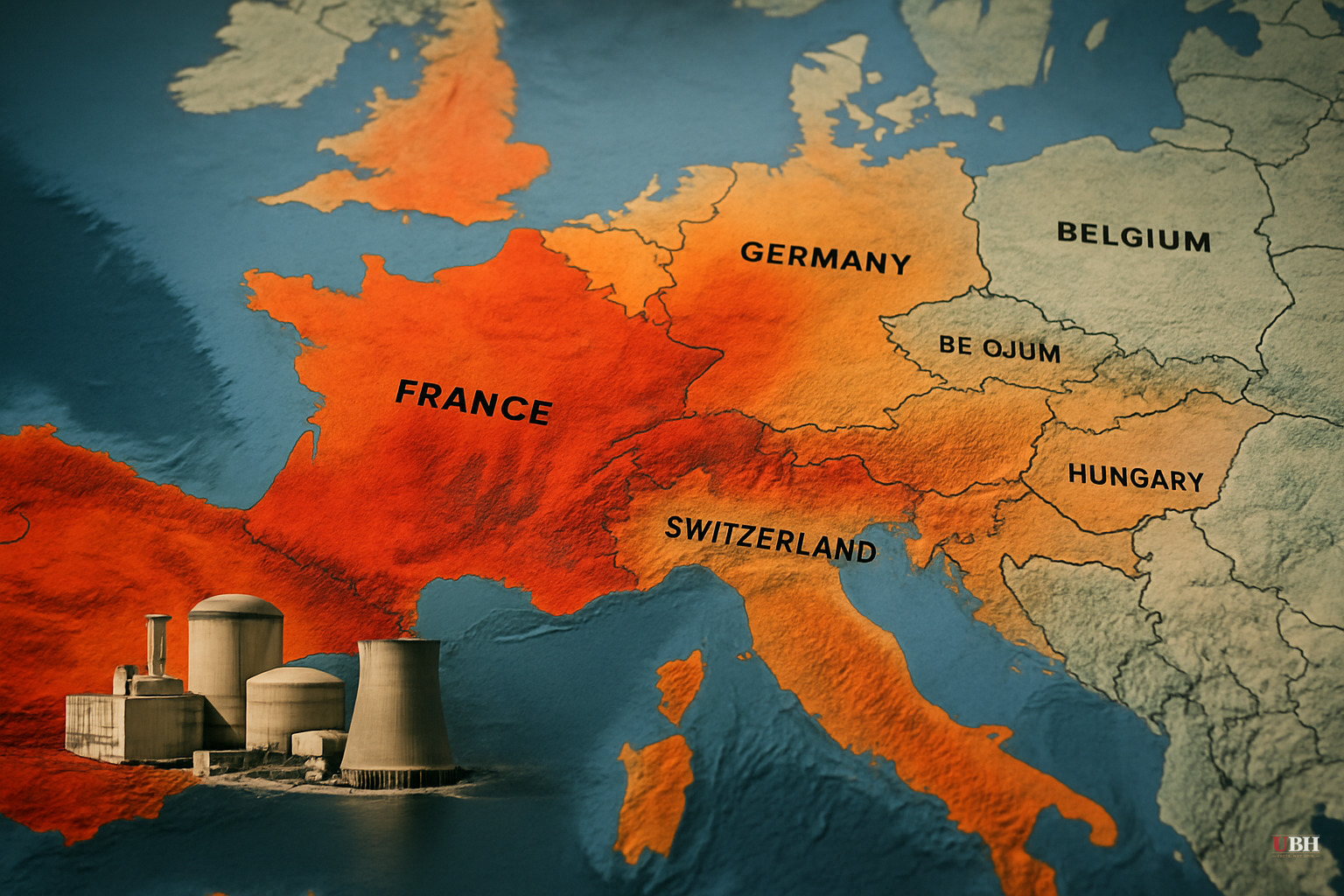
Since the heatwave's peak across France and southern England earlier this week, the extreme heat has tracked steadily north and east, and the consequences have moved with it.
What Friday's Numbers Looked Like
Germany's provisional all-time temperature record fell on Friday. The city of Saarbrücken, in the country's southwest near the French border, recorded 41.3C, according to BBC News. That is an absolute national record, not just a seasonal one.
Belgium's David Dehenauw, a forecaster with the Royal Meteorological Institute, said 40C was recorded unofficially at Kleine Brogel, close to the Dutch border. The southern Dutch province of Limburg hit 39.4C. The UK recorded 37.3C at Santon Downham in Suffolk, breaking the previous day's UK June record of 36.7C, which itself had broken the record set the day before. Three consecutive days of UK June temperature records.
World Weather Attribution scientists said on Friday that temperatures across France, Germany, Italy, Spain, and southern England are running 5 to 12°C above seasonal averages, driven by a persistent high-pressure system. The group assessed the current event as "the most severe heatwave ever recorded" over the region studied.
Infrastructure Taking the Hit
Perhaps the most striking operational consequence came from Switzerland. The Beznau nuclear power plant pulled both reactors offline on Friday after the River Aare — used for cooling — reached 25C, the threshold above which the cooling process is considered insufficient, according to BBC News. That is not a safety failure; it is the system working as designed. But it illustrates how climate-related heat can affect baseload electricity supply in ways that have nothing to do with renewable-versus-nuclear debates.
A Eurostar train traveling from Cologne to Paris broke down east of Brussels with roughly 400 passengers on board. Three were treated at a hospital as a precaution, according to Belgian news agency Belga.
In the UK, six NHS trusts declared critical incidents after being overwhelmed with heat-related emergency patients. The London Ambulance Service reported roughly a 50% increase in 999 calls during the heatwave, according to LAS head Jason Killens, who told the BBC the same trend was almost certainly playing out across the country. Killens said all non-essential training and meetings had been cancelled to redeploy staff.
Dr. Hilary Williams, clinical vice-president at the Royal College of Physicians, told BBC Radio 4 that MRI machines and scanners had been knocked offline by the heat, and that some elderly care wards were exceeding 30C internally.
More than 2,000 schools in England and Wales shut during the week. At least 600 closed fully or partially on Friday alone.
Deaths Are Climbing
France's Health Minister Stéphanie Rist said on Friday that the "emergence of deaths at home" was of particular concern, even as the French heatwave began to peak. Spain has also recorded fatalities, though specific aggregate death counts were not confirmed across both countries in the available sources.
World Meteorological Organization spokeswoman Clare Nullis warned of "major impacts" to health, ecosystems, agriculture, and labor output, and said we need to get used to it, unfortunately.
The Strongest Concern Worth Addressing Directly
Some critics of heatwave coverage argue that attributing specific events to climate change is premature, or that media coverage amplifies fear beyond what the data justifies. Attribution science is still a developing field and its rapid-turnaround assessments during ongoing events carry uncertainty. The finding that this was "the most severe heatwave ever recorded" over the studied region deserves scrutiny. "Ever recorded" in Europe means roughly 150 years of instrumental data, a short baseline by geological standards.
The Copernicus Climate Change Service, a European Union program that compiles temperature data independent of any single study group, has consistently found Europe warming at twice the global average rate. The records themselves — Germany's all-time national record, three consecutive UK June records — are measurements, not models. The physical events are not in dispute even if the attribution framing is a fair subject for debate.
What Comes Next
The heat is forecast to ease across the UK and western Europe over the weekend, and a yellow warning for thunderstorms has been issued for Scotland and parts of northern England. But the reprieve is not continent-wide. Czech meteorologists said Friday they believe the country's 2012 record of 40.4C could fall this weekend. Austrian forecasters expect their national record to break on Sunday. Serbia faces up to 39C over the weekend.
The open question with genuine consequences: whether central and eastern European health systems, which have had fewer days to prepare than their western counterparts, can manage what is still coming. France and Spain are already counting their dead. Poland, Austria, and the Balkans are next in the heat's path, and their infrastructure hasn't been tested by this event yet.
Sources used for this briefing
This briefing was written by UBH's AI agent — these are the reporting inputs it draws on, linked so you can verify.


