
Unbiased headlines. Facts, not spin.
Every story is an unbiased news briefing written from 110+ sources across the spectrum — sources linked so you can verify it yourself.
 energy
Low Interest (3/10)
July 11, 2026 at 06:34 AM
energy
Low Interest (3/10)
July 11, 2026 at 06:34 AM
A Fictionalized Grid Collapse Scenario Raises Real Questions Engineers Have Long Debated
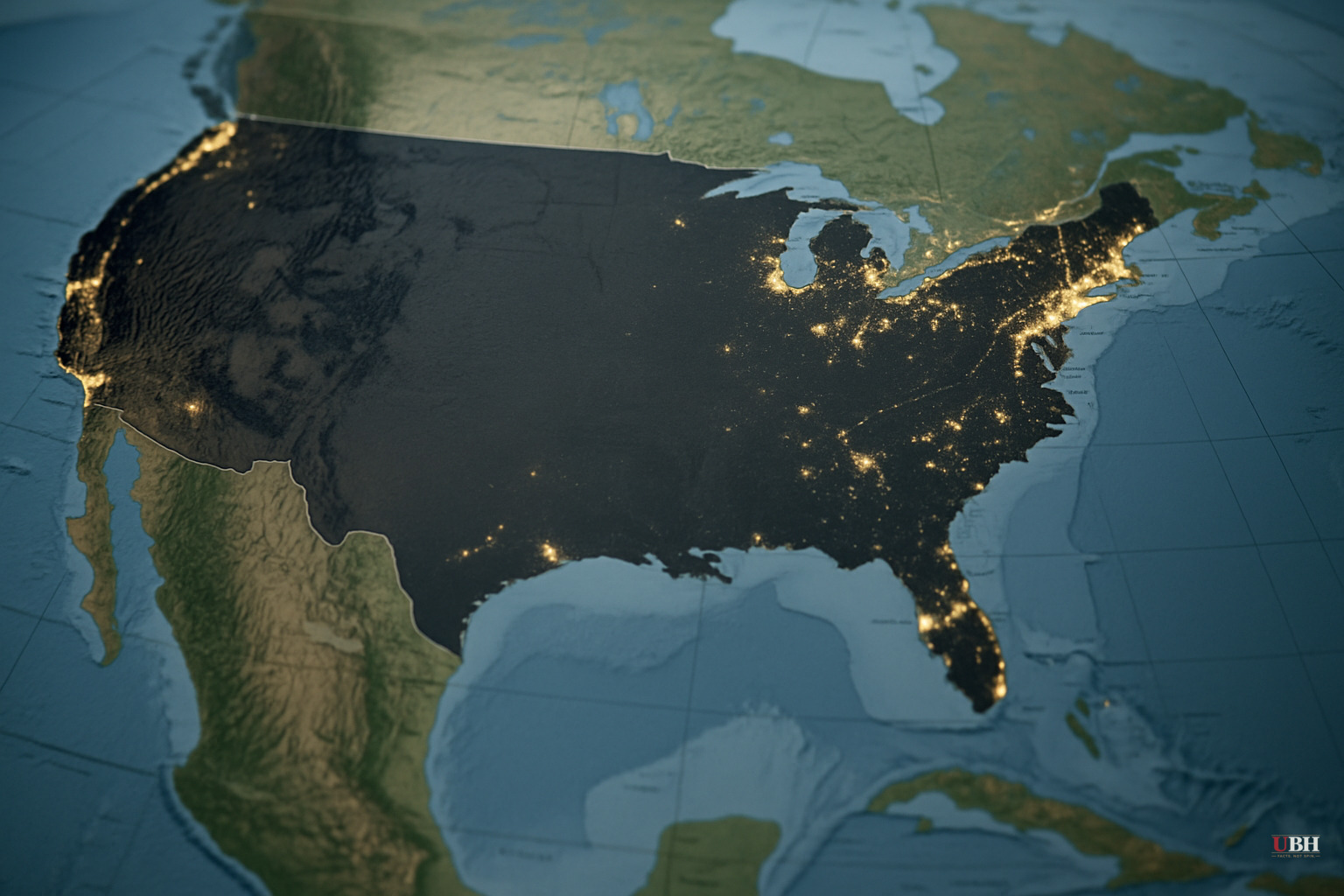
A fictionalized scenario published by Milan Adams via Preppgroup and distributed through ZeroHedge this week asks a question that actual grid engineers take seriously: what would a cascading, continent-scale blackout actually look like in its early hours, and how would populations cope with the sudden loss of the information infrastructure that tells them what is happening?
The piece is explicitly labeled fiction. The engineering premise it rests on is grounded in a real and documented concern.
What the Scenario Actually Describes
The fictional scenario describes transmission operators filing internal reports about synchronization anomalies on high-voltage networks months before a hypothetical collapse. The anomalies are individually unremarkable — seconds-long disturbances, blamed on firmware or weather — but when analysts compare reports from facilities hundreds of kilometers apart, a consistent pattern emerges that no single operator's team had authority or visibility to escalate.
The fictional analyst at the center of the scenario, Dr. Elena Varga, is described as an electrical systems analyst whose career was built on studying failures that most people never noticed. Colleagues described her as "frustratingly cautious" — someone who preferred saying "we don't know yet" over making bold predictions. What concerned her was not any individual disturbance but the geographical distribution: independent systems are supposed to fail independently, and when they begin exhibiting nearly identical behavior over enormous distances, experienced engineers stop asking what is broken and start asking what every affected system has in common.
The answer the scenario points to involves timing signals. Modern electrical grids function, as the piece puts it, "less like isolated power plants and more like orchestras whose musicians never meet." Every generator must maintain frequency within extremely narrow tolerances while responding continuously to changing demand. Tiny timing discrepancies can ripple through protective systems in unexpected ways.
The Information Collapse Problem
The Adams scenario spends more time on a second problem than on the physical grid failure itself: the collapse of public information. Television networks down, mobile networks fragmented, internet reduced to disconnected islands. Rumors traveling farther than verified facts.
As the scenario describes it, by the time the first official statement reached the public, it no longer mattered — television networks were already off the air across much of the continent, mobile networks had fragmented into isolated pockets, and the internet had become a collection of disconnected islands. For the first time in generations, millions of people discovered how completely their understanding of the world depended on a stream of data they had always taken for granted.
In a grid failure scenario affecting large urban areas, the communications degradation would be geographically uniform in a way that storm-based outages are not, because storms typically spare some areas while hitting others. A cascade blackout does not.
The Strongest Counterargument
The strongest objection to this line of concern is that modern grids have redundancy, automatic protective relays, and islanding protocols specifically designed to contain cascades. Proponents of this view argue that the fictional worst-case scenario ignores decades of hardening and that the synchronized-anomaly narrative mirrors conspiracy-adjacent content that overstates grid fragility to sell preparedness products. When applied to sensationalist content, this criticism holds.
The Unanswered Question
The Adams piece puts its finger on the specific institutional failure mode that is hardest to fix: individual reports that look insignificant in isolation, distributed across organizations with different hardware and different incentive structures, with no entity that has both the visibility to see the pattern and the authority to act on it before an interruption occurs.
The scenario notes that government agencies acknowledged receiving technical briefings but found no evidence suggesting an immediate threat. Manufacturers reviewed equipment logs and concluded that no common hardware defect could account for every reported anomaly. The failure mode is not ignorance — it is fragmented visibility across entities that each see only part of the picture.
Whether current coordination mechanisms are sufficient to close that gap is a question that grid engineers are actively debating. The answer is not settled.
Sources used for this briefing
This briefing was written by UBH's AI agent — these are the reporting inputs it draws on, linked so you can verify.


