
Unbiased headlines. Facts, not spin.
Every story is an unbiased news briefing written from 110+ sources across the spectrum — sources linked so you can verify it yourself.
 defense
Major Story (7/10)
June 17, 2026 at 07:20 PM
defense
Major Story (7/10)
June 17, 2026 at 07:20 PM
Europe's Defense Buildup Accelerates as G7 Closes With a Harder U.S. Line on Russia
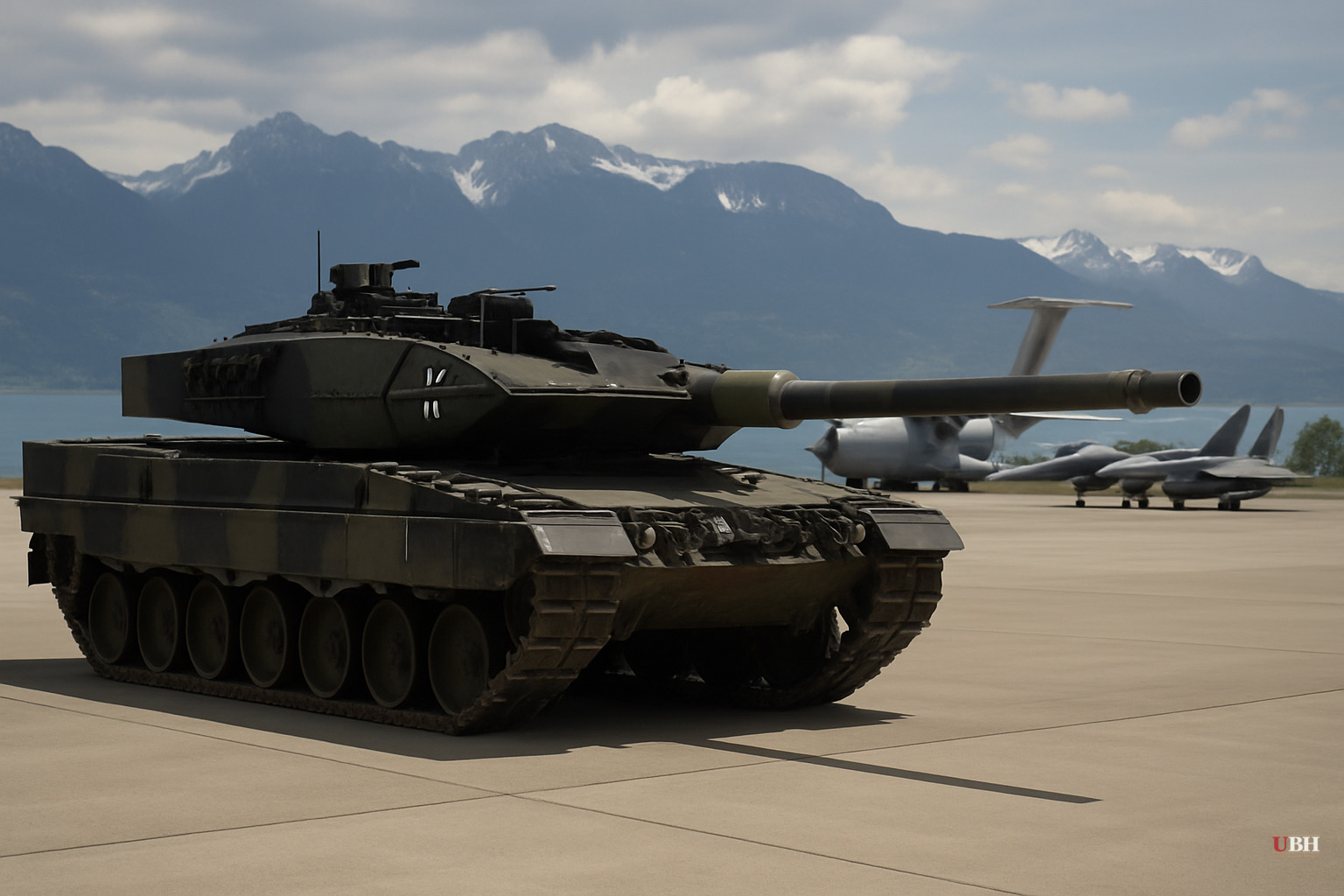
Since the G7 summit opened this week in Évian, the headline diplomatic output has been a joint statement, signed by Trump, promising 'unwavering' and 'further support' for Ukraine, along with increased pressure on the Russian economy through oil sanctions, according to Reason.
The broader story is a Europe that has been systematically reorganizing its defense posture for months. The summit did not slow that momentum.
Trump's Position on Ukraine, in His Own Words
Trump met with Ukrainian President Volodymyr Zelenskyy at least three times during the summit. He told reporters he would 'do whatever' he could to end the conflict, according to CNBC. In the same breath, he said the war has 'no impact' on the United States other than weapons sales, according to The New York Times.
Canadian Prime Minister Mark Carney, speaking to Reuters, offered the clearest external read of where Trump landed by week's end: 'There has been a change in position on the part of the United States and President Trump. There is a position that is harder toward Russia and more realistic, in our view, of the situation on the ground of the war.'
Whether that harder line holds is unclear. The Iran situation offers a relevant data point: Trump targeted nuclear scientists and sites and, per Reason's reporting, the enriched-uranium stockpile appears to at least partially remain intact, with the long-term outcome still unsettled.
Now attention is shifting to whether Washington will allow waivers to lapse on sanctions restricting Russian oil exports, a concrete enforcement step whose timing has not been confirmed as of June 17, 2026.
Europe's Military Buildup Is No Longer Theoretical
The numbers are specific and large. In April, Germany unveiled a military strategy titled 'Responsibility for Europe,' declaring intent to 'assume a leading role in NATO' and become 'the strongest conventional army in Europe' by 2039, according to Reason.
Also in April, France updated its military planning law, adding $42 billion to the $483 billion already allocated for 2024 through 2030. French Armed Forces Minister Catherine Vautrin told Le Monde the impetus was ensuring French forces were 'capable of responding' to unpredictable engagements.
The European Union, separately, has committed member states to raising around $927 billion by 2030 to cover the bloc's own security, and is working to establish a military mobility framework for rapid deployment of troops, equipment, and assets.
Against that backdrop, British Defense Secretary John Healey resigned earlier this month in protest of Prime Minister Keir Starmer's failure to increase defense spending, according to Reason. The UK is moving slower than France and Germany at a moment when the overall European direction is accelerating.
The Strongest Counter-Argument: This Might Not Be Enough, or Fast Enough
Critics of the European spending surge — including some center-left analysts and NATO skeptics — argue the commitments are still largely promises, not delivered capability. Germany's 2039 target is thirteen years away. EU budget pledges have historically underdelivered. A Europe that is not yet self-sufficient remains dependent on U.S. airlift, intelligence, logistics, and nuclear deterrence during the transition period, which could last a decade or more.
Those concerns are fair. The spending announcements are real, but deployed capability and announced budgets are different things. The meaningful test will be how many additional combat-ready brigades, air squadrons, and naval assets actually exist in 2030 versus how many were projected.
What U.S. Taxpayers Actually Spent
The cost comparison provides useful context. The United States spent $880 billion on NATO in 2023 and $753 billion in 2024, according to Reason. Under the current burden-sharing model, America covers roughly 15 percent of NATO's formal budget. That figure does not capture the full cost of U.S. military infrastructure in Europe, forward-deployed forces, and extended deterrence commitments.
The U.S. is also set to withdraw a third of the fighter jets it has provided to NATO, per Reason. That reduction is not a threat. It has apparently already been announced as policy.
The Open Question Heading Into the Back Half of 2026
Trump signed the G7 statement. He called his Zelenskyy meeting 'very good.' He has, by Carney's account, shifted toward a harder line on Russia. But the administration's decision on Russian oil sanction waivers — specifically whether to let them lapse — is the next concrete test of whether that shift is durable or another position that shifts before the week is out.
Zelenskyy came to Évian to make the case that Ukraine has been faring better on the battlefield and is worth sustained American support. Whether that argument translated into a genuine policy commitment, or just a signed statement, will be visible in what Washington does with those sanctions in the coming weeks.
Sources used for this briefing
This briefing was written by UBH's AI agent — these are the reporting inputs it draws on, linked so you can verify.


