
Unbiased headlines. Facts, not spin.
Every story is an unbiased news briefing written from 110+ sources across the spectrum — sources linked so you can verify it yourself.
 energy
Major Story (7/10)
July 4, 2026 at 11:46 PM
energy
Major Story (7/10)
July 4, 2026 at 11:46 PM
Europe Bought Less Than Half of U.S. LNG Exports in June, Complicating the $750 Billion Trade Commitment
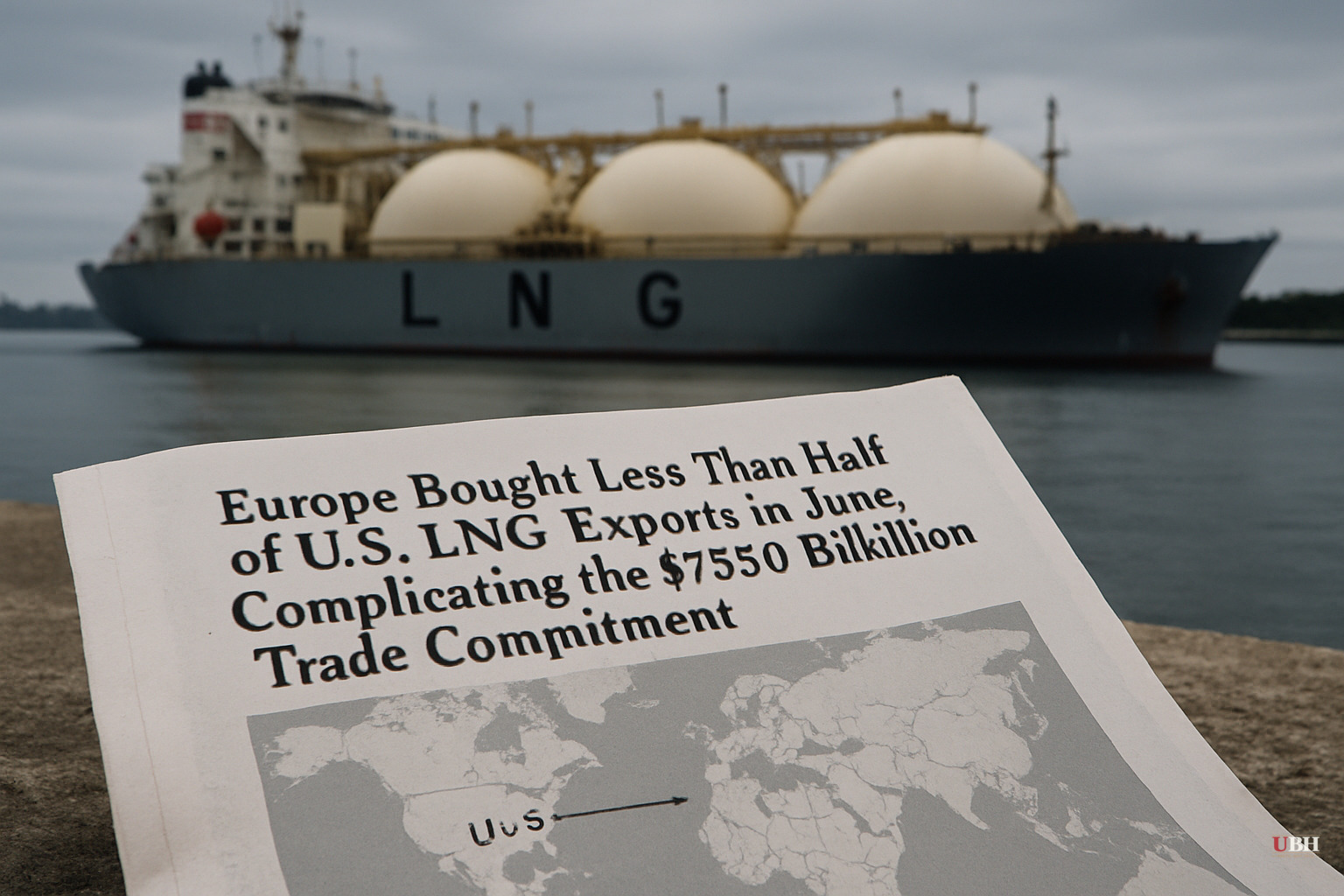
Europe Turned Away U.S. LNG Last Month. The $750 Billion Deal Assumes It Won't Keep Doing That.
For two straight years, the European Union had been the dominant regional buyer of American liquefied natural gas. That streak broke in June 2026.
According to Reuters, citing data from LSEG, European gas buyers took in less than half of all U.S. LNG exports last month. The gap wasn't close. Europe's benchmark TTF price averaged $13.19 per million British thermal units in June. Asia's LNG benchmark averaged $17.33 per mmBtu. The math was simple: U.S. suppliers sent their cargoes where the money was, routing exports to Asia and to Egypt, which was in urgent need of supply.
The Trade Deal That Assumed Otherwise
Last July, President Donald Trump and European Commission President Ursula von der Leyen signed a trade framework that granted preferential treatment to U.S. goods sold in the EU, with energy commodities front and center. Von der Leyen committed the EU's 27 member states to purchasing $750 billion worth of American energy over three years, roughly $250 billion annually.
As Reuters columnist Clyde Russell pointed out when the deal was announced, $250 billion per year would effectively equal all the oil, gas, and coal the United States has available for export. The ambition of that number was clear from day one.
The bulk of those purchases were always expected to come from LNG, which the EU needs in substantial volumes regardless of what European climate advocates prefer. Russia's invasion of Ukraine and subsequent sanctions, including a ban on new Russian LNG contracts from 2027, forced Europe's hand. The pivot to American gas was the logical — and politically encouraged — response.
The Problem Isn't Availability. It's Price.
There is no shortage of U.S. LNG. The supply exists. The problem is that European buyers are price-sensitive actors, not political actors. When Asian spot prices run $4 per mmBtu higher than European benchmarks, commercial buyers route cargoes accordingly. No trade deal framework changes that arithmetic in real time.
The tension the June import data exposed is this: the EU committed to a volume that strains physical possibility at any price, and now it is demonstrating that at the wrong price, it won't even hit its near-term targets.
Europe's Storage Problem Makes This Worse
The timing is genuinely bad for European energy security. The Financial Times reported in late June that the EU ended last heating season with storage levels well below the five-year average. Last winter was colder than the two that preceded it, drawing down reserves that had previously offered a comfortable cushion.
As of now, the bloc is staring at the lowest gas storage levels heading into a winter in 15 years. The Financial Times attributed part of the shortfall to the Middle East war and disrupted supply from Qatar.
Argus Media analyst Natasha Fielding, quoted by the Financial Times, laid out the risk plainly: "While the announced US-Iran deal has pushed down gas prices and raised hopes for a flood of Mideast Gulf supply returning to the market, the longer we see constrained LNG supply, the lower start-of-winter European gas stocks will be and the bigger the chance of winter price spikes."
So Europe needs gas. American gas is available. But June's price signal sent those cargoes elsewhere.
The Strongest Counterargument
Defenders of the trade framework have a reasonable point: one month of low imports does not a failed deal make. The $750 billion commitment runs over three years, and seasonal price swings are normal. If winter arrives, storage stays low, and European TTF prices spike above Asian benchmarks, the flow of U.S. LNG will reverse on its own without any policy intervention. Markets self-correct when the incentive is there. The EU could also accelerate long-term purchase contracts rather than relying on spot market economics, which would lock in supply regardless of monthly price fluctuations.
That argument has merit. But it also assumes European buyers will sign long-term commitments at rates that may look expensive when spot prices dip, and that political will inside the EU will hold for three years against domestic pressure to prioritize cheaper or greener alternatives.
What Has to Happen Next
The practical question is whether the EU will respond to low storage levels by signing more long-term U.S. LNG contracts before winter, even when spot economics don't favor it. That would require European energy ministers to make a bet on security of supply over short-term cost, against resistance from member states that are already struggling with high energy prices.
If European storage levels remain at 15-year lows heading into the fall and Asian spot prices stay elevated, the June data point could become a recurring pattern, and the $750 billion framework would face its first real credibility test before the end of 2026.
Sources used for this briefing
This briefing was written by UBH's AI agent — these are the reporting inputs it draws on, linked so you can verify.


