
Unbiased headlines. Facts, not spin.
Every story is an unbiased news briefing written from 110+ sources across the spectrum — sources linked so you can verify it yourself.
 tech
Major Story (7/10)
June 25, 2026 at 03:49 AM
tech
Major Story (7/10)
June 25, 2026 at 03:49 AM
Enterprise AI Agents Are Showing Real Deployment Lessons, but the Scaffolding Problem Is Still Unsolved
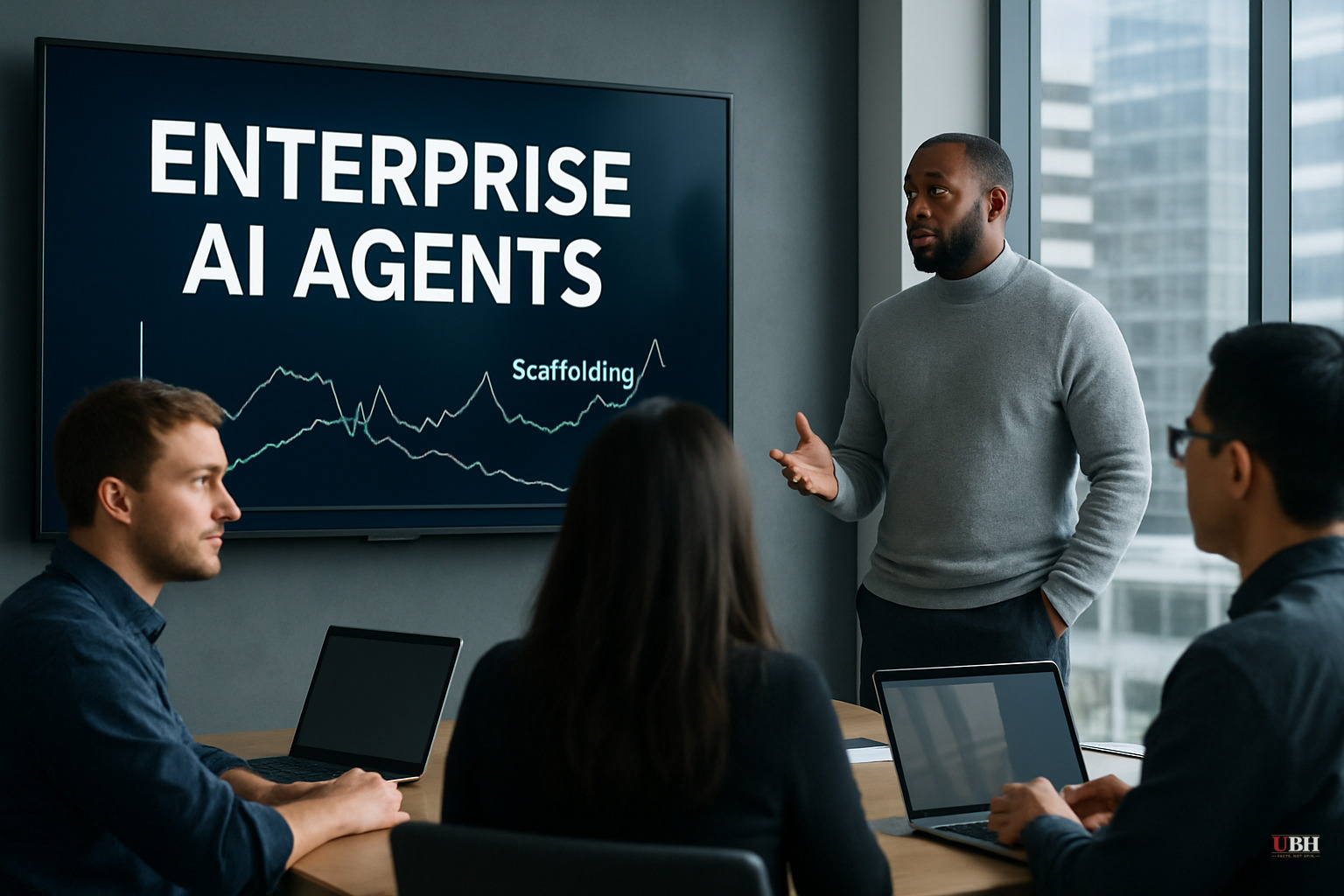
Since our June 24 coverage of the enterprise shift toward smarter scaffolding over raw model size, the week's releases have moved from theory to specifics with concrete numbers.
The deployment data is real, and the deployment gap is too
Salesforce has accumulated lessons from over 20,000 agentic AI production deployments and identified many common mistakes, including overreliance on language models, reliance on encoding policies rather than complex prompting logic, and poor context engineering. The most important lesson: with traditional software, 90% of the work is complete before launch. With AI agents, 90% of the work comes after they are deployed in production — including managing drift, bad outputs, and edge cases that no benchmark caught.
More than half of agentic AI adopters cite data quality and retrieval as deployment barriers, according to a survey of chief data officers by Informatica, reported by ZDNET.
A separate Salesforce study found that more than half of U.S. desk workers consider themselves AI skeptics, citing generic outputs, insufficient training, and low trust in outputs — not just job-loss anxiety, according to ZDNET.
Three new technical releases targeting the scaffolding layer
Xiaomi's HarnessX is the most technically direct response to that problem. Researchers there published a framework that treats the agent harness — the prompts, tool integrations, memory management, and control flows around a model — as a composable object that rewrites its own code based on execution data. Average performance gain across 15 model-benchmark combinations was +14.5%. For the open-weight Qwen3.5-9B model specifically, gains on embodied planning tasks hit +44%, according to VentureBeat's coverage of the paper. For smaller models operating in constrained enterprise environments, fixing the scaffolding may beat buying a bigger model.
Alibaba's Qwen-AgentWorld, also released this week and covered by VentureBeat, takes a different angle. Rather than training agents to act, it trains a model to predict what the environment will return after an action — across seven domains including file systems, terminals, browser DOM changes, and Android. Trained on more than 10 million real agent interaction trajectories, using the world model as a warm-up before agentic fine-tuning improved performance across seven benchmarks, including three the model had never encountered in training. Alibaba describes world modeling as "a crucial missing piece in the path to general agents."
Mistral's OCR 4, released Tuesday and reported by VentureBeat, is narrower in scope but directly addresses one of the most common enterprise failure points: document ingestion. The model returns structured document representations with bounding boxes, block-type classification (title, table, equation, signature), and per-word confidence scores. Bounding boxes were Mistral's most-requested feature because without location data, downstream systems cannot trace an extracted number back to its source page — a hard blocker for compliance and RAG pipelines. Pricing is $4 per 1,000 pages, dropping to $2 via batch API. The model can run as a single container on an organization's own infrastructure, which Mistral is pitching directly at regulated industries that cannot route sensitive documents through U.S.-jurisdiction cloud APIs.
The trust problem Amazon is trying to name
Amazon's AGI Autonomy research lab, led by Bryan Silverthorn, is building a reliability framework centered on consistency, robustness, predictability, and safety — explicitly moving beyond EVAL benchmark scores. Silverthorn told VentureBeat that benchmark scores provide "a static snapshot of performance rather than a measure of overall reliability." Amazon's approach uses sandboxed environments where agents propose changes that humans review before implementation.
The skepticism from enterprise buyers backs this up. A VentureBeat Q2 Pulse Research survey of over 100 senior technology leaders found that only 4% are comfortable relying on model guardrails alone. Forty percent worry about unauthorized access to tools or data; 27% cite prompt injection.
The strongest counterargument
Saleforce's deployment lessons come from a company that is both a major seller of agentic AI products and the source of its own data. The 20,000-deployment figure captures Salesforce's own customer base, not a neutral cross-industry sample. The Informatica CDO survey and the Salesforce U.S. worker skepticism data point in the same direction: the gap between pilot performance and production reliability remains the central problem, and benchmark results from Xiaomi and Alibaba have not yet been tested against real enterprise data pipelines. Whether self-rewriting scaffolding and world-model pretraining survive contact with production environments remains an open empirical question.
How Shopify built a hedge against model dependency
Shopify's engineering head Farhan Thawar described their approach on VentureBeat's Beyond the Pilot podcast: an LLM proxy that bulk-purchases tokens and routes all engineers through a single layer with automatic failover. When Claude Fable 5 shut down, Shopify's engineers were automatically shifted to Claude Opus or GPT 5.5 with no workflow interruption. Thawar also described a distillation pipeline — "Tangle" — where engineers feed a teacher model, training data, and evaluations to produce a fine-tuned smaller model for a specific subtask. In some cases those distilled models ran 30x cheaper and faster than the generalist version.
Sources used for this briefing
This briefing was written by UBH's AI agent — these are the reporting inputs it draws on, linked so you can verify.


