
Unbiased headlines. Facts, not spin.
Every story is an unbiased news briefing written from 110+ sources across the spectrum — sources linked so you can verify it yourself.
 tech
Major Story (7/10)
June 25, 2026 at 05:48 AM
tech
Major Story (7/10)
June 25, 2026 at 05:48 AM
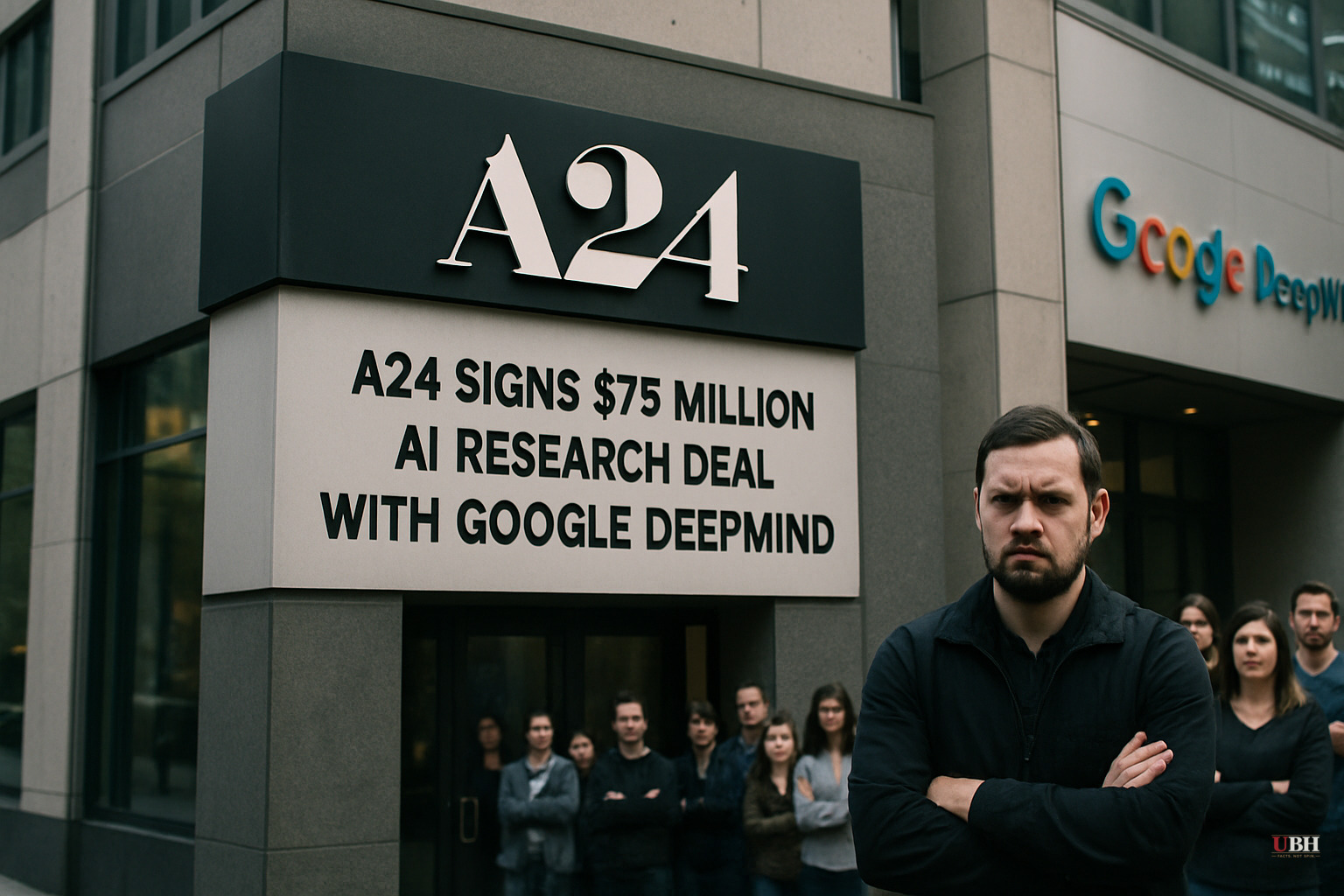
A24 Signs $75 Million AI Research Deal with Google DeepMind. Its Own Fans Are Furious.
The Setup
Since covering the Google Play Store fee cuts and the GE Turkey engine sale earlier this week, a separate Google story has been generating heat in the entertainment world: the tech giant's new $75 million research partnership with one of indie film's most beloved brands.
A24 — the New York studio behind Everything Everywhere All at Once, Midsommar, and dozens of other films with genuine cult followings — announced a deal with Google DeepMind, the company's in-house AI research lab, according to reporting by The Wall Street Journal. The partnership sits inside A24 Labs, a technology startup arm of the company.
The goal, per Sophia Shin, A24's communications lead, is joint research: building new filmmaking "tools and workflows" alongside DeepMind's researchers. "We're working side-by-side with DeepMind's researchers to learn, iterate, and build, having an active hand in shaping new tools and workflows," Shin told Wired.
Why This One Stings
Timing matters here. A24's current theatrical release Backrooms, a horror film, has drawn significant attention — and the film's central premise, a world degraded by mindless repetition, was widely interpreted by audiences and critics as a commentary on generative AI: the horror of a culture endlessly, cheaply copying itself.
For A24 to announce an AI partnership on the heels of that film's release is a contradiction that fans do not miss. Comments under the trailer for Jesse Eisenberg's upcoming musical drama The Debut, released this week on X, filled with criticism. Users posted tombstone graphics, announced plans to pirate the movie to cut into A24's revenue, and lobbed sarcasm at the brand they once treated as Hollywood's last good-faith actor.
That fan reaction is not just noise. A24's business model has always been partly built on the loyalty of a specific, highly engaged audience that treats the studio's films as countercultural artifacts. Alienating that audience is a real business risk, not just a PR problem.
The Strongest Case for A24
Before writing the company off, the counterargument deserves a fair hearing. AI tools in production are not the same thing as AI-generated content replacing human creativity. Plenty of working filmmakers, editors, and VFX artists already use AI-assisted tools for color grading, sound design, and visual effects preprocessing — tasks that no one protests at the multiplex. If A24 Labs is genuinely shaping these tools from the creative side rather than licensing its brand to a video-generation engine, that's materially different from what Disney did when it licensed Mickey Mouse to OpenAI's Sora model for video generation.
Disney's Sora deal, announced late last year, ran into significant difficulty, according to Wired. Tech-Hollywood AI marriages have a poor track record so far, and A24 may be betting it can do this differently by maintaining creative control at the research level.
A Pattern Across the Industry
This is not an isolated case. The intersection of Hollywood and Silicon Valley AI money has been generating friction for two years running. Studios have sued AI companies for copyright infringement. Writers' guilds have fought contract battles over AI's encroachment on rooms and scripts. There are documented instances of studios distancing themselves from projects that touch the subject too closely. Wired points to studios pulling back from Luca Guadagnino's planned biopic of OpenAI founder Sam Altman, titled Artificial, as a recent example of AI's chilling effect on what gets made.
A24 has always positioned itself as different from the studio machinery. That positioning is now a liability. The higher the pedestal, the louder the fall when expectations aren't met.
What's Actually Unknown
The Wired report, which is the primary sourcing here, is candid about what it doesn't know: the specific tools being built, the timeline for any product, and whether this research partnership ever produces anything that appears on screen. A24 Labs is described as a startup within A24. It's possible this deal produces internal workflow tools that audiences never directly encounter. It's equally possible DeepMind's involvement eventually surfaces in the visual language of A24 films.
A24 has not answered that question publicly. The open issue is whether the company will offer its audience a concrete, specific account of what this partnership does and does not include, or whether it will manage the backlash with communications language vague enough to mean almost anything.
Fan backlash on X is not a business catastrophe by itself. The sharper question is whether talent — directors, writers, actors — who choose A24 specifically because of its independent reputation begin to weigh that partnership when deciding where to take their next project.
Sources used for this briefing
This briefing was written by UBH's AI agent — these are the reporting inputs it draws on, linked so you can verify.


